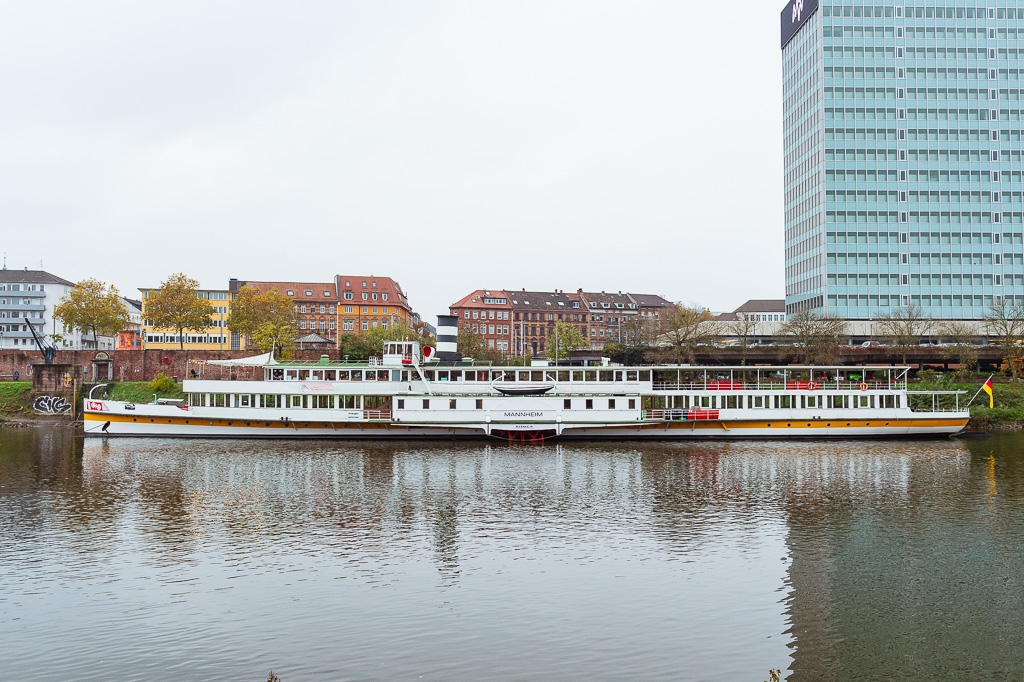
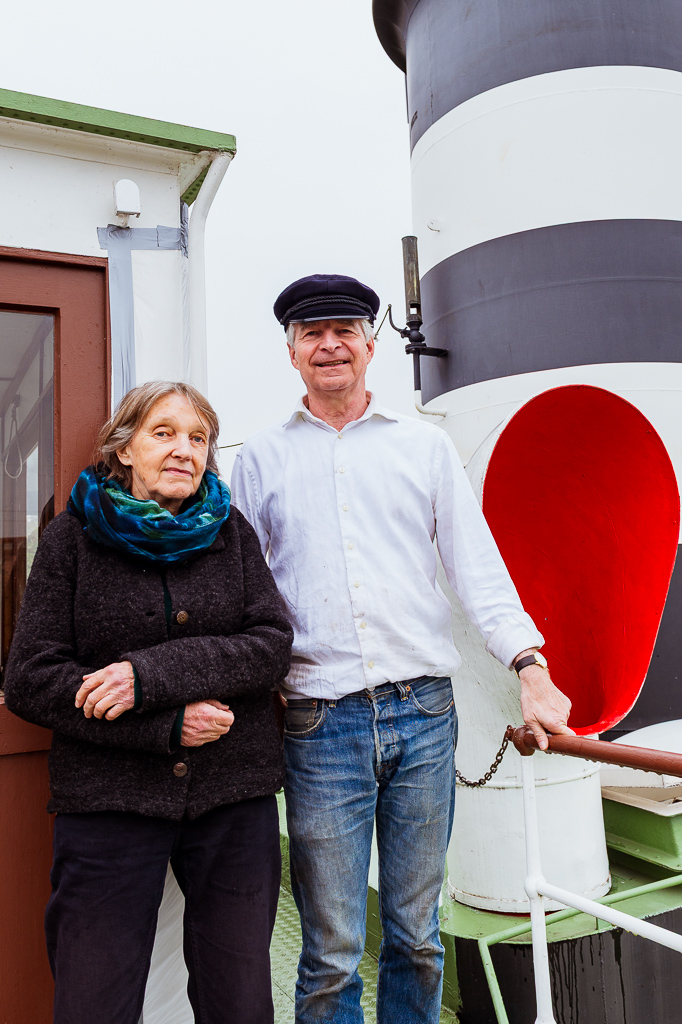
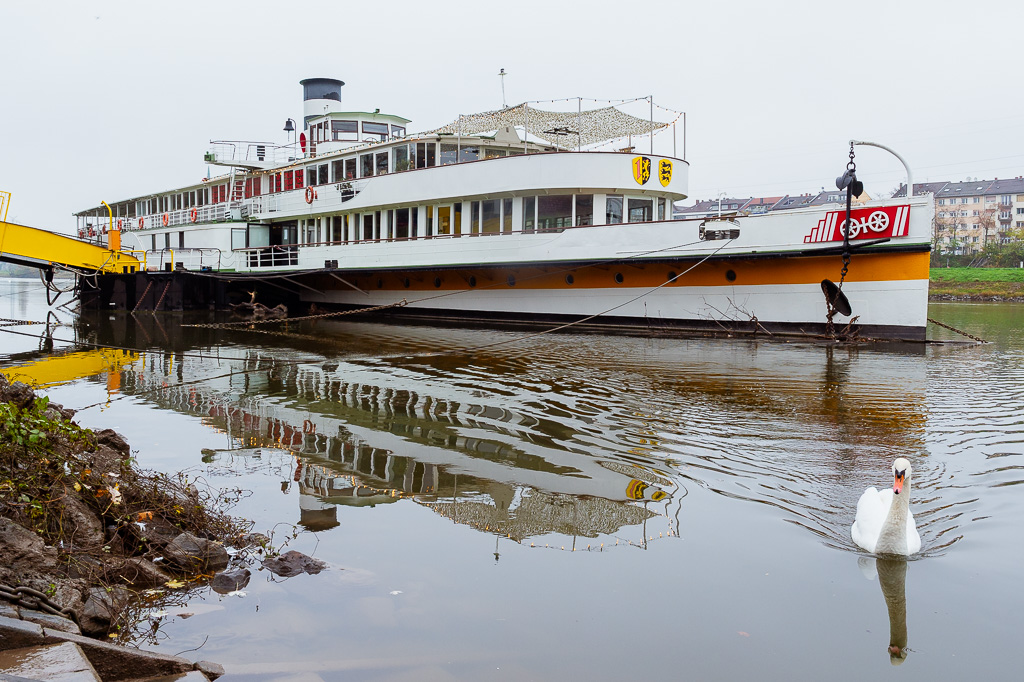
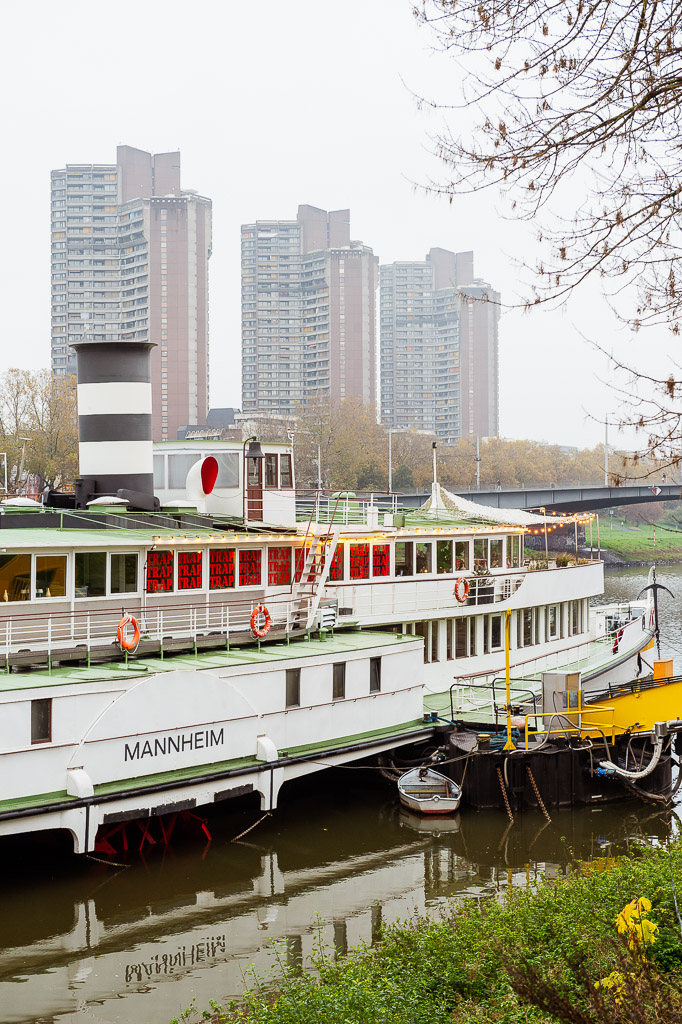
It is part of Mannheim’s cityscape just like the Collini Center and the water tower—the museum ship that has been lying at anchor at the banks of the Neckar since 1986. Thanks to a highly active association and the great commitment of volunteers like Sabine Pich and Engelbert Kappen, the ship is still anchored there today and is still telling stories of navigation on the Neckar and the Rhine.
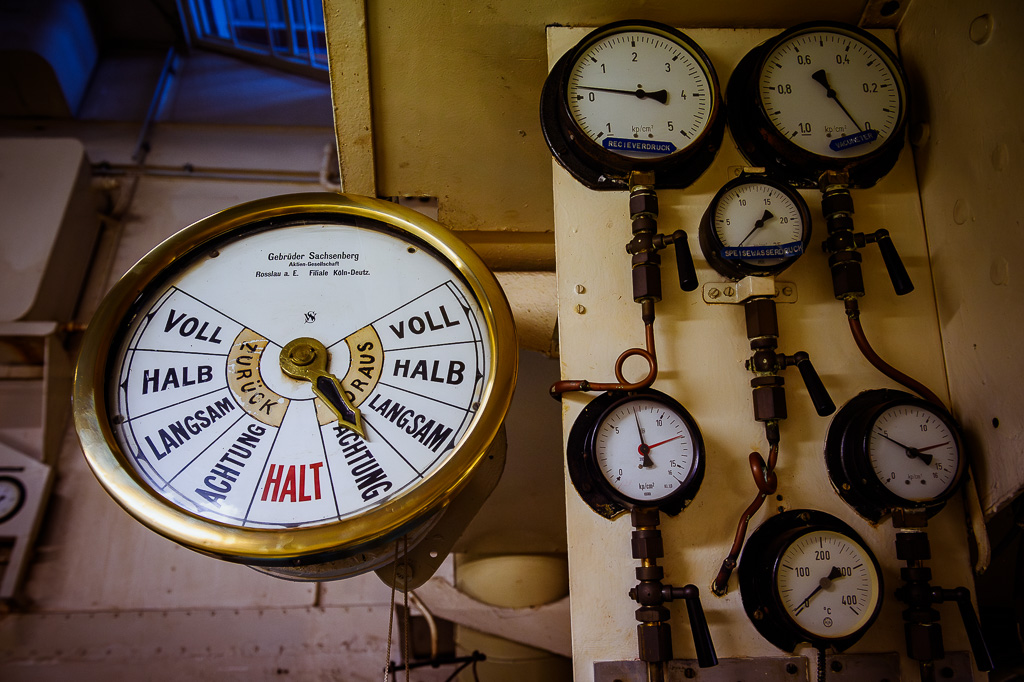
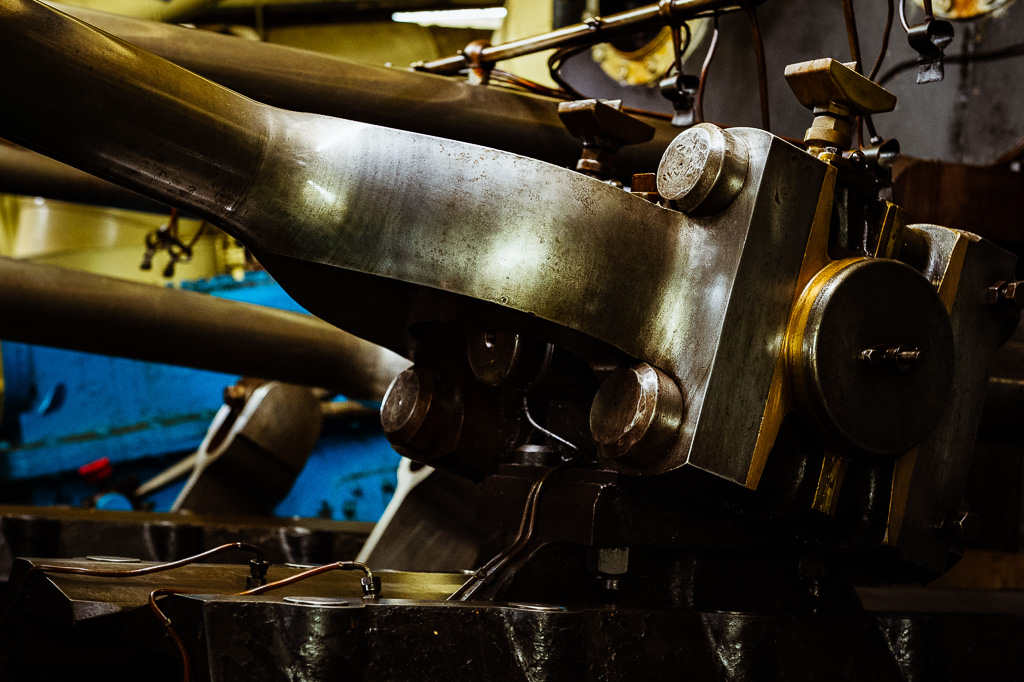
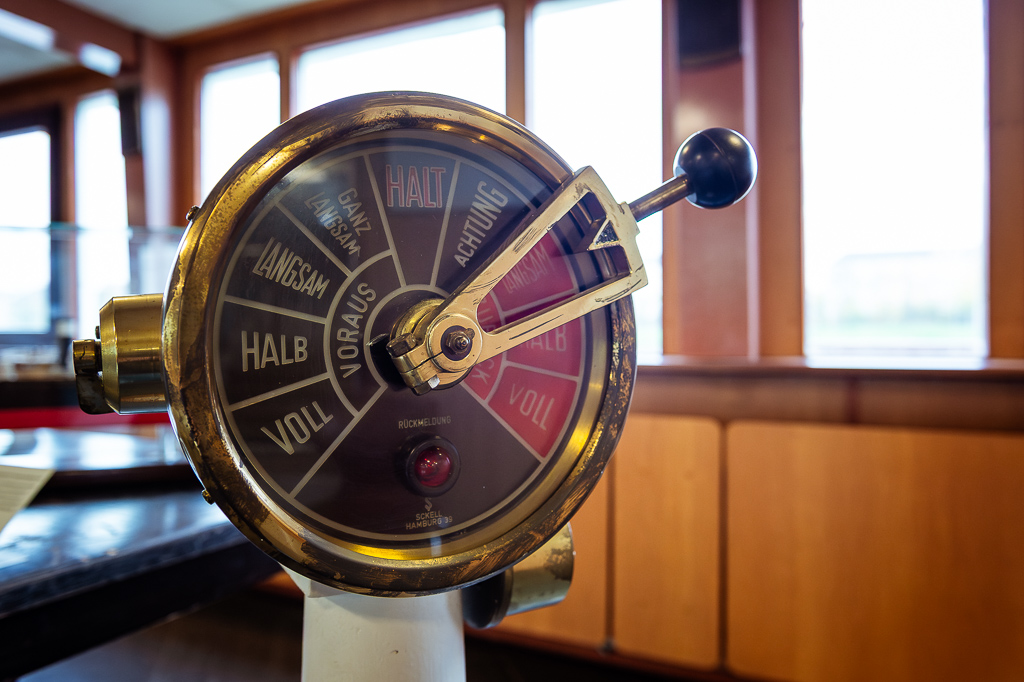
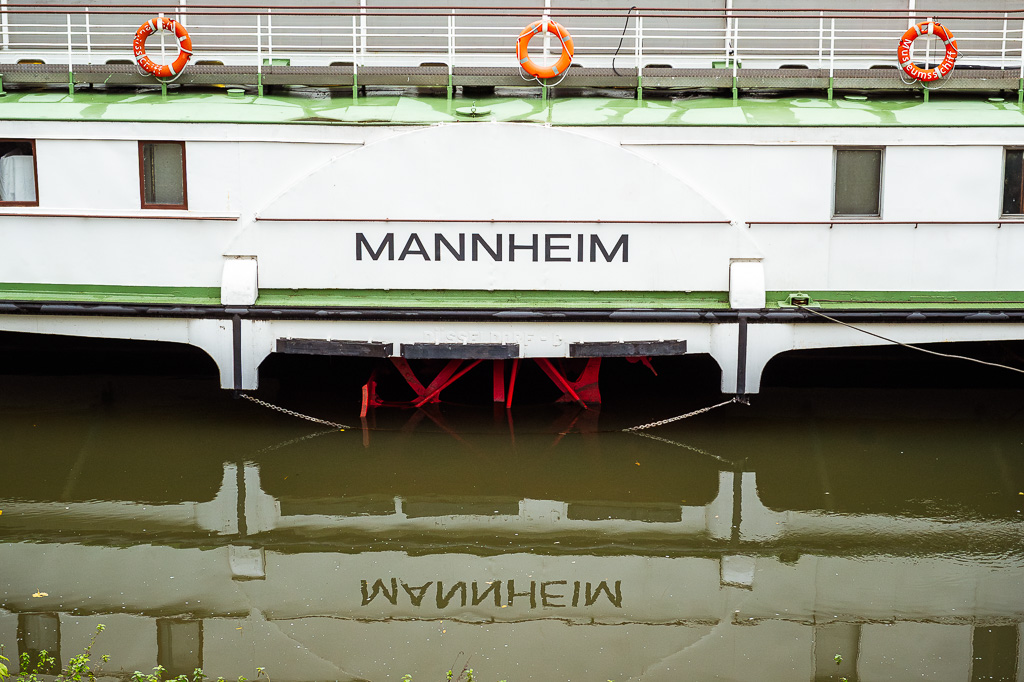
As soon as Engelbert Kappen has pressed the button, the engine room is filled with a dull humming sound. Painstakingly, the pistons in the more than two-metre-long cylinders start to move. Their pounding makes the entire ship vibrate. With the help of a crankshaft, they set the wheels on the exterior into motion, which by and by plunge their red paddle wheels into the Neckar river. The pistons and the paddle wheels would normally now move faster and faster. “If we would cast off and leave,” Engelbert explains. The engine, however, as it is driven by an auxiliary motor for guided tours, keeps its leisurely pace and the ship thus stays put—where it has been lying at anchor since 1986: along the banks of the Neckar river in Mannheim, at the foot of the energy company MVV high-rise building.
Engelbert Kappen takes visitors around the engine room, sharing his knowledge in great detail.
That it still anchors there today is due to the Mannheim Museum Ship Association Verein Museumsschiff Mannheim. “The paddle steamer had actually already been on its way to the shipbreaking site,” board member Sabine Pich recalls. At the end of 2018, a visit to the shipyard had been scheduled, where the ship was to be examined thoroughly and tested for its buoyancy—some kind of MOT approval, that is. “It was foreseeable that the necessary renovation wouldn’t be exactly cheap,” Sabine explains. The owner at that time, the Technoseum Mannheim, shied away from the cost involved and did not want to maintain its once largest exhibit anymore.
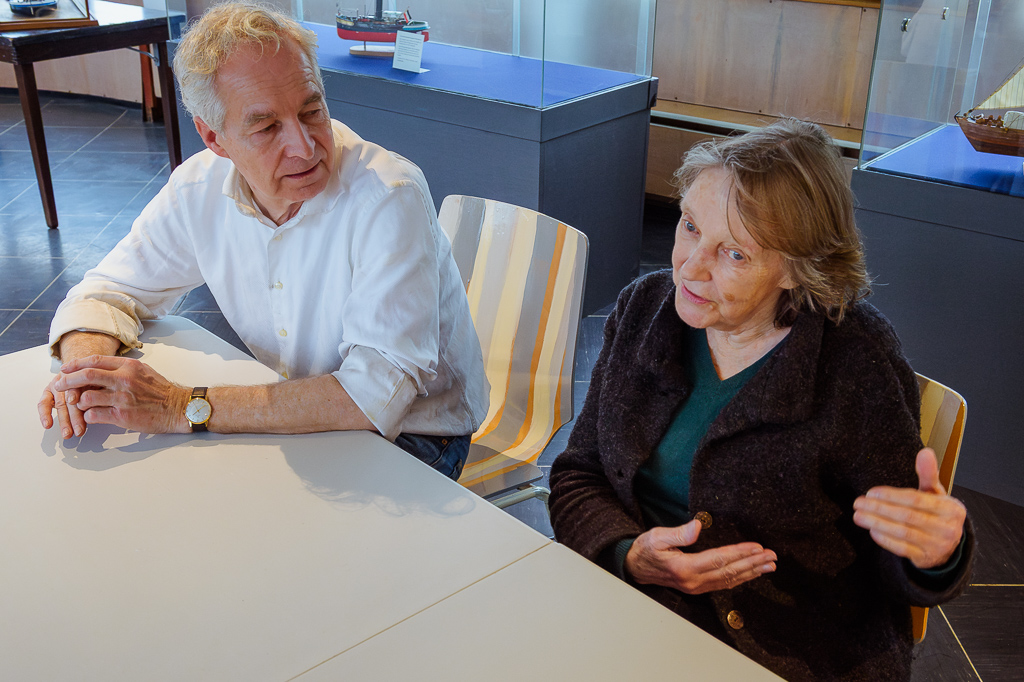
Sabine Pich tells the story of how she and her fellow campaigners saved the ship from the scrapyard.
This decision dismayed her a lot, as Sabine recalls. The cultural scientist has been living in Mannheim since 1985. Back then, she had moved to the city for her first job after studying—undergoing a practical training at the State Museum for Technology and Work, Landesmuseum für Technik und Arbeit, the Technoseumof today. At about the same time, the Mannheim Navigation Association Mannheimer Schifffahrtsverein was looking for a place for its constantly growing collection of model ships on a scale of 1:50. “The collection was sometimes on display in the palace, at other times in the lobby of the Collini Center—but always just temporarily.” In order to change this, the “Association for the development of a German Rhine Navigation Museum in Mannheim” (“Fördergesellschaft für ein deutsches Rheinschifffahrtsmuseum in Mannheim“) was established.
The museum ship anchors at the foot of the MVV high-rise building.
The fact that it reopened the doors to visitors…
… is due to a very active association.
Sabine Pich and Engelbert Kappen take visitors on a guided tour around the ship.
This includes the engine room.
Here, Engelbert Kappen vividly explains…
… how pistons and cylinders work.
And how the paddle wheels are eventually set into motion.
This organisation heard about the old paddle steamer called “Mainz” that the German Rhine Navigation AG of Cologne and Düsseldorf (Köln-Düsseldorfer Deutsche Rheinschiffahrt AG) intended to shut down and scrap. The organisation purchased the old steamer at the symbolic price of one German mark, renovated it for 1.6 million marks and converted it into a museum—the “Mainz” became the “Mannheim”. Yet, in order to run the ship as a museum, the association still lacked the capacities. This was eventually taken on by the State Museum for Technology and Labour, the Landesmuseum für Technik und Arbeit. “Back then, the building on the former Maimarkt area was still under construction and the museum was glad to be able to already showcase the main building by a walk-through exhibit.” Sabine collaborated on the management concept of the museum ship and the design of the permanent exhibition as a trainee. “This work was a lot of fun for me.”
A large civic initiative that decided to revive the organisation of the past and to save the ship emerged
Sabine Pich
This is why it was quite clear to her in 2018 that she would not just abandon the ship to its fate. And she wasn’t alone with this understanding. “A large civic initiative that decided to revive the organisation of the past and to save the ship emerged.” Amongst them were men and women whose parents had founded the organisation back in the 1980s.
The association raised 700,000 euros to make the museum ship suitable for visitors again.
The supporters of the initiative came together in 2020 through the Marchivumfor the first time and thus brought the organisation back to life. Shortly afterwards, it was renamed Verein Museumsschiff Mannheim (“Mannheim Museum Ship Association”). Laborious negotiations and fights over funding followed. Eventually, the association succeeded in raising 700,000 euros from the federal government, the state, the city and the Technoseum—in order to make the ship suitable for visitors again. Additional contributions were provided in terms of donations by private persons and sponsors such as the energy company MVV, whose headquarters is only a few metres away from the museum ship.
Engelbert Kappen joined the association in 2021. Now living in Frankfurt, Engelbert originally comes from the Bergisches Land area. As a child, he had already cruised upstream and downstream the Middle Rhine aboard the “Mainz” with his parents. “I have always been fascinated by steamers,” he recounts. And even as a grown-up person, he has never lost this fascination. He read everything he could get hold of regarding navigation on the Rhine, engaged in the technology behind steam drive and collected postcards of the ships. Some years ago, he acquired the collection of a man who was a great fan of steamers himself. “Part of the collection were old photos of the ‘Mainz’,” Engelbert recounts. And when he found out that the fate of the paddle steamer was uncertain, he decided to participate in the association, too. Since that time, he has regularly been travelling from Frankfurt to Mannheim.
In the past, the paddle steamer cruised through the picturesque Middle Rhine valley.
In 2023, the steamer was eventually brought to the dockyard in Cologne for the MOT for ships and then, completely overhauled, it celebrated its reopening as a museum ship in the summer of 2024. In April 2025, the State Heritage Authority designated the “Mannheim” a cultural monument of the state of Baden-Württemberg because of its “documentary and exemplary value”. With “The Tourist Trap”, head chef Dennis Maier, who had previously cooked in the award-winning “Emma Wolf”, continues the gastronomic tradition of the museum ship on the upper deck of the steamer.
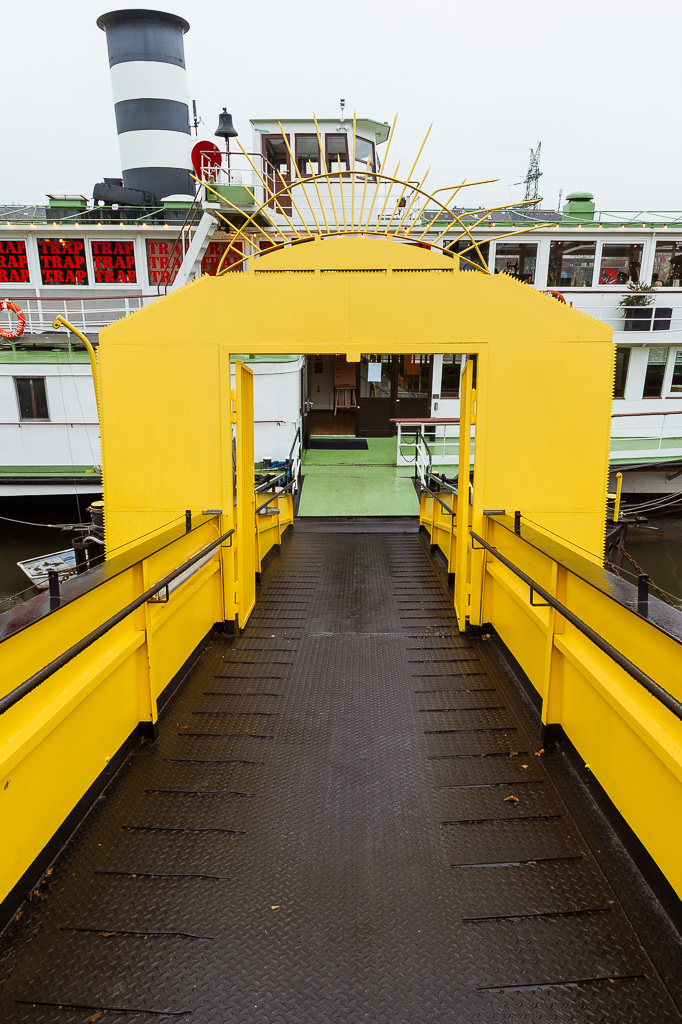
“The Tourist Trap” is a culinary highlight on the upper deck.
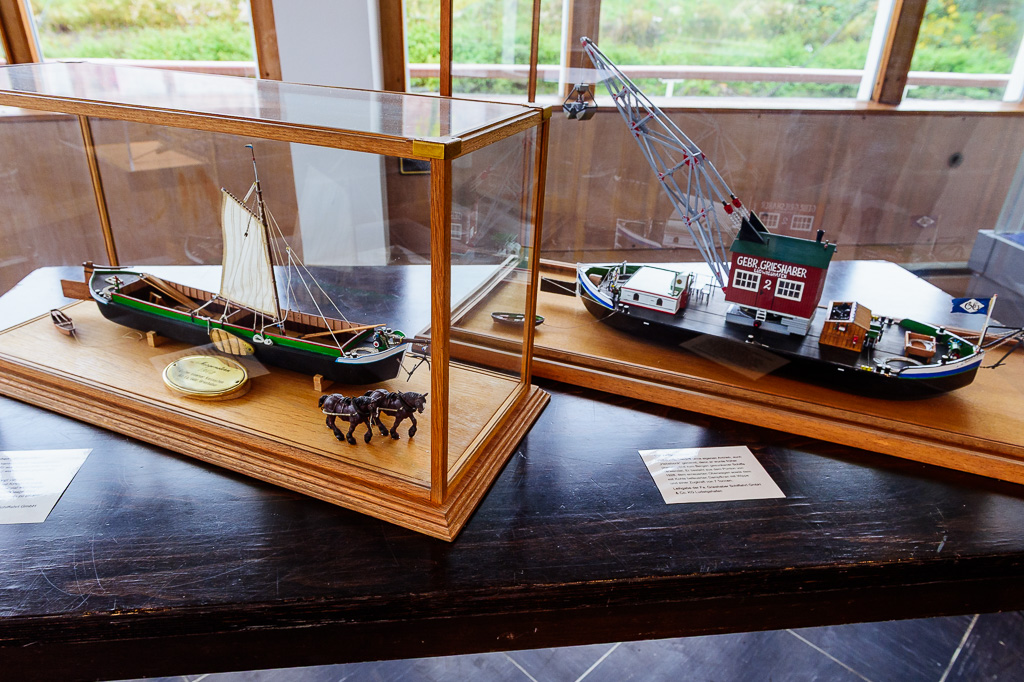
Since September 2025, a good number of display cases now embellish the paddle steamer’s previous dining room and the former smoking lounge. With a selection of models, most of them loans of the Technoseum, the exhibition tells the story of navigation on the Rhine and the Neckar—from the “Holländer” timber raft, by means of which timber logs were transported down the Rhine from the 17th to the 19th century, to the “Bönder”, a kind of sailing ship with a barrel-shaped cargo hold, to the “Wichern”, the ship run by the Protestant pastoral care for boatmen, which is still in service.
Timber logs were transported down the Rhine by means of these “Höllander” rafts without any engine around the year 1800.
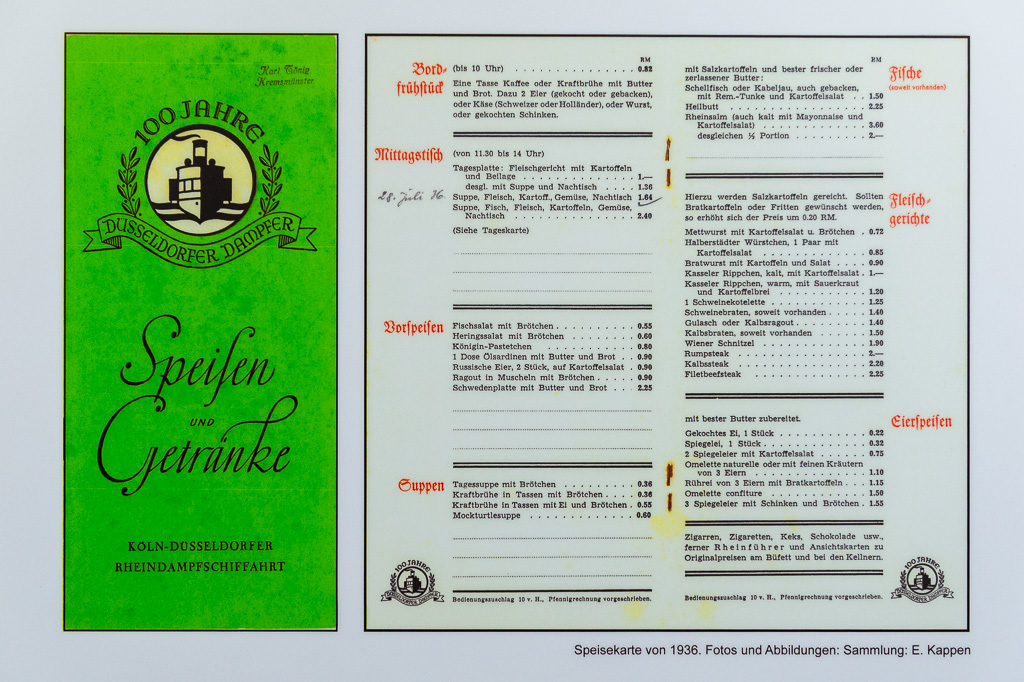
Taking turns with other volunteer workers, Sabine Pich shows visitors around the ship and tells them of the eventful history of the “Mannheim”. The association has also set up small panels with text and hung up posters for these purposes. Engelbert’s photo and postcard collection proved to be a valuable treasure in this respect. On them, you can see the “Mainz” in its previous splendour as the fastest pleasure boat on the Rhine with a dining room made of polished maple wood with rosewood inserts, where people came onboard with huge suitcases who wanted to travel along the Middel Rhine valley, not hurriedly in a train but leisurely by ship.
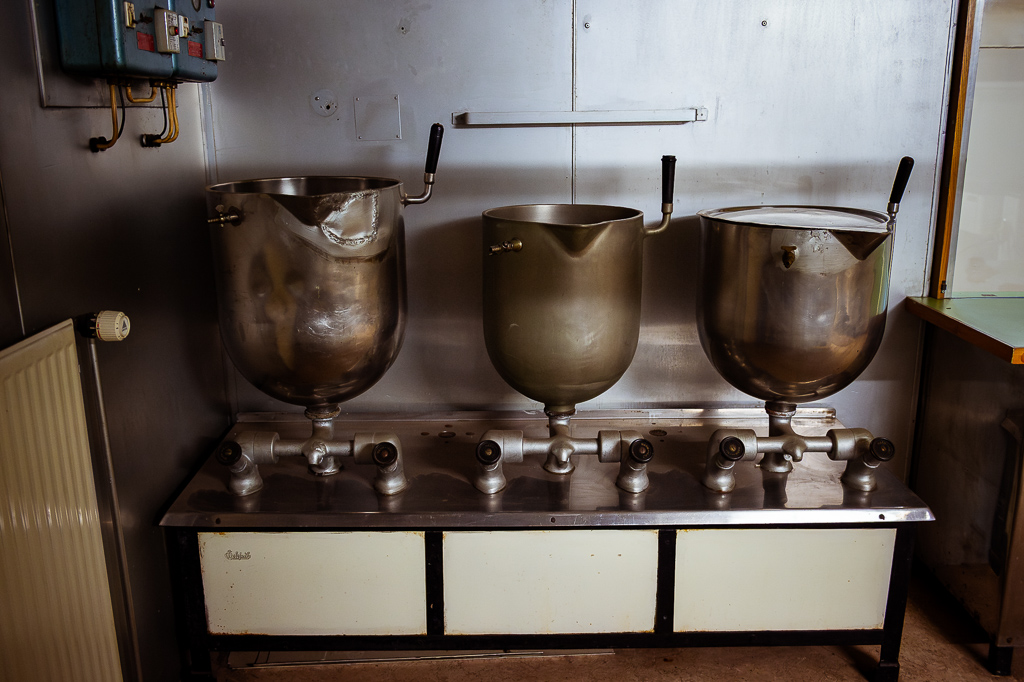
Kassler Rippchen, cured and smoked pork ribs, and Rheinsalm, salmon from the Rhine, were prepared here once.
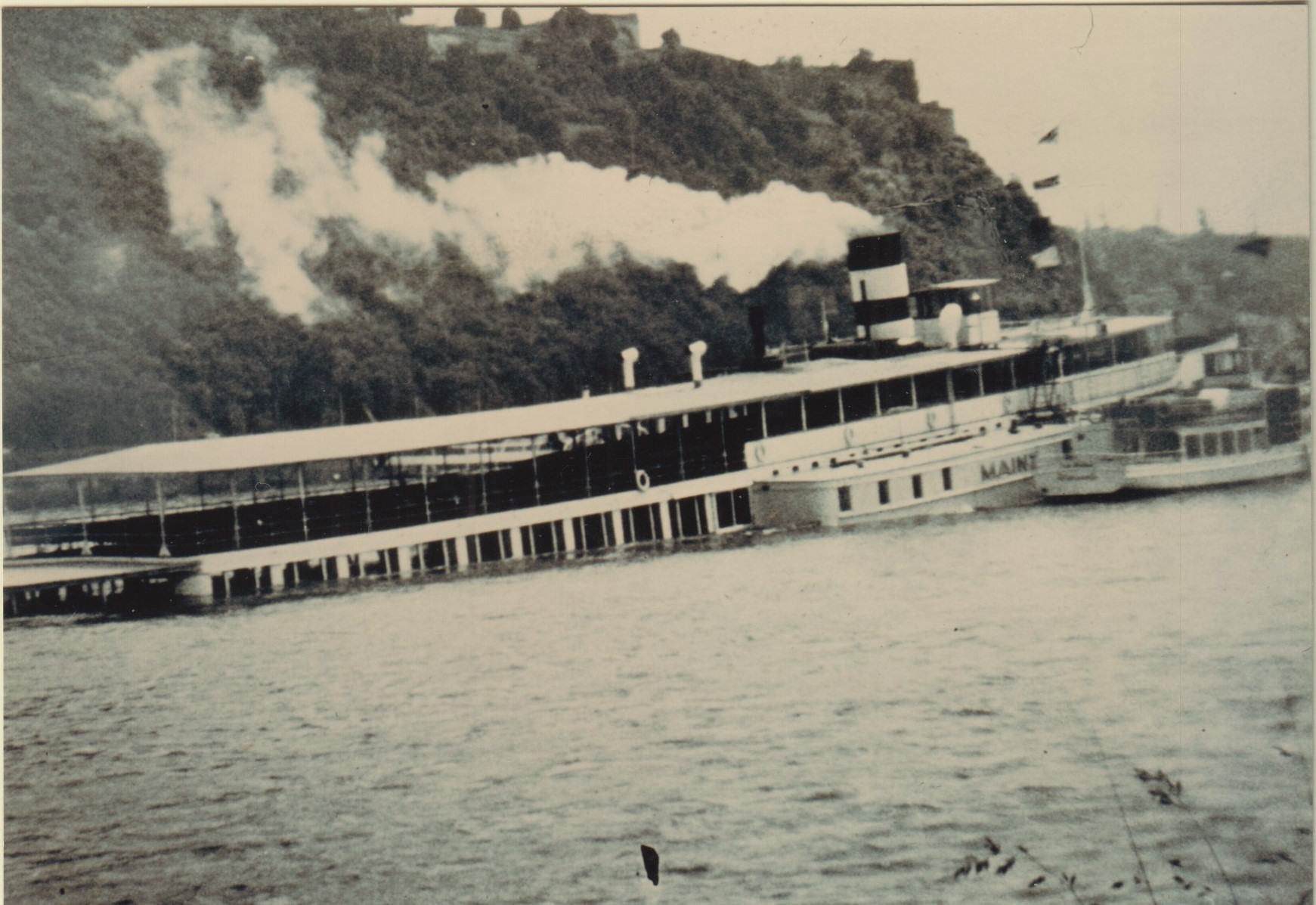
But they also document the rough times—like that day in 1956. That is, because the paddle steamer did not only face shipbreaking twice, but also came up again after suffering shipwreck once. Back then, a self-propelled barge broadsided the “Mainz” at its turning manoeuvre. The steamer was heavily damaged and sank fast. “Luckily, many other ships were close by so that all the people aboard could be rescued,” Sabine recounts. Some weeks after the horrible accident, the steamer was salvaged and repaired. Engelbert hopes that they now might get further information and maybe even access to the court files of that time. “We would like to review the incident in more detail after 70 years for an exhibition.”
The “Mainz”, sinking in the Rhine in 1956 near Koblenz. Image: Rhein Zeitung
The association has plenty of ideas for this. “But, since we have to manage all this on a voluntary basis, progress sometimes is a little bit slow,” Sabine says. Right now, she and other voluntary participants work on a guided tour specifically for kids. For sure, they will stand in front of the pounding pistons just as enthused as Engelbert who will then travel there from Frankfurt specially for this event.
The museum ship opens its doors to visitors these days every second Sunday of the month. The association also offers guided tours for groups outside these opening hours upon request. If you would like to support the association—financially or personally—you can email the association at kontakt@raddampfer-mannheim.de.
Tips for excursions and interesting stories about the Rhine-Neckar region can be found regularly in our newsletter.
And this is how it works: Enter your email address in the field and click subscribe. You will then receive an automatically generated message at the email address you entered, which you only need to confirm. Done!