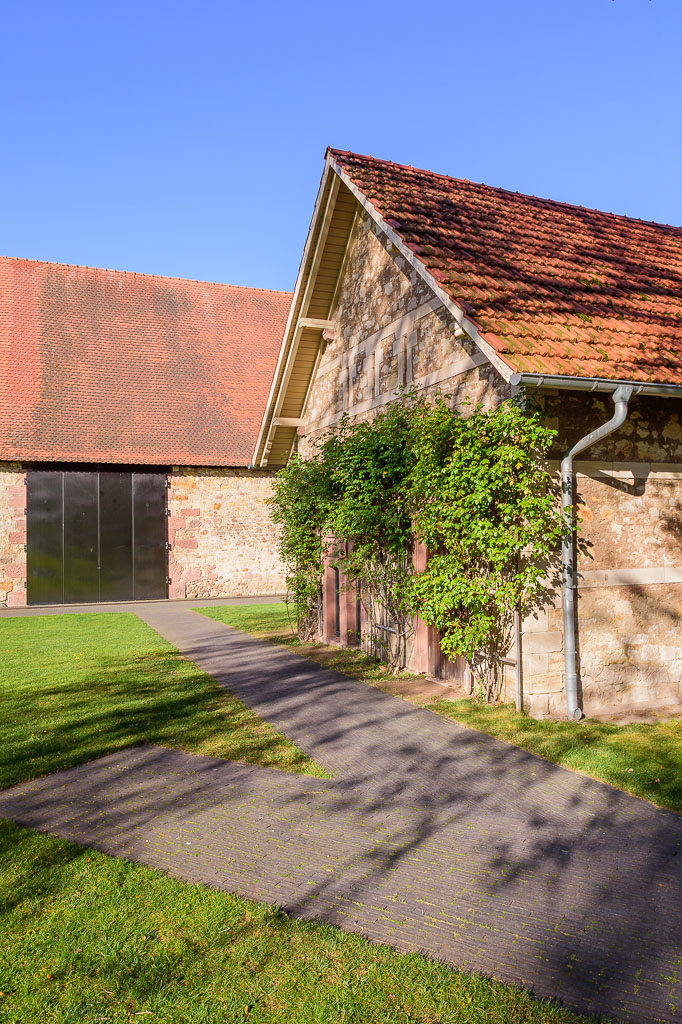
Somewhat hidden behind the tithe barn of Lorsch Abbey, a UNESCO World Cultural Heritage Site, is a herb garden dedicated to the Lorsch Pharmacopoeia that speaks of mysterious powers. A working group from the local history and culture club tends to over 200 plant species here and also preserves the knowledge about the oldest surviving medical book from the early Middle Ages.
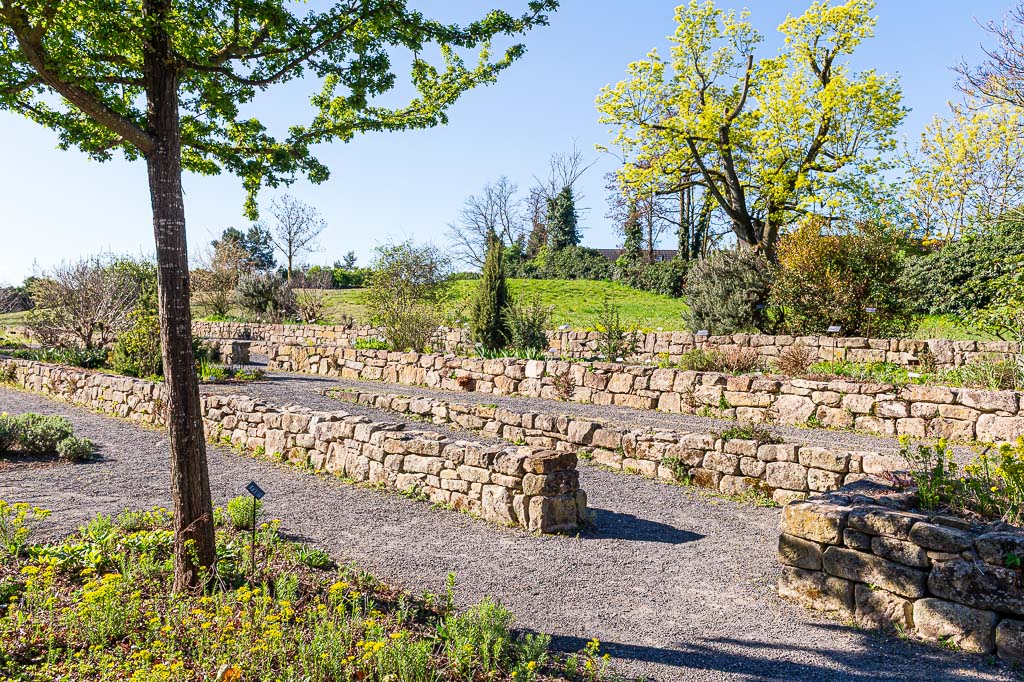
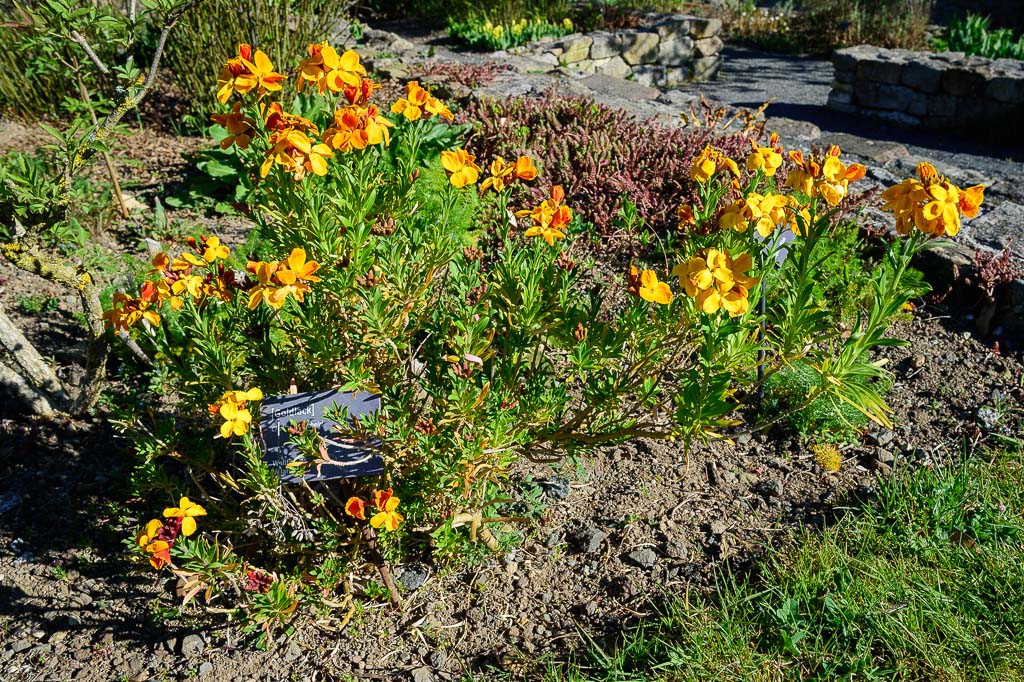
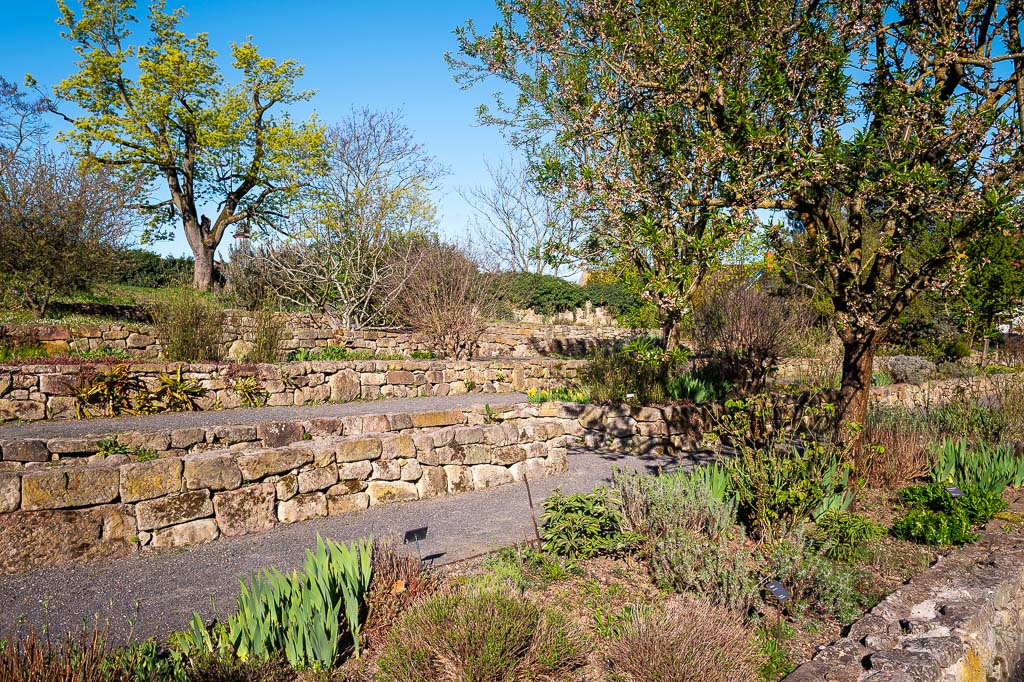
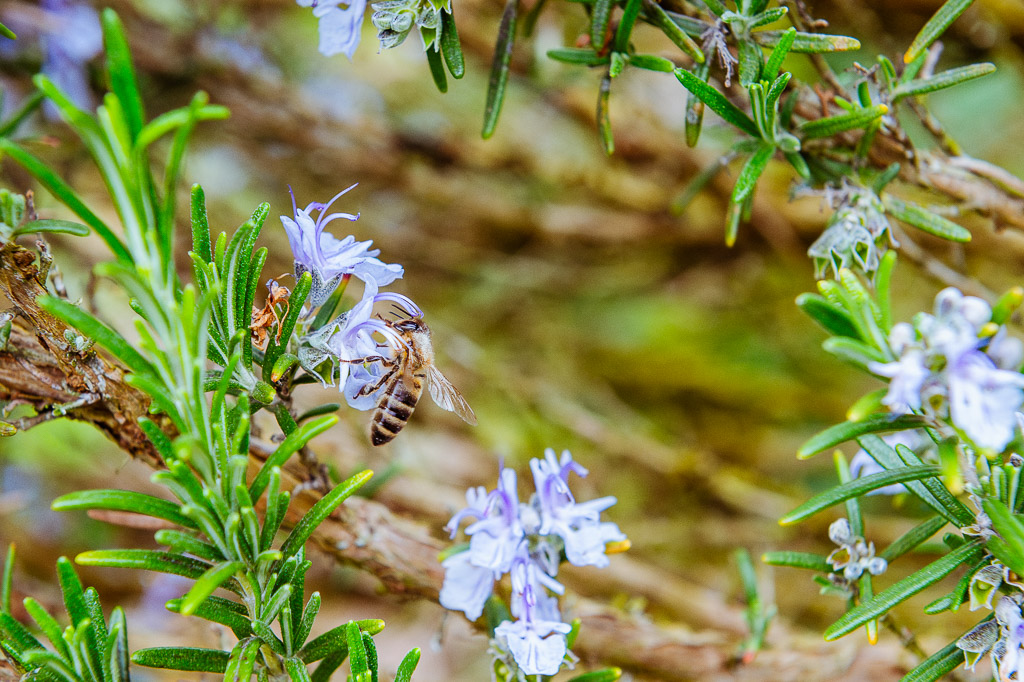
The herb garden is still asleep. In the morning, its terraces lie in the shadow of the tithe barn. But the garden awakens with every metre the spring sun climbs higher—terrace by terrace, bed by bed. Bettina Walter walks along the dry stonewalls, the gravel crunching beneath her shoes. She walks past wallflowers, which are opening their vibrant yellow-orange blossoms, and rosemary, around whose delicate lilac flowers numerous bees and bumblebees are buzzing, and past the monk’s pepper and the Madonna lily, which are still in hibernation, until she stops in front of a tall flowerbed. “This is where the cough remedy grows,” she explains.
The spring sun shining on the terraces of the herb garden.
However, it is not yet possible to make cough syrup from these little plants. But in summer, when hyssop rivals lavender with its intense purple flowers and when horehound blooms white, you could actually use its leaves to make tea—just as the monks of Lorsch Abbey did over 1,000 years ago. They recorded it in one of the many recipes that have been handed down to this day—in a manuscript that appears simple and unassuming, yet brings together the knowledge of centuries. The Lorsch Pharmacopoeia is one of the most significant medical manuscripts of the early Middle Ages, preserving knowledge from antiquity with the herb garden as a walk-through version.
Wallflower was traditionally used to treat heart and gastrointestinal complaints.
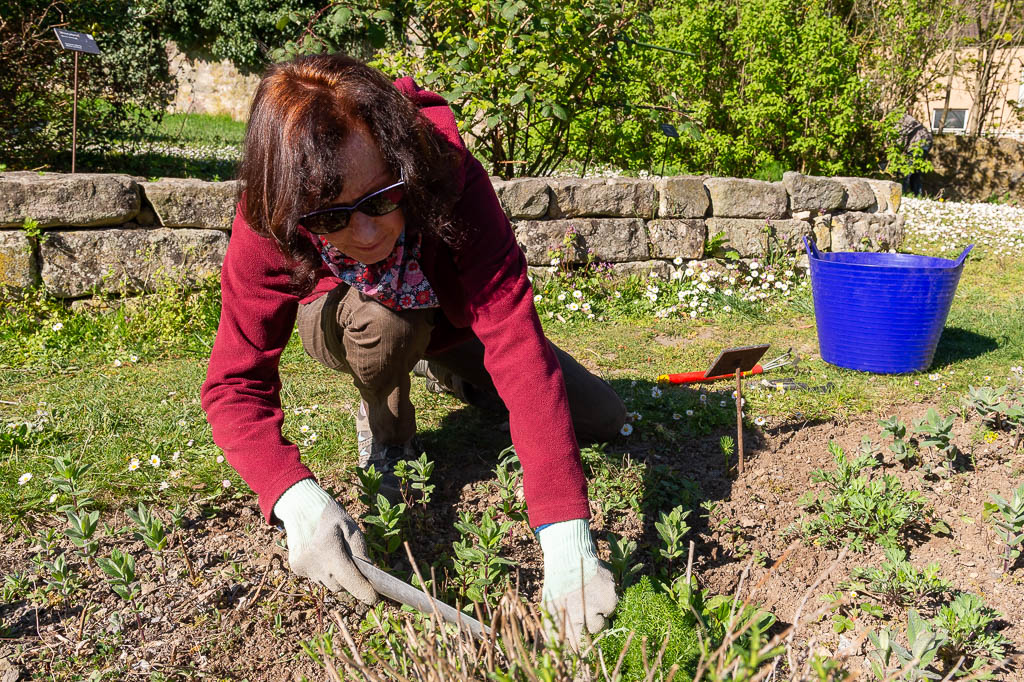
Bettina continues along the gravel path until it disappears behind the tithe barn. She arrives at a small garden shed, situated in a recess between the old monastery wall and the barn. The shed is crammed full of boxes, watering cans, spades and rakes. The working group of the local history and culture club meets here every Wednesday to look after the herb garden. Bettina has been its spokesperson since 2017. Little by little, the club members arrive. All of them are volunteers. “There are a good 15 of us, and we all bring our own expertise to the table,” explains Bettina; there are professional and amateur gardeners as well as people who look after the paths or keep the irrigation system in good working order. For the latter however, there is full-time support.
The Lorsch Abbey World Cultural Heritage Site holds more than just its famous treasures.
Somewhat hidden behind the tithe barn…
… is the herb garden as a walk-through version of the Lorsch Pharmacopoeia.
Lovingly tended to by volunteers…
… who meet here every Wednesday.
The plants that grow here…
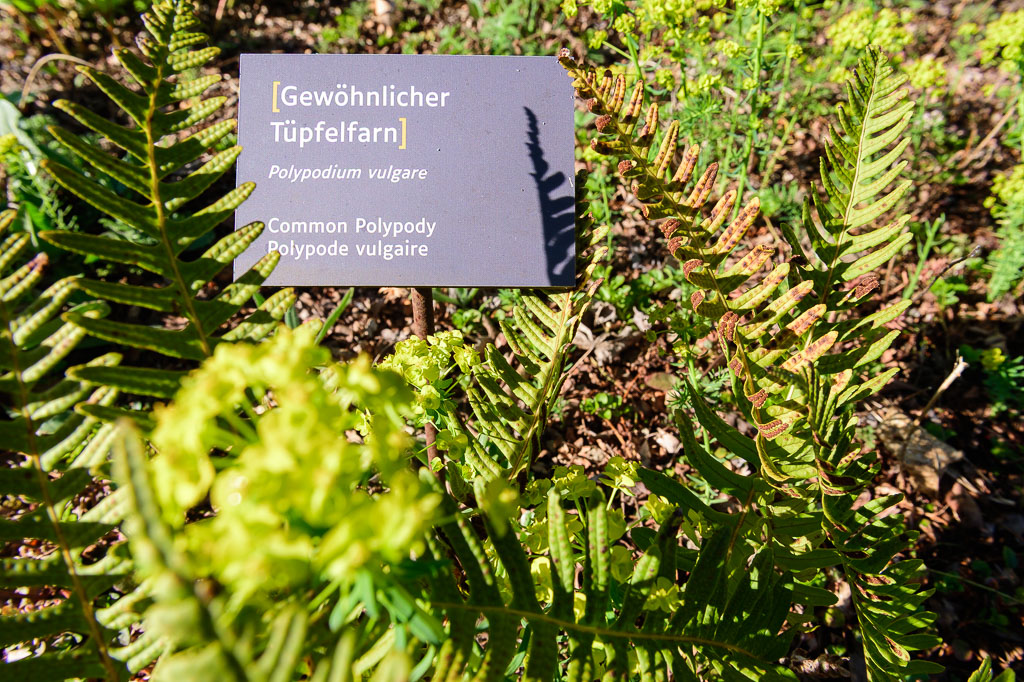
… all feature in the pharmacopoeia.
The herb garden has been in Lorsch since 1982. Back then, a small garden was created next to the Nibelungenstraße route, inspired by the poem written by the monk Walahfrid Strabo about the 24 plant species in his little garden. It was primarily the late Adelheid Platte from the club who championed the herb garden. Her aim was to show visitors to the monastery premises how the monks practised horticulture and medicine in those days. The club only established the link to the Lorsch Pharmacopoeia a few years later.
If you want to get rid of your freckles, you have to boil a gecko.
Bettina Walter on a recipe from the Lorsch Pharmacopoeia
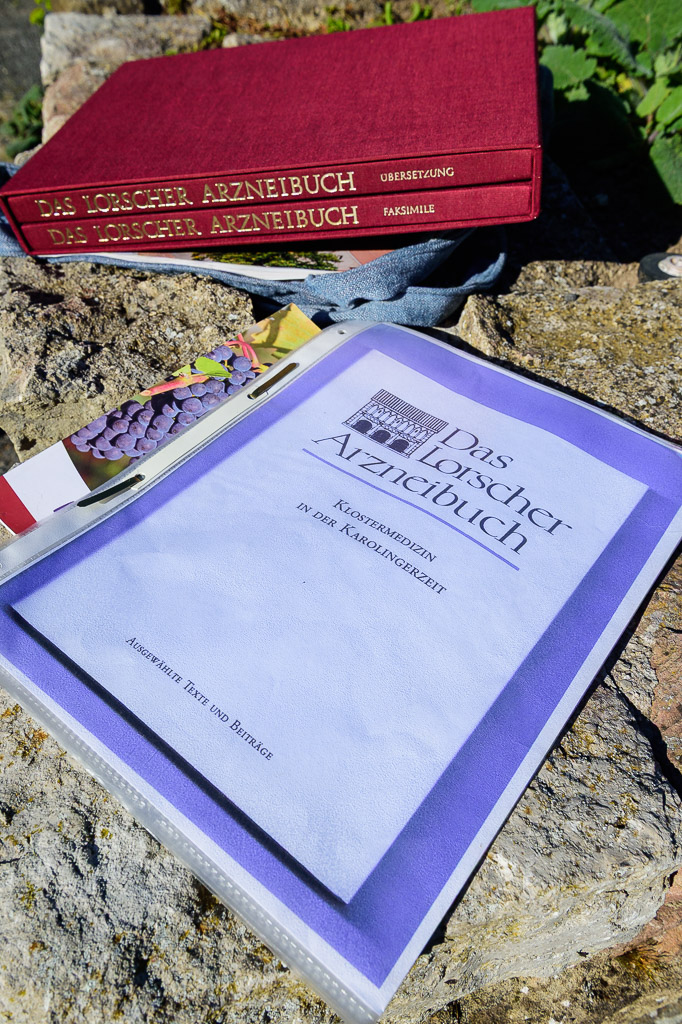
Although the pharmacopoeia had long been known, it was not until the 1960s that the historian Bernhard Bischoff discovered that the Codex Bamberginsis medicinalis with its 482 recipes had been written in the scriptorium of Lorsch Abbey. Walter presents a facsimile of the work. Page after page is filled with text, written in Latin, in uniform Carolingian minuscule. Adelheid recognised the significance of the work for the town, and the local history and cultural club and eventually succeeded in persuading the town of Lorsch—with the support of the pharmaceutical company Boehringer Ingelheim—to fund a doctoral post at the University of Würzburg in the late 1980s. Ulrich Stoll translated the text into German, thereby making it accessible to people without knowledge of Latin.
Bettina Walter showing us a facsimile of the Lorsch Pharmacopoeia, written in Carolingian minuscule.
With the publication of his work in 1992, the idea finally arose to expand the garden planting herbs that are mentioned in the Lorsch Pharmacopoeia. However, in 2013, the herb garden, just like the peony bed, had to make way for the redesign of the monastery premises. The peonies were moved to the garden of the Protestant church while the herbs were moved to the strip behind the tithe barn. It is now somewhat hidden away and in its seclusion has something of a wild, romantic oasis of tranquillity. It expresses a stark contrast to the clean, minimalist landscaping of today’s premises.
An idyllic haven of peace within the monastery premises.
It was around this time that Bettina, who came from Tübingen, joined the herb garden working group. She studied biology and geography to become a teacher and now teaches at the Ludwigsburg University of Education. She moved to Lorsch to be with her husband in 2007. When the Lorsch local history and cultural club teamed up with the town council to train tour guides in 2009, she seized the opportunity. “For me, it was a great opportunity to get to know my home town better,” she explains. Through her new role, she got to know Adelheid and the working group. “I found the combination of practical gardening and the historical and medical background very exciting.” And as a biologist, she quickly settled into the working group.
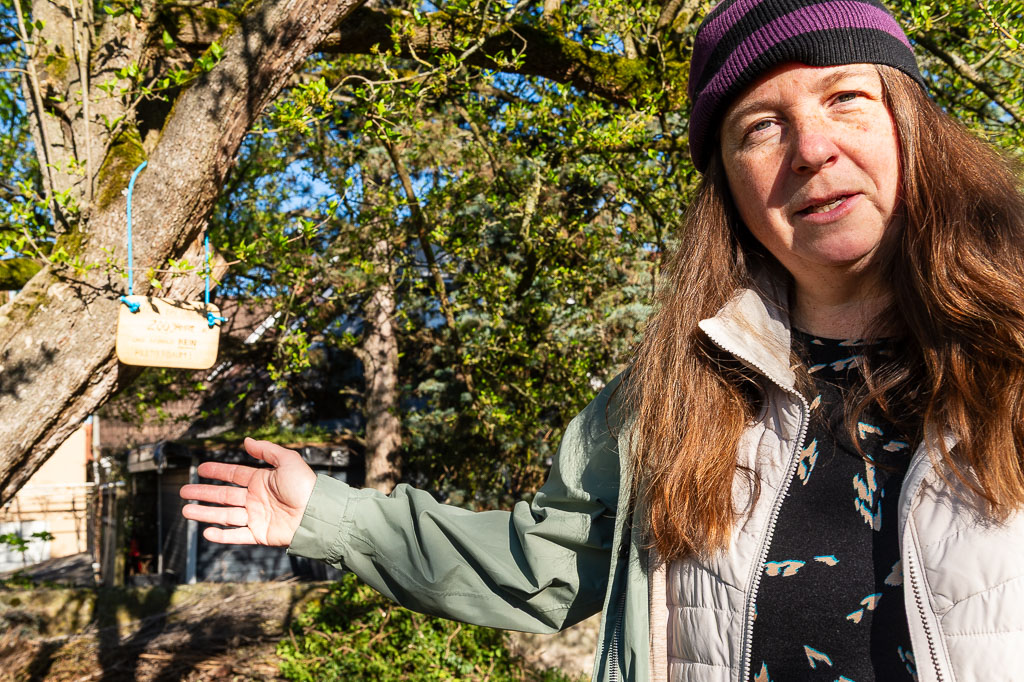
Bettina thinks a particular treasure the garden holds is the over 200-year-old cornelian cherry.
Bettina pulls the German translation of the Pharmacopoeia from the burgundy-coloured slipcase. This version may be less pretty, but it is clearer and easier to read. She pauses as she comes past a recipe for shingles. “Ah yes, you need hemlock juice for that,” she murmurs. Spotted hemlock doesn’t grow here, however. “Much too poisonous to be grown in a show garden,” she explains. “Socrates could certainly confirm that,” she adds. The ancient philosopher was executed by drinking a cup of hemlock. But coriander and black elderberry as well as other plants in the recipe actually do grow in Lorsch. “Then add egg yolk,” Bettina reads on. “Then brush the mixture on with a feather and sprinkle the ashes of burnt millet over it.”
Boiled geckos and slug ash—some of the recipes in the pharmacopoeia are rather unusual.
Bettina smiles and points to the next recipe. It is a remedy for ergot poisoning, which uses earthworms boiled in vinegar. “And if you want to get rid of your freckles, you have to boil a gecko,” she reports. Her colleague Ulrike Pavel adds: “And the ashes of a slug help with foot pain!” The two women laugh; which is often the case, Ulrike reports. “Some things do seem rather strange to us today. But alongside superstition, the pharmacopoeia contains precise scientific observations and findings.” Medicinal plants such as hyssop, horehound and ivy are, after all, still used in cough syrups today.
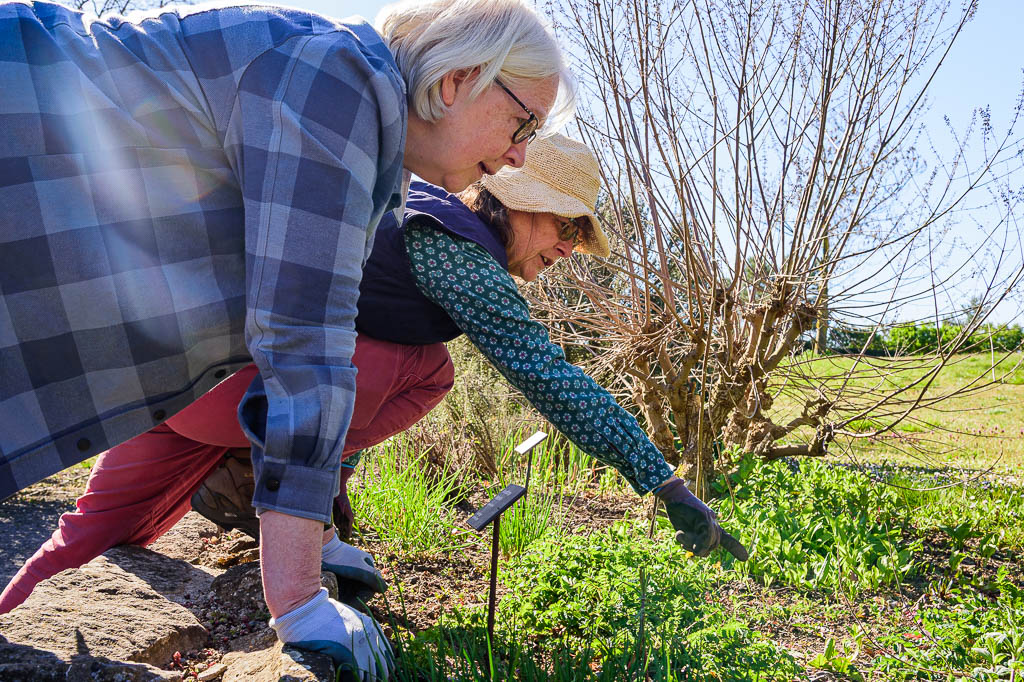
Ulrike Pavel (right) and a fellow club member having an expert discussion.
The pharmacopoeia gained its historical significance not least because of its preface, says Bettina. “It is a defence of medicine. The monks defended it against the reservations some Christians had, because they saw it as an unacceptable interference with God’s plan.” The author argues that the powers of medicinal plants are just as much a gift from God, and that helping others with medical knowledge follows the commandment to love one’s neighbour. UNESCO included the manuscript in the Memory of the World register in 2013.
Anyone who enjoys working with herbs and plants is welcome to join in the gardening here.
Meanwhile, every bed is being raked, trimmed, planted and labelled. Anyone who enjoys working with herbs and plants is welcome to join the working group. Those who prefer just to look around can also take a guided tour led by the volunteers. Furthermore, other organisers offer programmes in the herb garden, such as a wine tasting or a herb-based menu featuring herbs from the garden or a workshopfor families recreating two recipes from the Lorsch Pharmacopoeia. But don’t worry, the remedy recipes for shingles, freckles and foot pain are certainly not included.
Tips for excursions and interesting stories about the Rhine-Neckar region can be found regularly in our newsletter.
And this is how it works: Enter your email address in the field and click subscribe. You will then receive an automatically generated message at the email address you entered, which you only need to confirm. Done!