Harald Klein runs the last brush making manufactory of the Palatinate region together with his family in Ramberg. The town might be small, yet it looks back at a long history of craftsmanship.
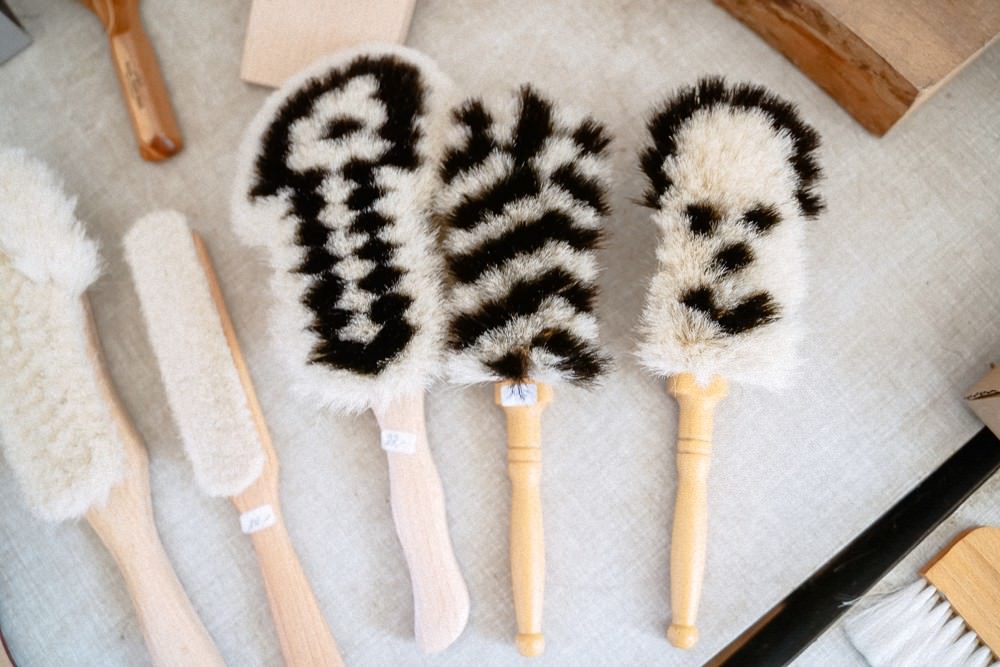
Harald Klein runs the palm of his hand over the black-and-white bristles of the hand broom, picks up a pair of oversized scissors and cuts lengthwise across the tufts several times. Shearing is what this is called. It is the final step in the brush or broom making process when the last protruding bristles are removed. After all, the brooms, hand brooms, bottle and pastry brushes, the dusters and the furniture brushes are supposed to do a perfect job of brushing and sweeping in the end.
Mit dem Laden des Videos akzeptieren Sie die Datenschutzerklärung von YouTube. Mehr erfahren
A visit to the broom and brush factory of the Klein family.
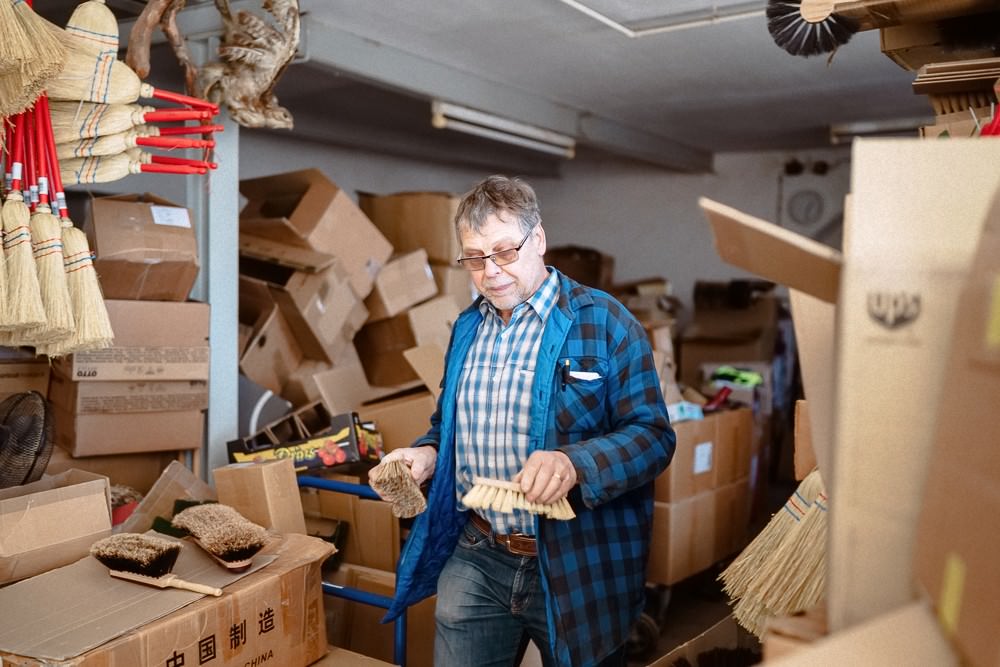
Harald is standing in the semi-darkness on the upper floor of his brush and broom manufactory in Ramberg in the Palatinate, surrounded by boxes filled with brushes of various sizes, neatly arranged side by side. Although—manufactory might not be the best word to describe it—more precisely, it is a micro-entity that he runs together with his brother Hans-Dieter and his wife, Harald’s own wife and their daughter. In addition to that, one permanent employee and a handful of manual workers belong to the business.
The Klein family are the last remaining broom and brush makers of Ramberg, a village in the southern Palatinate Forest in the collective municipality of Annweiler, which once was the centre of the brush-making trade. In the 19th century, the entire community made a living from the craft either directly or indirectly. Today, it is just the Kleins. Ramberg—that means forested mountains to the right and forested mountains to the left with some houses in between, plus a high street running through the valley basin. From the Rhine valley, it takes 20 minutes to travel to the “state-approved resort town”—a label that Ramberg bears with pride. The rose-coloured Catholic St. Laurentius Church is situated in the centre of the village. Back when it was consecrated in 1836, the life of the village people looked quite different. The people of Ramberg did not have much, especially not enough space for farming. This is why they resorted to brush and broom making. They learned this craft by watching the French. “Many people back then went to France, hoping for a better life,” Harald explains. But when their lives did not improve, they returned to their old home—and brought the craft of brush making with them.
Ramberg looks back at a long tradition of brush making.
Today, it is only Harald Klein and his family who keep it alive.
In his small brush and broom manufactory.
Where wood...
...and bristles....
...are turned into products that last a lifetime.
In 1850, 130 people worked as brush makers in the village with 1300 inhabitants. And when the peddlers, called buckelkrämer in the Palatinate vernacular, with their enormous keetzen panniers turned up in the towns in neighbouring France, the Netherlands, or even in Scandinavia, the inhabitants of the towns exclaimed: “The people from Ramberg are coming.” They knew—what you get here is quality, not trashy stuff.
A handmade broom lasts a lifetime
Harald Klein
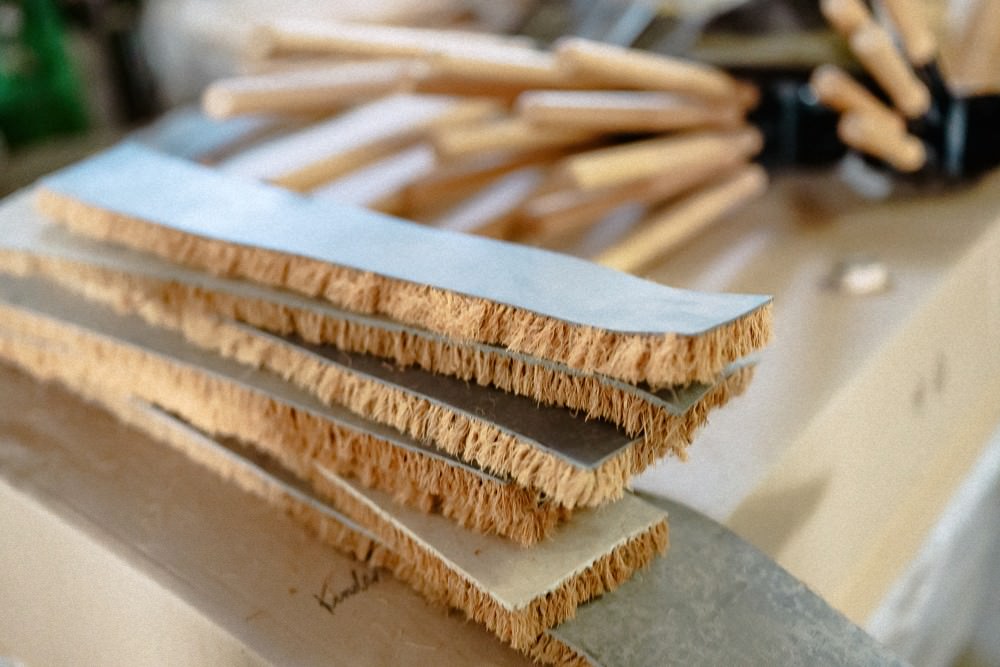
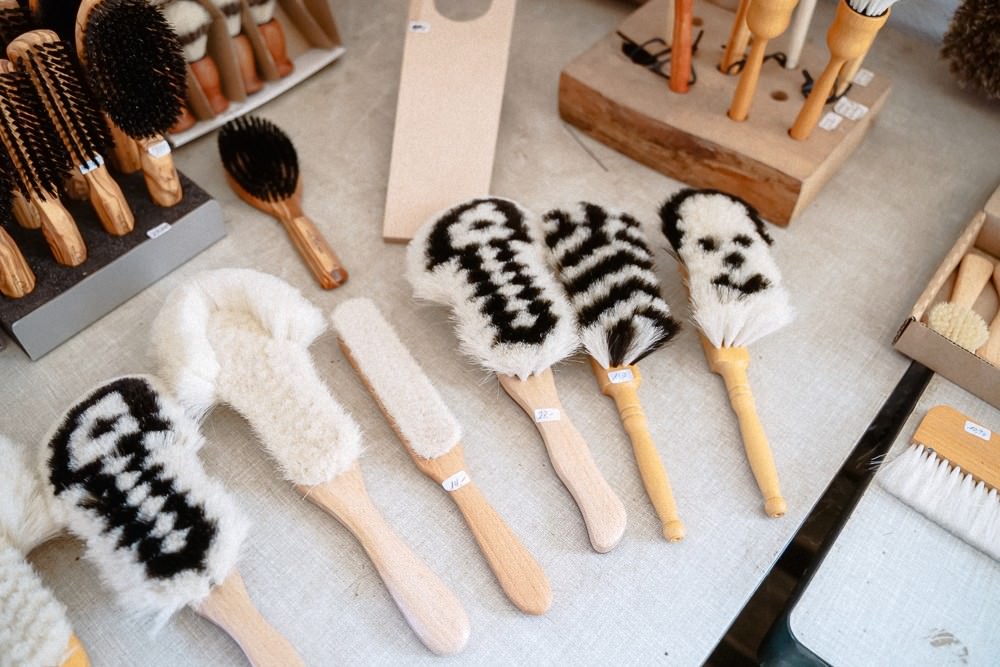
Today, most people want brushes and brooms made of plastic, because it is cheaper,” Harald says sorrowfully and lifts black-and-white bristles, neatly wrapped in packing paper and tied down with string, out of a cardboard box. Goat hair from the Tibetan highlands, that is, which he obtains via an importer from China. “The hair is soft and can bind the dust thanks to its own fat content,” he explains. Harald also sources bristles of domestic and wild boars from China. “They make fine pastry brushes and are suitable for hairbrushes, too.” And what about the common broom? It is made from horsehair, the mane or the tail hair of the horse. To craft a sturdy yard broom or hand brush, Harald draws on palm or coconut fibres from Indonesia, Brazil or India.
Soft goat hair is particularly suitable for binding dust.
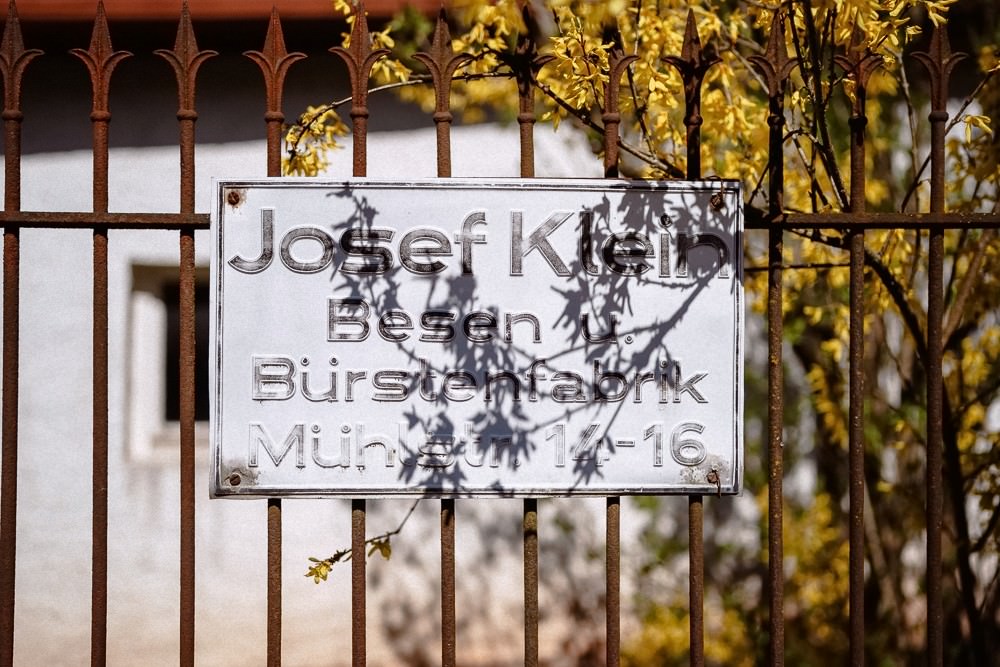
A phone rings. Harald fumbles his mobile phone out of his trouser pocket. “I will call back later,” he says and pockets his mobile. It will ring again several times during the next few hours. Somebody wants to order something; a woman inquires about broom sizes. Harald keeps his cool. He will not get worked up by any of this. Not by the boxes at his feet that need to find their way to customers. Not by the work ahead of him, the orders, requests, invoices that are towering up in opened and unopened envelops on the desk in his office. The Ramberg mill once stood on the premises where the Kleins now produce their brushes. Harald’s great-grandfather Josef had founded the broom and brush making manufactory here at the end of the 19th century. Later, his first-born son Josef, Harald’s grandfather, took over the business—it was he, too, who purchased the former mill in an auction in 1931.
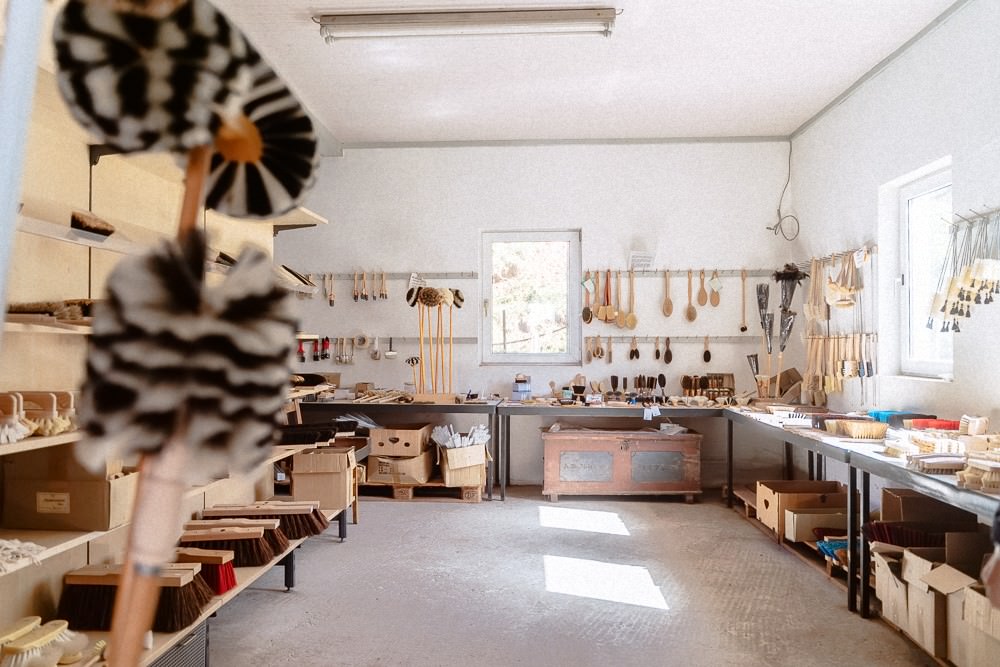
Cases, crates, cartons—and, in between, all sorts of bristles, brushes and brooms.
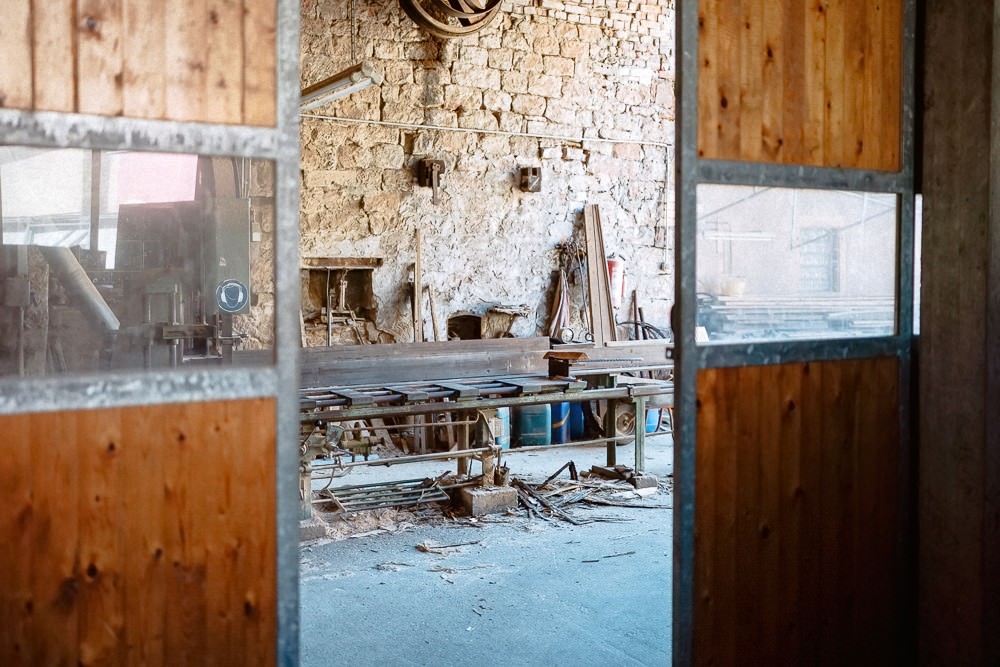
Today, the rooms tell the story of the manufactory’s long history. There are cases, boxes and baskets piled almost to the ceiling, shelves full of broomsticks, freshly delivered from Canada and Brazil, wooden planks—some still rough-cut, others already planed into broom bodies that the drill spindle will later bore the holes into—and, of course, the bristles and fibres, without which the brooms and brushes would be nothing in the end. The machines were already acquired by Grandfather Josef or his son Arnold, Harald’s and Hans-Dieter’s father. Grandfather Josef, though, did not live to the day one of the most important innovations was introduced—although he had already initiated the purchase at a fair in 1972 right before his death: a punching machine that drills holes into the wooden broom bodies in a fully automated process, while at the same time shooting bristle bundles into the wood with the help of punching wire.
The punching machine made the brush makers’ work so much easier.
On this particular day, the machine park is not operating any more, which is why Harald demonstrates the procedure on a semi-automatic machine. The wooden broom body, already prepared with holes, has to be guided manually, everything else works automatically. “This requires precision,” the brush maker says, while switching on the machine. Humming and rattling sounds arise, a curved arm picks up a specific amount of bristles from the bristle channel, whilst at the same time some sort of tongue produces a wire loop, which grabs the bundle of bristles and shoots it with a “click” into the hole in the wooden body that Harald has positioned precisely. “It works really fast, 130 bundles per minute.” Harald uses the semi-automatic machine for special orders in small quantities, like for instance, brushes that can clean vacuum cleaners or line brooms at tennis courts.
130 bundles of bristle are pulled into a piece of wood per minute.
But Harald can do even more. He masters the handcraft of broom making just like the first broom makers in Ramberg did. To demonstrate this, he goes up the stairs again into a room where you can still find the so-called “pull-in tables”. They might look like commonplace wooden tables, yet they used to be the centrepiece of the brush making process. Harald points to the round cut-out in the centre of the workbench. A wire spindle used to be inserted here, and next to it lay the pre-drilled wooden brush body. The wire is threaded through the pre-drilled hole from below; and through this noose the bundle of bristles—removed from a stack with a practised hand movement—is being “looped through”, flipped over in the middle and finally pulled into the wood. “When the bundle slips into the wooden body, it makes a certain sound,” Harald explains while he portions the bristles with his large hands. This is called “straddling” by the brush makers. The sound is produced when the bundle is really full and pulled into the hole with a lot of strength, as he says. When he hears this sound, Harald knows: That’s a perfect fit.
No matter what device you take—the bristles fit perfectly, that’s for sure.
When he was a child, about ten men and women sat at the “pull-in table”. He, too, had lent a hand. And when the jingle of the ice-cream van could be heard in the afternoon, he was allowed to get a scoop. Later, he received real money as payment—50 pfennig per hour. The brushes and brooms clean more thoroughly, the more holes and bristles there are. “I stole this with my eyes,” he says. Just like his brother, he underwent a commercial apprenticeship in his father’s firm; his father was granted an exceptional permission that allowed him to conduct trainings at all, Harald recounts. However, he learned by watching others. He can make four street sweepers in one hour—a machine can accomplish the same task in four minutes. Harald, however, says it is not the same. “A handmade broom lasts a lifetime.” To this day, women in Ramberg continue to handcraft products for him. They do not sit at the “pull-in table” any more, though, but in their own homes.
Whether there is a future to the business or not is something Harald cannot know for sure. There are several grandchildren, he says, but the oldest of them is just 14. On the other hand, people are starting to value regional products again—a fact that he can observe when he is out and about at farmer’s and artisan markets to sell his brushes and brooms.
They might look antiquated—yet they come into favour again these days: handcrafted brushes and brooms.
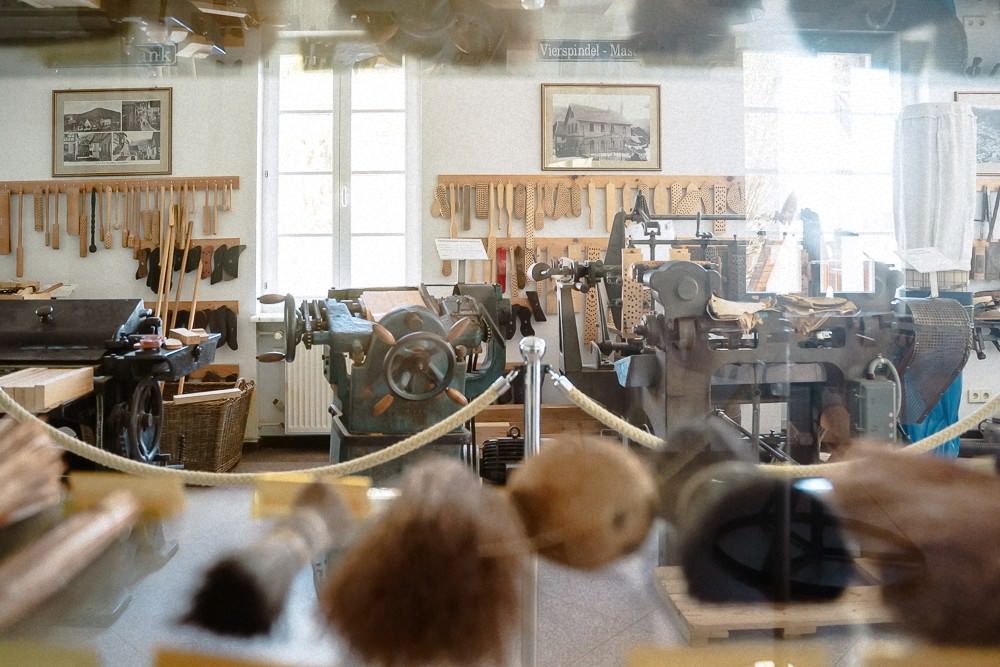
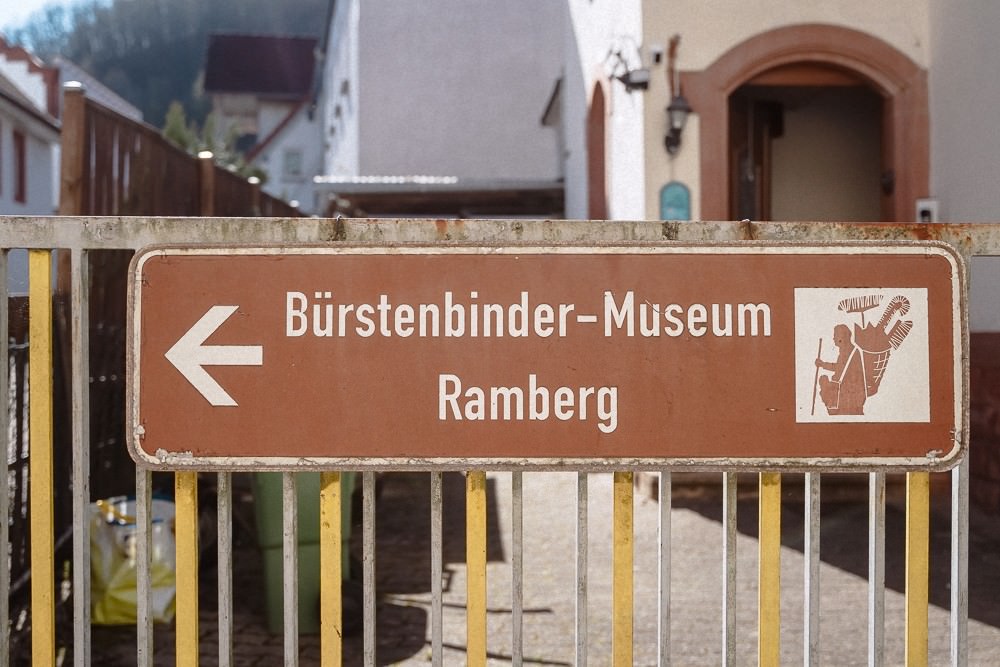
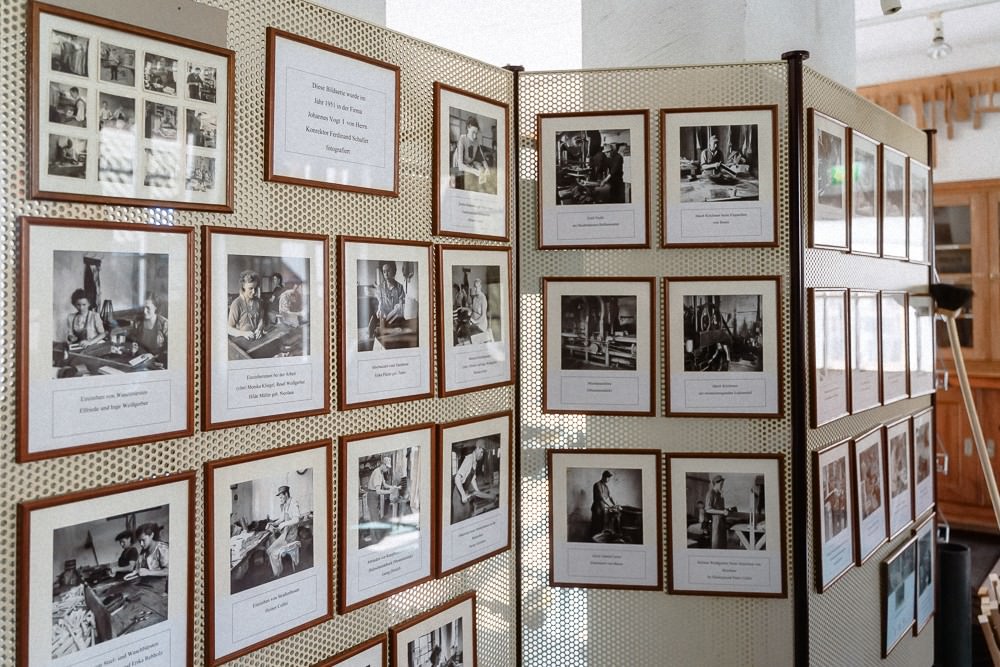
At least, there is a place in the village that ensures that the handcraft itself and all the stories related to it do not fall into oblivion—the broom maker’s museum. Here, you can find the same machines as in Harald’s workshops and even older ones. You can find pictures of broom makers’ families here, and of the last pannier of the village with his keetze on his back. A flag is put up here in reminiscence of the strike of the brush makers in 1907 in Ramberg—an unprecedented uprising of the workers against poor wages and harsh working conditions that had captured the entire village for almost one year.
The broom maker’s museum tells stories of the profession and of Ramberg.
In the end, Harald demonstrates the proper treatment of his products. He picks up a broom with a stick and explains in his broad Palatinate vernacular: “Put ya hand on top of the roundin’, because then ya keep standin’ up-right. And then, push it, don’t press it down!” Handled this way, the dirt will stay in front of the broom. Secondly, never place a good broom or brush on its bristles. “That cuts me to the quick.”
Tips for excursions and interesting stories about the Rhine-Neckar region can be found regularly in our newsletter.
And this is how it works: Enter your email address in the field and click subscribe. You will then receive an automatically generated message at the email address you entered, which you only need to confirm. Done!