In the 16th century, Elector Friedrich II had a hunting château erected in the forest of Bellheim. But apart from a moat and a very inconspicuous commemorative stone, nothing really had been there to remind passers-by of the château for a long time. Until communication designer Kilian Kunz discovered the former portal during a visit to a museum and came to a bold decision: to restore a part of history to his home village in the Southern Palatinate region.
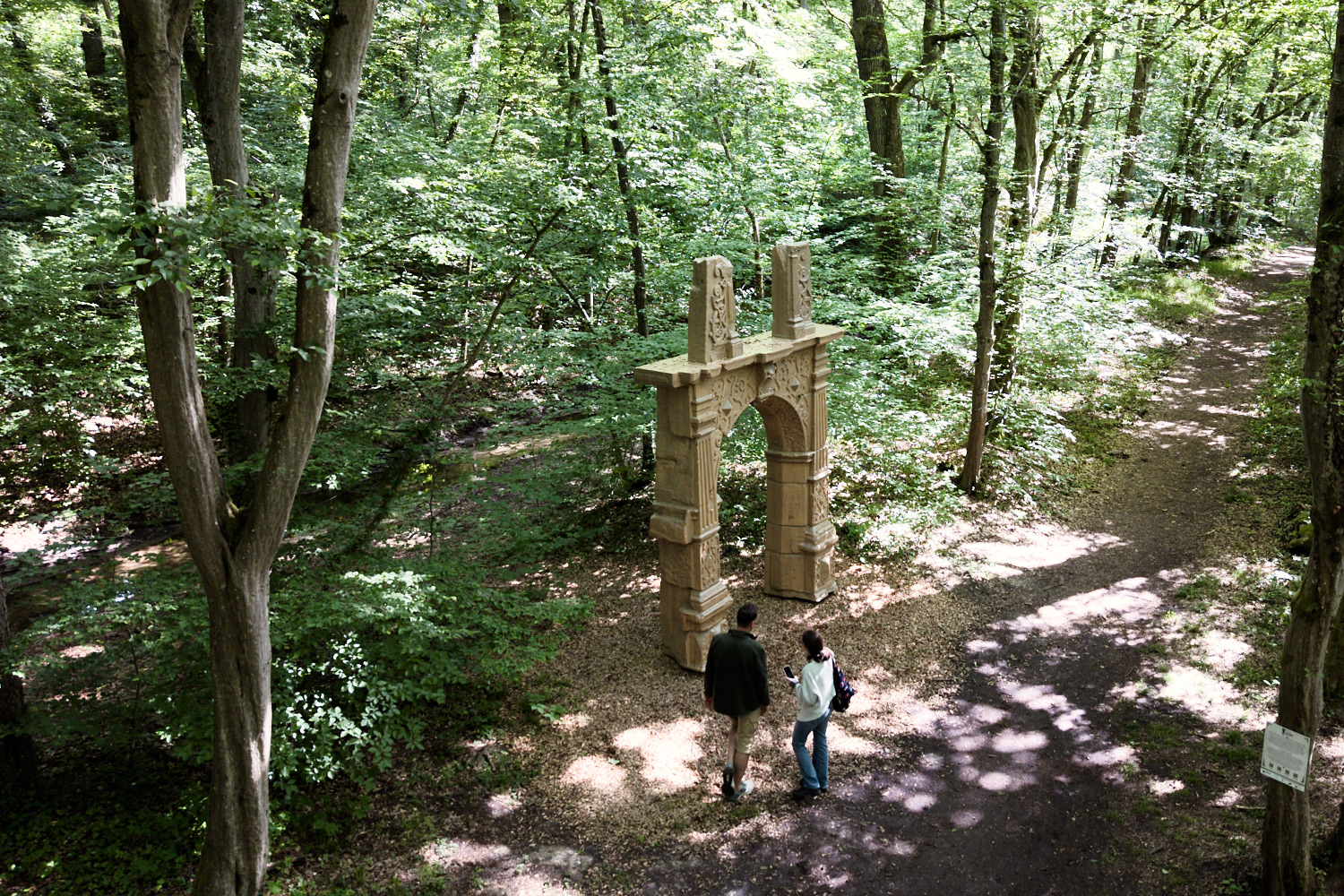
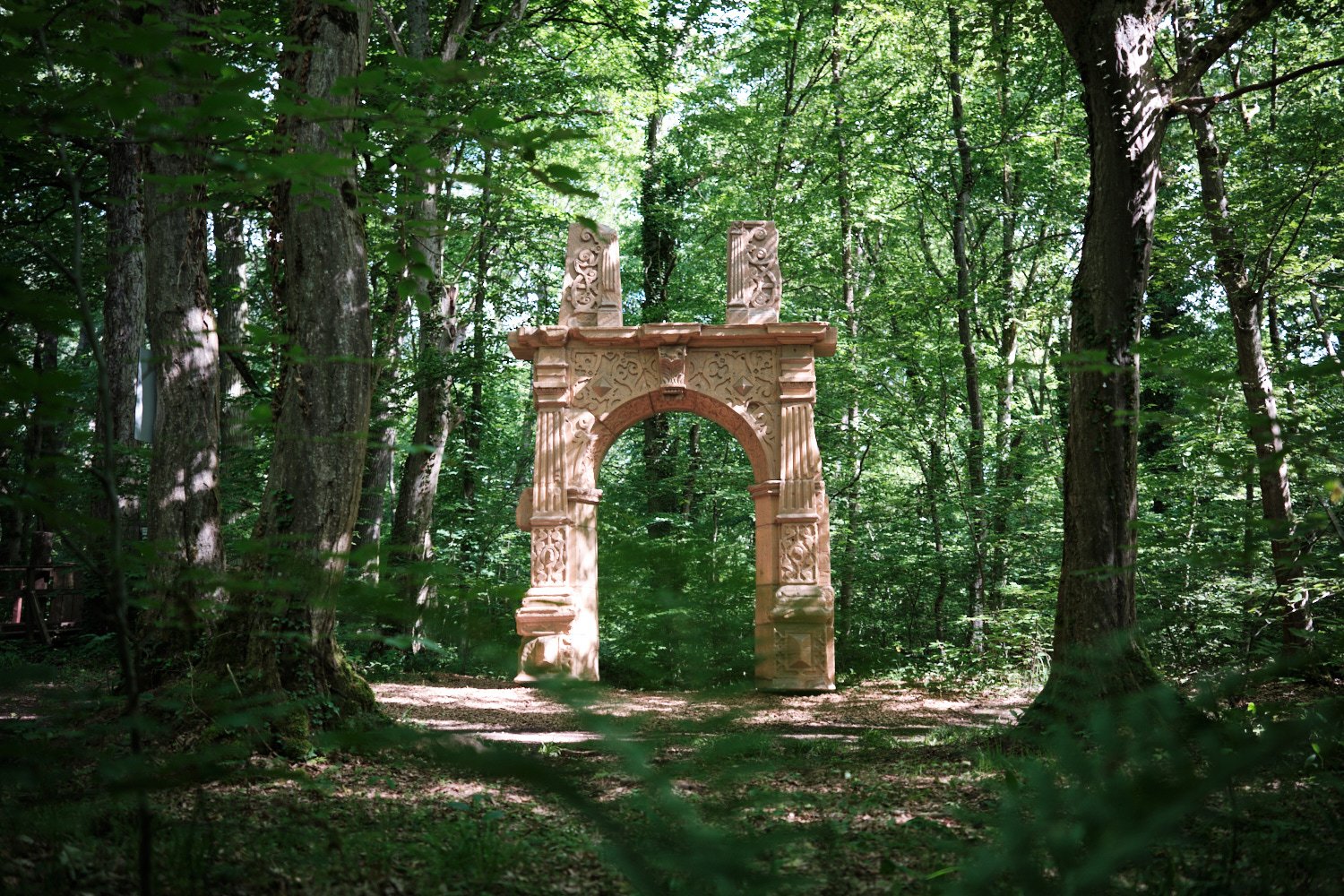
“The light is just perfect,” Kilian Kunz says delighted, as a monument comes into sight in a clearing. Approaching, an archway becomes discernible. There it stands as part of the landscape, solitary, almost mysterious. Kilian had visited this place in Bellheim forest in the Southern Palatinate countless times, roamed the area, observing the position of the sun, the nature of the ground and water levels in order to reconstruct the history of this spot of land.
Mit dem Laden des Videos akzeptieren Sie die Datenschutzerklärung von YouTube. Mehr erfahren
By now, he knows this place like the back of his hand. And the people who are out and about jogging or walking their dogs greet him warmly—with a waving of the hand here and a friendly hello there. He likes to be in nature, the athletic dark-haired man from the Palatinate shares. Born in Landau in 1976 and grown up in Rülzheim, he has been living in Bellheim for many years now. He loves hiking, as he says, whether in South Tyrol during family vacations or here, in the Southern Palatinate region.
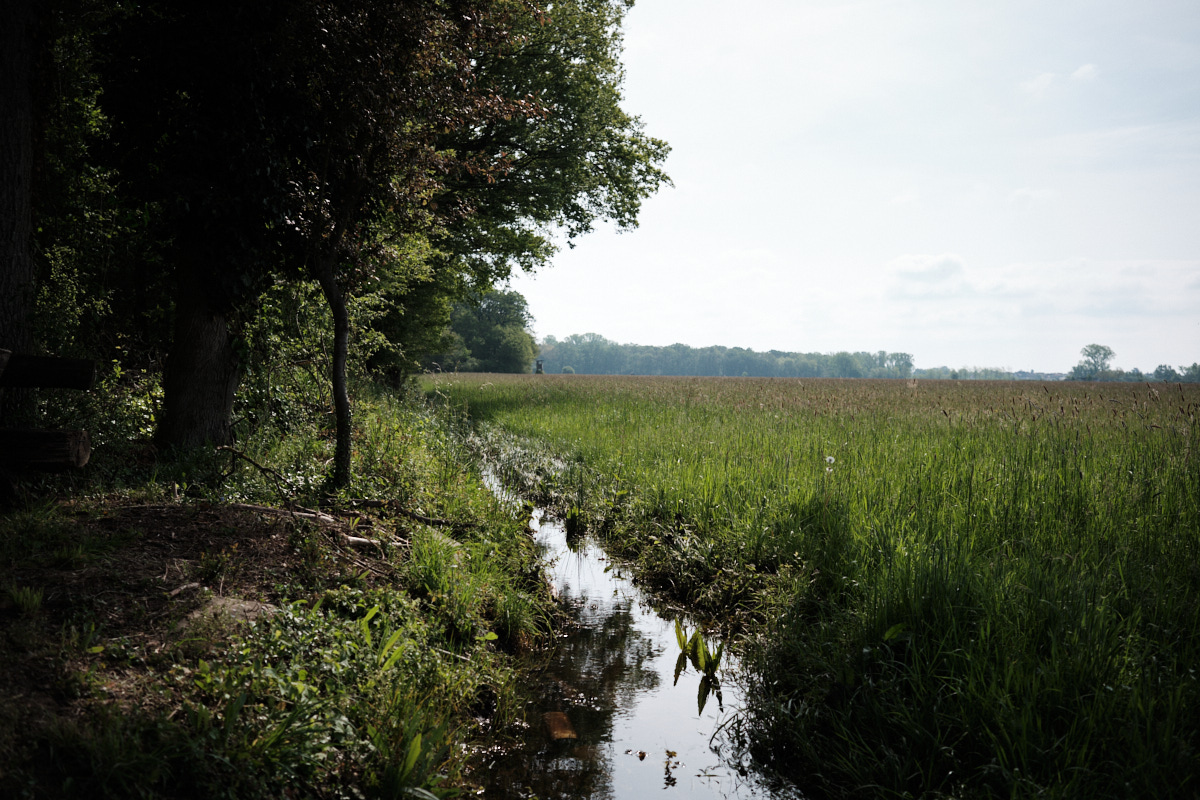
Picturesque views are guaranteed along the canals of the Queich—even when looking in the direction of the former château Friedrichsbühl. Photo: Julian Beckmann
It is a popular route. The Friedrichsbühl hiking loop starts at the marksmen’s club house with the large adventure playground nearby, passes by a planting area for new trees and then goes on in the direction of the Holzwiesen meadows, which—with their irrigation system thanks to the river Queich—have become part of the UNESCO world heritage in 2023. Just before these meadows, the route branches off and leads to the destination after about three kilometres: the experiential station Friedrichsbühl.
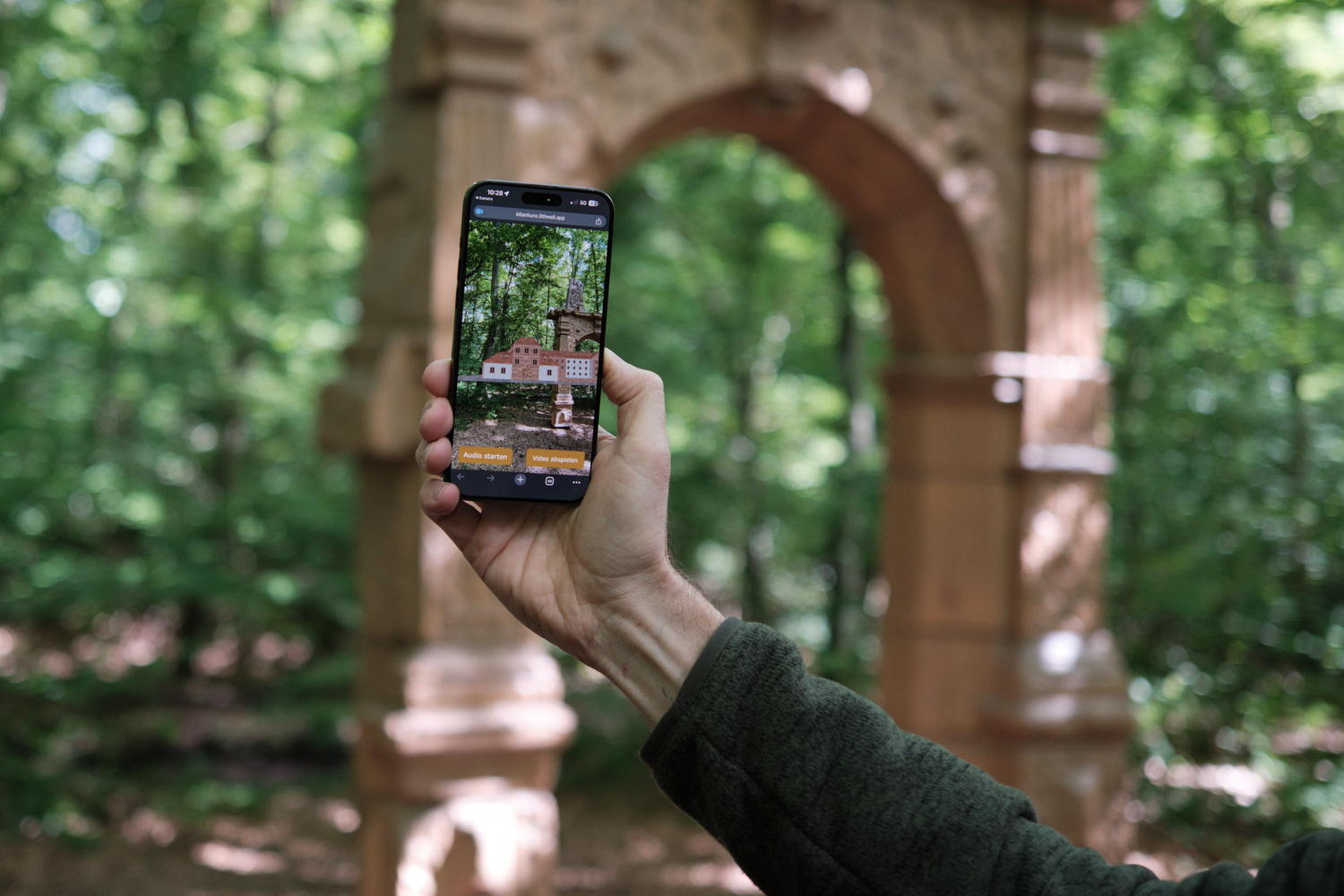
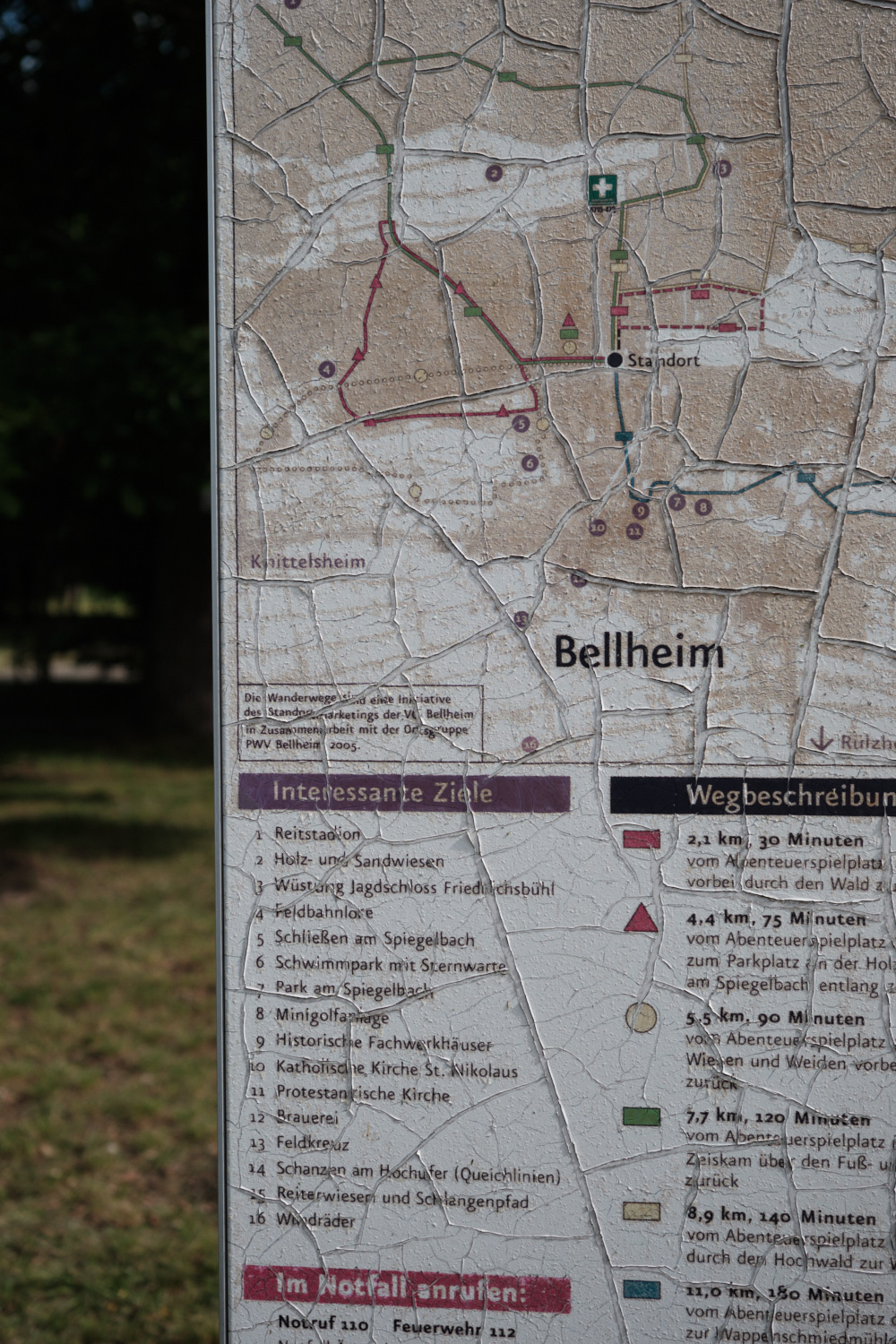
Summer is in the air this late morning, as the midday sun breaks through the luscious green canopy of leaves. One of the trees displays an information board with QR codes explaining your current location. In 1550/1552, Friedrich II, Elector of the Palatinate, erected a hunting and summer residence at this spot with big expenditure—since it was here that one of the best hunting grounds of the Electoral Palatinate could be found at that time. Here, the Elector received his guests, cultivated his political contacts and held opulent festivities.
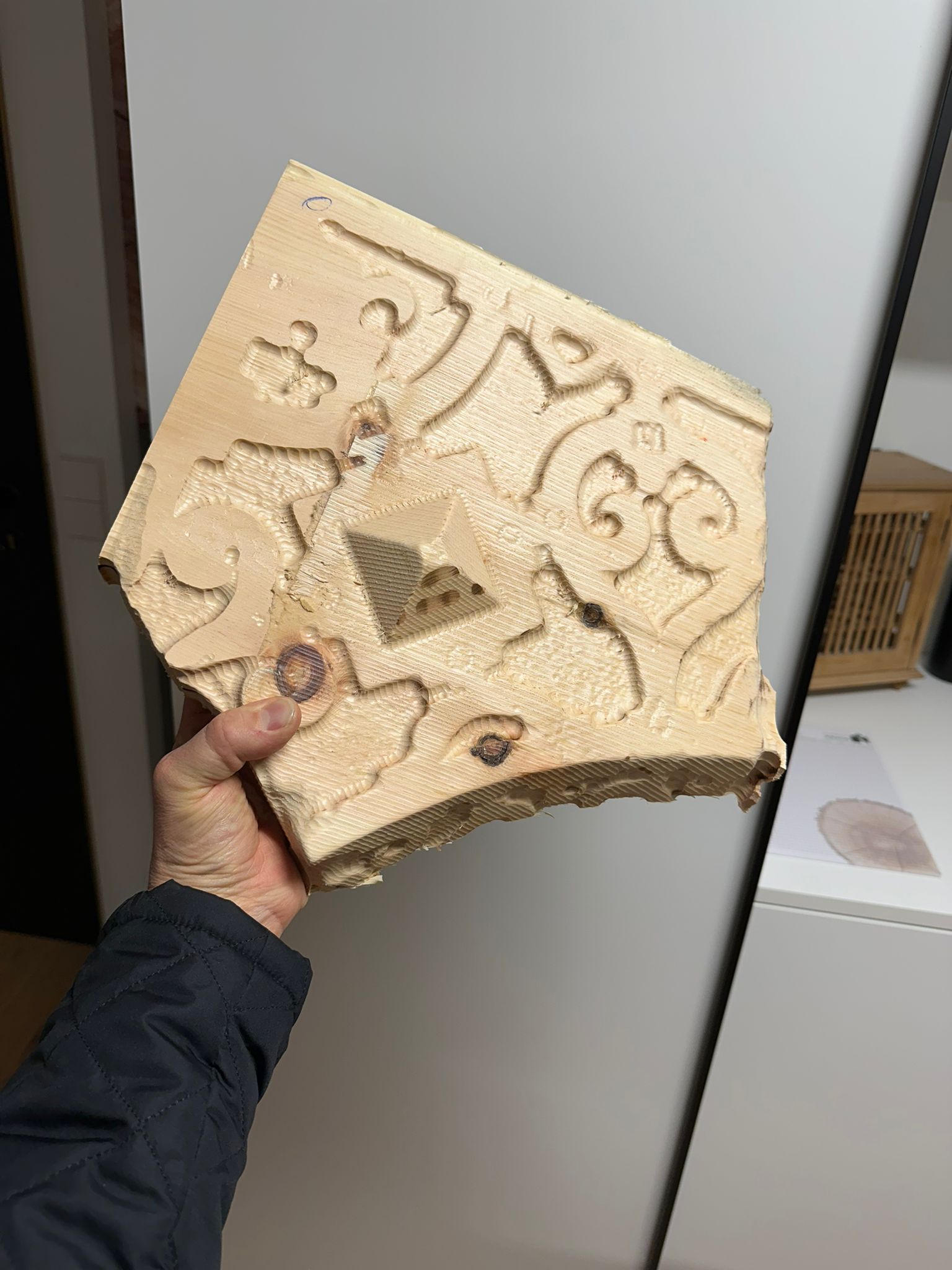
A piece of the archway of château Friedrichsbühl, reproduced in wood. Photo: Kraus Joinery.
Digital reconstruction: the historic archway of Friedrichsbühl on the screen of a laptop. Photo: Kraus Joinery.
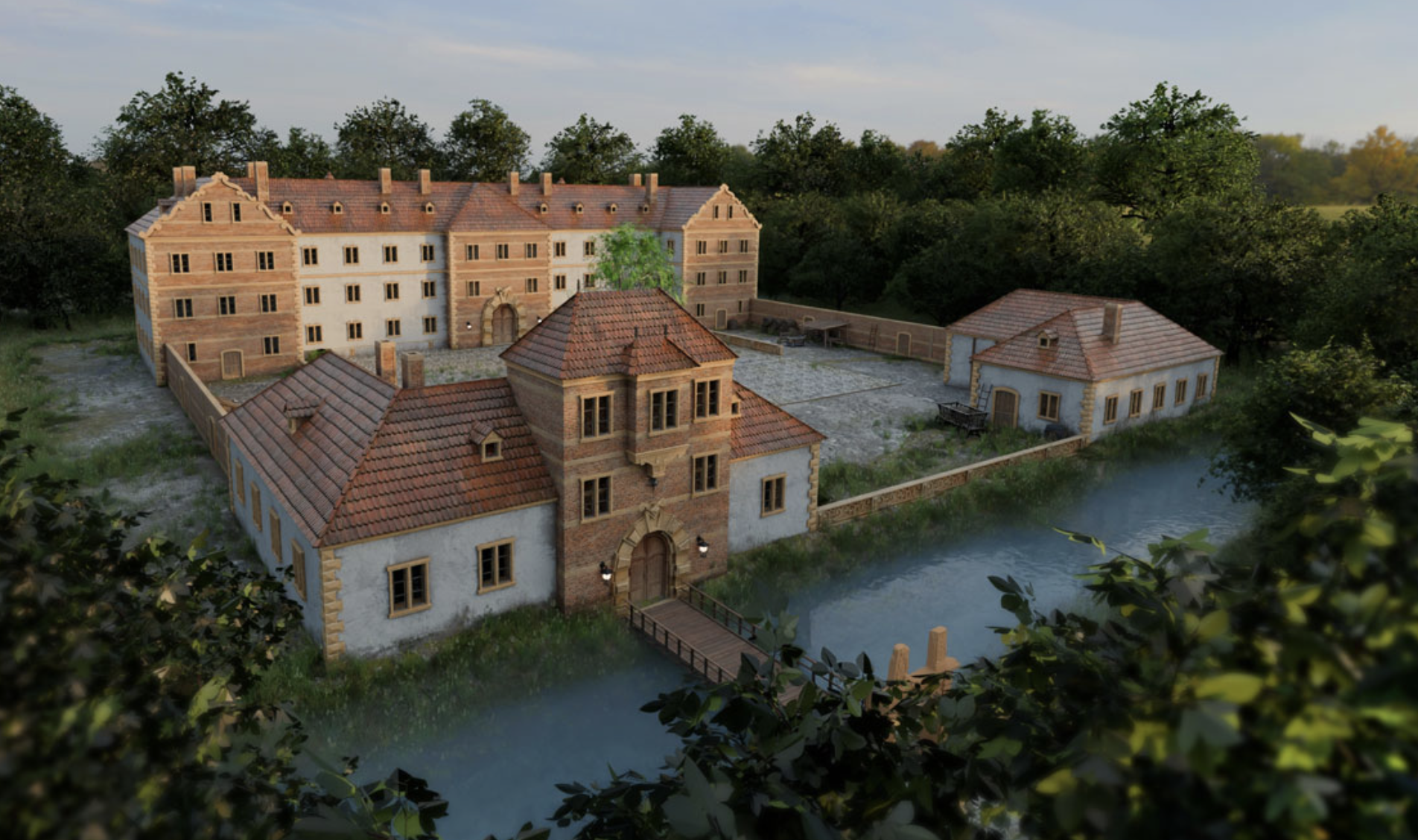
Scanning one of the QR codes, a 3D reconstruction appears, displaying how the château might have looked like back then. “We can only speculate because there are no plans, drawings or paintings that have survived,” Kilian, who runs a communications agency in Bellheim, says. He has dived into the history of the château several times already on behalf of the municipality—for instance, he produced a film about the origin of the place based on historical accounts. The discovery he made with Friedrichsbühl, however, involved a good amount of research. “We used historical repair bills and inventory records to get a little bit closer to understanding what the hunting château looked like.” What is known is that it was a three-storey building completely surrounded by a moat and accessible only by bridge.
Wahrscheinlich wollte man mithilfe der Wassergräben Wölfe fernhalten, die damals in der Region ihr Unwesen trieben.
There are several explanations for Friedrichsbühl being a moated castle. As well as serving a representative purpose, the moats were useful for watering the large vegetable gardens situated outside the castle grounds. Furthermore, another trace could be found in church and municipal council records of the time: “Wolves were on the prowl here in the region. Presumably, the moats were intended to keep them out to protect the game that had been brought down.”
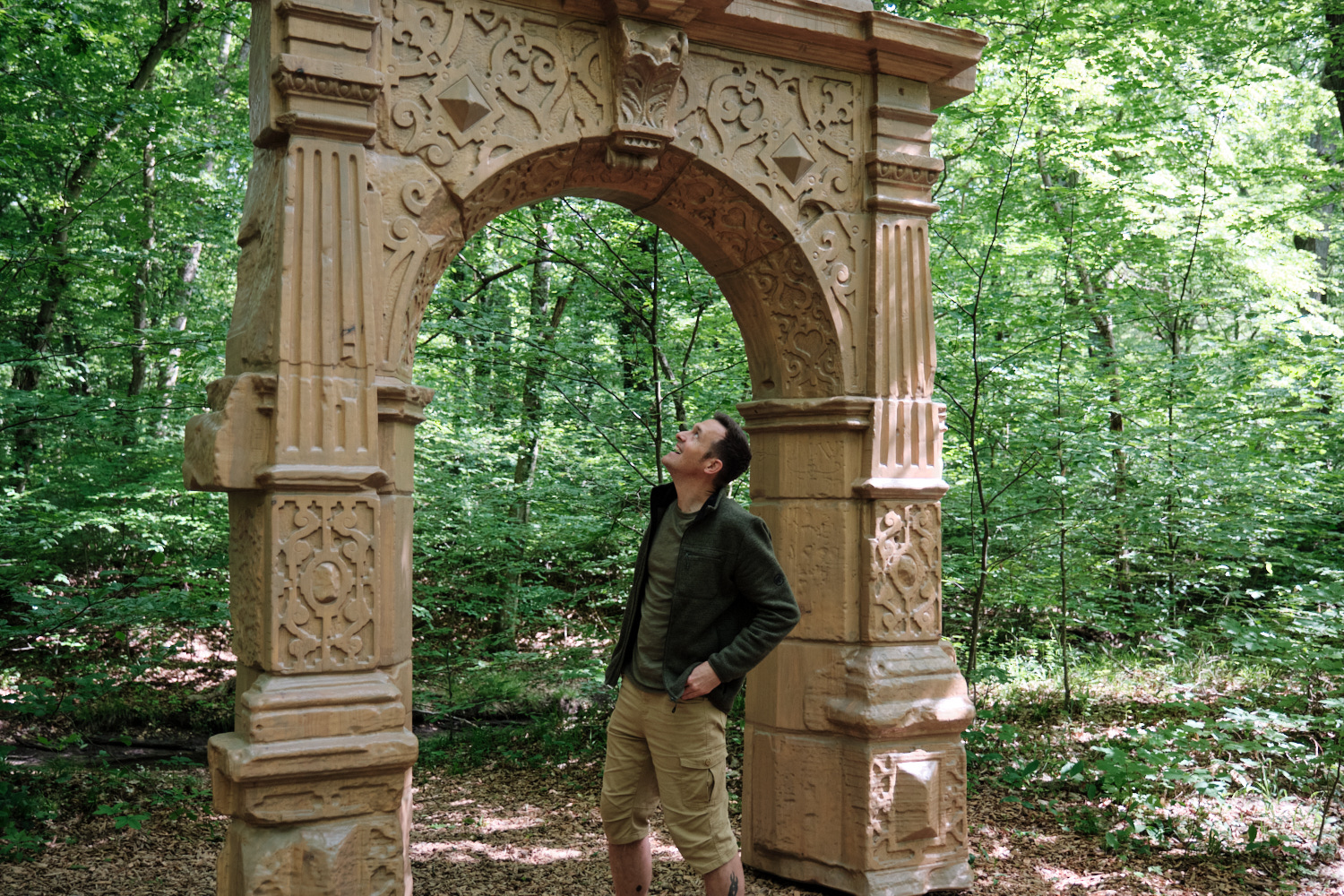
The moats can still be seen today. They are fed by the Sollach, an artificially created tributary of the river Queich. “Depending on the season, it is filled with more or less water,” Kilian reports. Today, you can see only a small runlet. “The moats run through a square area that is approximately 100 metres long and wide,” the amateur historian explains. “We assume, the château grounds were in the middle of this area.” At the southern end of the moat enclosure is the spot where it once stood—unattached on the premises, as he presumes—the portal that is now standing here again. Sort of, anyhow.
A piece of the archway of château Friedrichsbühl, reproduced in wood. Photo: Kraus Joinery.
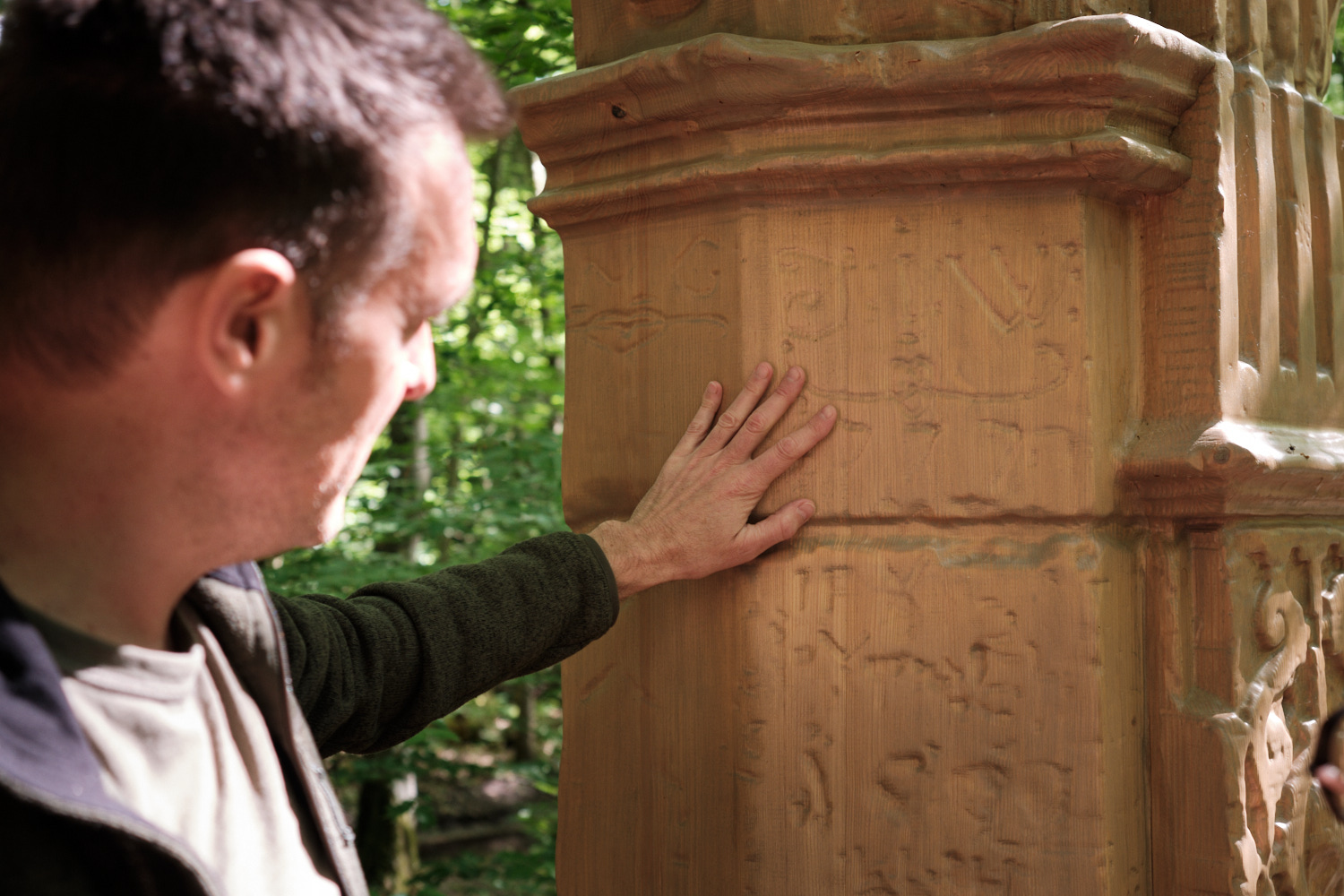
Because what looks like sandstone at a first glance is something quite different. The masonry has a faded quality to it and a light grid pattern is evident. As you touch the supposed stone and tap against it with your fingers, it becomes clear very quickly that it is not a renaissance archway at all what is standing here. “It’s a wooden replica.” Together with his cousin Sebastian Kraus, who runs a joinery in Bellheim, he reconstructed the portal, the only surviving relict, and returned it to its original location.
The original portal of château Friedrichsbühl can be found in Speyer. Photo: Historical Museum of the Palatinate.
Kilian gained the decisive impulse while he was visiting the Historical Museum of the Palatinate in Speyer (link to the story)—at his daughter’s birthday party. He had just taken a little time out for himself and enjoyed the break in the museum café when his eyes were suddenly drawn to something particular. “Years before that moment, I had contributed to a publication and had been somewhat surprised to learn that there had been a château once in Bellheim,” Kilian recalls. Yet, in Speyer, he saw the portal of château Friedrichsbühl for the first time. Made of yellow sandstone, it is over four metres high, one metre deep and three metres wide. Fluted pillars line a round archway adorned with decorative motifs, the centre of which is graced by an ornate keystone.
The archway had been carelessly lying around in the garden of the local vicarage, after it had been integrated in the entry area of the Catholic church and had then been discarded in the course of renovation works. In the beginning of the 20th century, the Historical Museum (here is the link to our portrait of the Historical Museum, see also link above) brought the gateway to Speyer in order to preserve it professionally and put it on display as one of the first exhibits of the collection there—protected from wind and weather. This way one thing led to another—Kilian came up with his idea to create a replica of the portal. He was working with a 3D scan and thought that the archway could be measured that way. Yet, it became apparent soon that a gateway made of sandstone of this size would be logistically and financially unfeasible. And when he asked his cousin if it was possible to make a wooden structure of the entire monument with his automated milling machines, his cousin was basically on fire. “I almost had to put the stops on him,” he recounts.
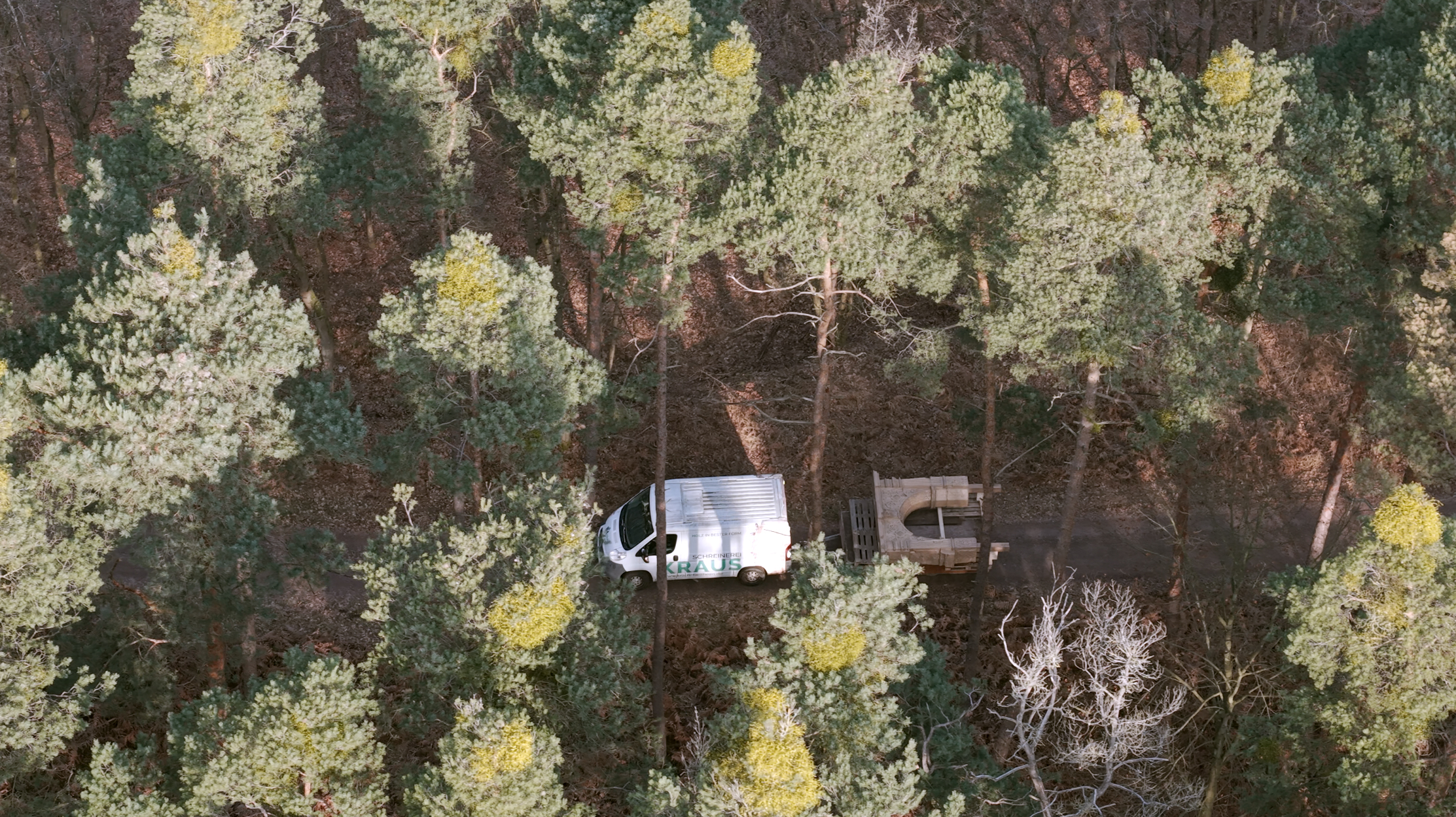
This drone shot shows how the replica archway of Friedrichsbühl was brought into the forest of Bellheim. Photo: K2 Fachbüro
Eventually, it was necessary to obtain funds and a construction permit. But these hurdles were quickly cleared, the municipal council supported the project, and it was funded by the EU, the federal government and the federal state of Rhineland-Palatinate. Special requirements arising from the site’s location within a bird sanctuary—such as finding a suitable varnish that is both weather-resistant and environmentally friendly, whilst also resembling sandstone in appearance—were also successfully met. “That turned out quite well,” a pleased Kilian says as he runs his hand over the wood. “As it will become moss-covered over the years and as it is exposed to the weather conditions, it will look even better.”
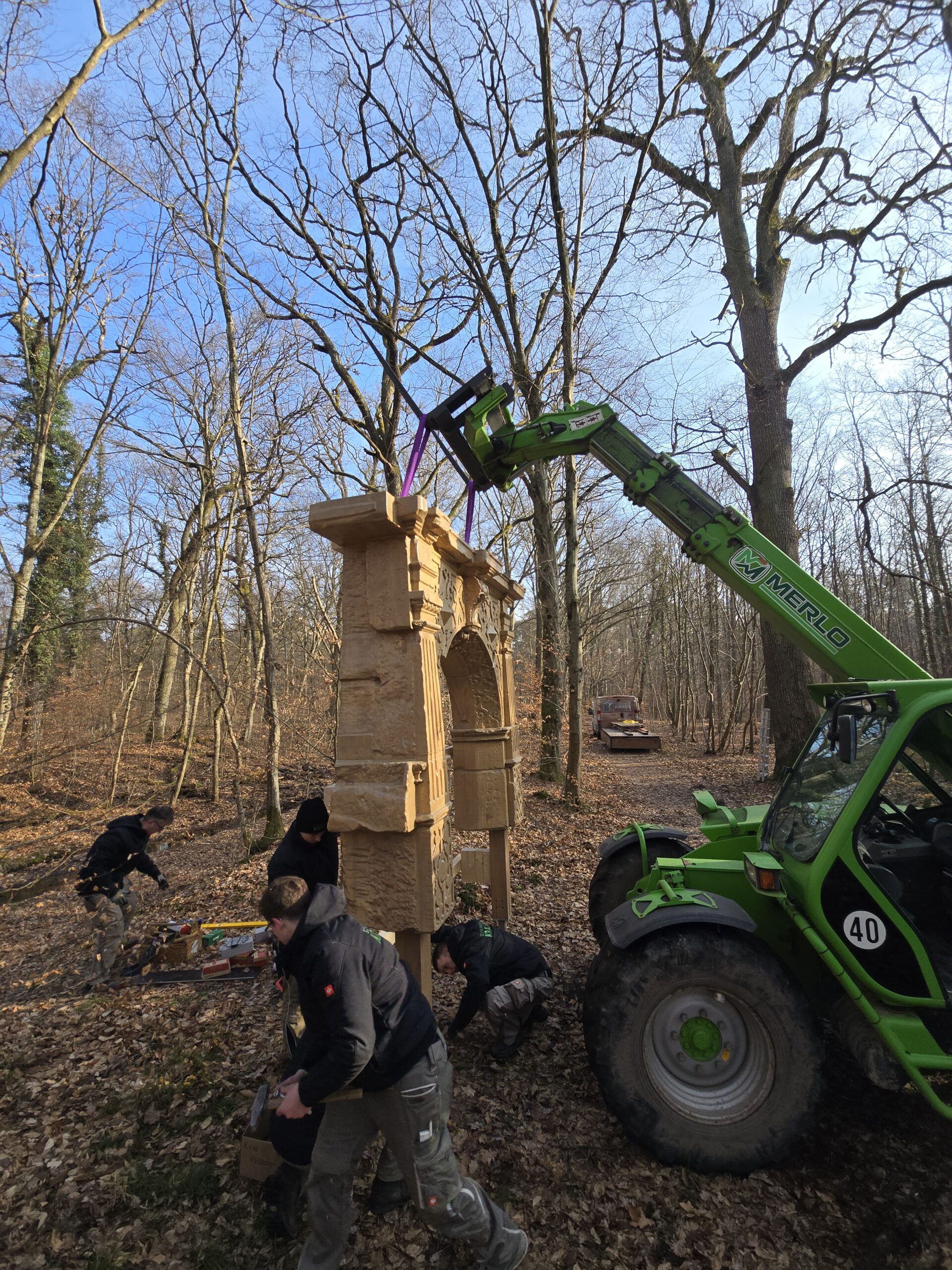
From a technical point of view, the biggest challenge was to break the gate down into individual milled parts and afterwards put them together again so they perfectly fit. Some problems needed solving underway—“learning by doing, that is,” as Kilian says laughing. And it is not a one-to-one copy. “Our archway is a little bit deeper than the original,” he explains and points to a heart-shaped ornament that has been stretched out in width. “In Speyer, metal bars support the portal; and this is how we balance the statics.”
Friedrichsbühl hunting and summer residence—virtually reconstructed. Photo: K2 Fachbüro
Since January 2026, the replica gateway evokes the memory of the historical château Friedrichsbühl with its eventful, albeit short history. During the Thirty Years’ War, the residence had been destroyed for the first time in 1622 by Archduke Leopold V’s troops. In 1623, he had the château repaired again. Under the reign of his wife Claudia de’ Medici, the estate gained recognition as a hunting château and horse breeding farm once again. Horses for the Emperor’s court in Innsbruck were bred here—the enormous need for hay was, amongst other things, met by the yields provided by the irrigation system for the Queich meadows. Another destruction, however, spelt doom for château Friedrichsbühl, presumably by Swedish troops. The damage was so grave that a reconstruction was dismissed. Around 1725, the last ruins disappeared; stones were re-used for different purposes. “Some of them were found integrated in the sluices of the Queich meadows,” Kilian says.
Research into château Friedrichsbühl is far from being complete. The cultural association of Bellheim is still working on it. “Some of its members are now trying to find out what was cultivated in the vegetable gardens on the basis of soil samples. Seedlings remain in the soil for many centuries,” Kilian reports and sits down on a bench by a little roofed hut at a table displaying a chequerboard pattern. The Palatinate Forest Club created this resting area here. He reveals a bag with pastries and a can that allows him to brew fresh espresso even when he is out and about. Is this what he is into, trying out new things? The amateur historian laughs impishly. Friedrich II, too, was on the lookout for unusual solutions—not least by having Friedrichsbühl built. A moated château in the middle of nowhere.
Tips for excursions and interesting stories about the Rhine-Neckar region can be found regularly in our newsletter.
And this is how it works: Enter your email address in the field and click subscribe. You will then receive an automatically generated message at the email address you entered, which you only need to confirm. Done!