Balancing, swinging, climbing, flying—ninja sport does not only require a lot of strength on the part of the athletes but also endurance, balance and agility. As a child, Julian Lind from Weinheim was an avid viewer of the TV show “Ninja Warrior”—and then, a few years later, he participated in it himself.
Julian Lind is flying. Four, five metres—in a high arc. Then, he lands on the mat and deftly lands on his knees. It looks easy, playful somehow. “That’s better,” he comments aloud and immediately returns. He hangs onto the two holds again, which he had previously attached to a bar with ropes, a good four meters above the ground. He swings back and forth, higher and higher. And lets go at the highest point. He wants to go even higher, even further.
Mit dem Laden des Videos akzeptieren Sie die Datenschutzerklärung von YouTube. Mehr erfahren
Flying from obstacle to obstacle—our video shows Julian Lind during training.
Julian is a ninja athlete. Ninja is an up and coming sport that was introduced from Japan to Germany via the US only in 2016, when the television station RTL broadcast “Ninja Warrior Germany”, an adaptation of the successful Japanese TV show. Competitors have to complete a complex course, overcoming many different kinds of obstacles. They balance, swing, climb and fly. They run over rolling tires, swing on ropes and sometimes hold their entire body weight with just their fingertips on narrow handle strips. Strength alone is not enough—endurance, balance and agility are also required of the athletes.
Flying indeed—Julian wants to swing even further.
The sport looks really spectacular—and Julian, like so many, was glued to his TV set in 2016 as an eleven-year-old when the first season of the show was broadcast. “I had never seen anything like this before—it looked impressive and like a lot of fun, too.” Since that time, the boy from Weinheim feverishly looked forward to the show each year. Back then, he was actually into more graceful kinds of sports: He practised dancing in the Latin formation of TSG Badenia sports club in Weinheim, which competed in the German second league at the time.
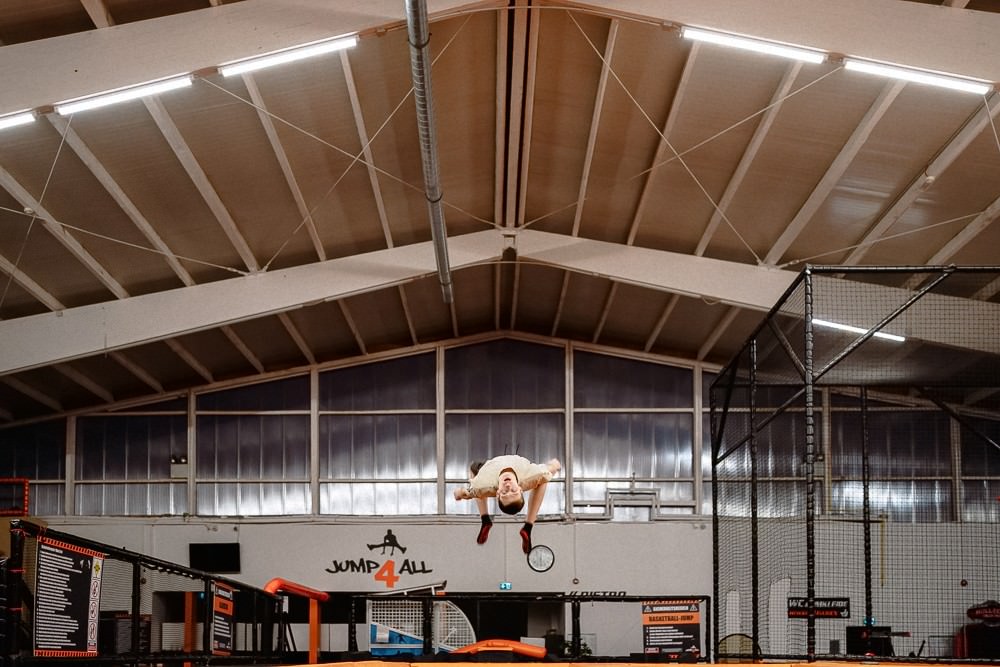
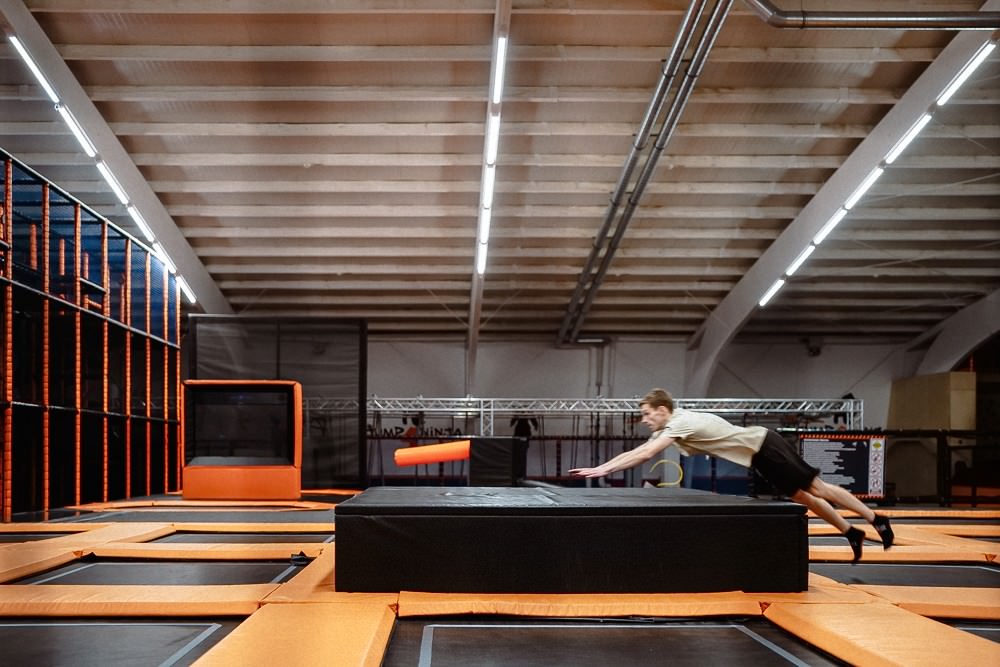
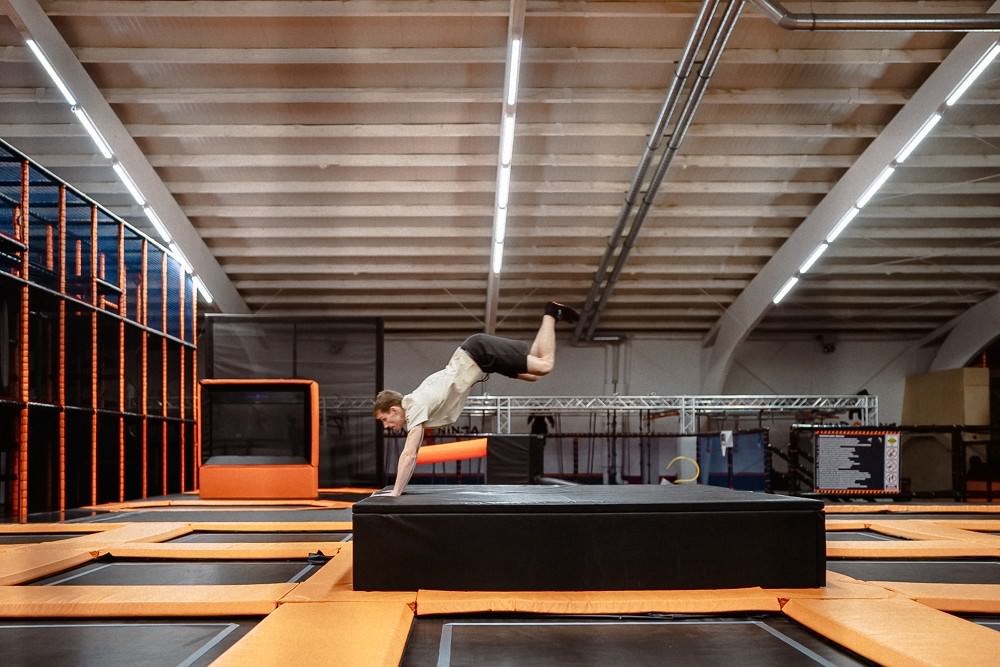
At the Jump4All hall in Ladenburg, jumping is the main activity.
Just a few backflips to warm up…
...and a little bit of stretching...
...before you start the obstacle course.
Balance is just as important...
...as agility on rolling bars.
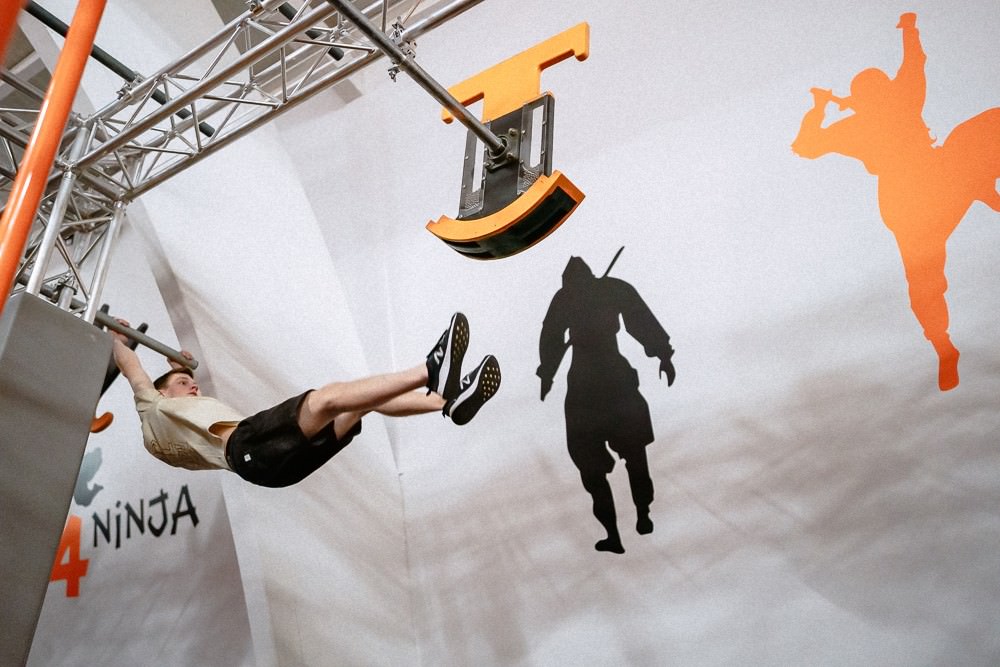
A ninja also needs strength…
… to gain momentum.
Then came the pandemic and Julian was looking for a distraction from the dull everyday life during lockdowns—and found it in the Calisthenics park in the Schloßpark area of Weinheim, some kind of outdoor gym with poles, parallel bars and hanging ladders. “I tried to get from one obstacle to the next, just like the ninja athletes in the TV show—and that was loads of fun.” When sports centres reopened after a lockdown, he looked for a possibility to continue his training on real obstacles. And he found it in the beginning of 2021 in the trampoline park Jump4All in Ladenburg, where a group of athletes trained twice a week on a ninja course back then.
It would be ideal if ninja became an Olympic discipline
Julian Lind
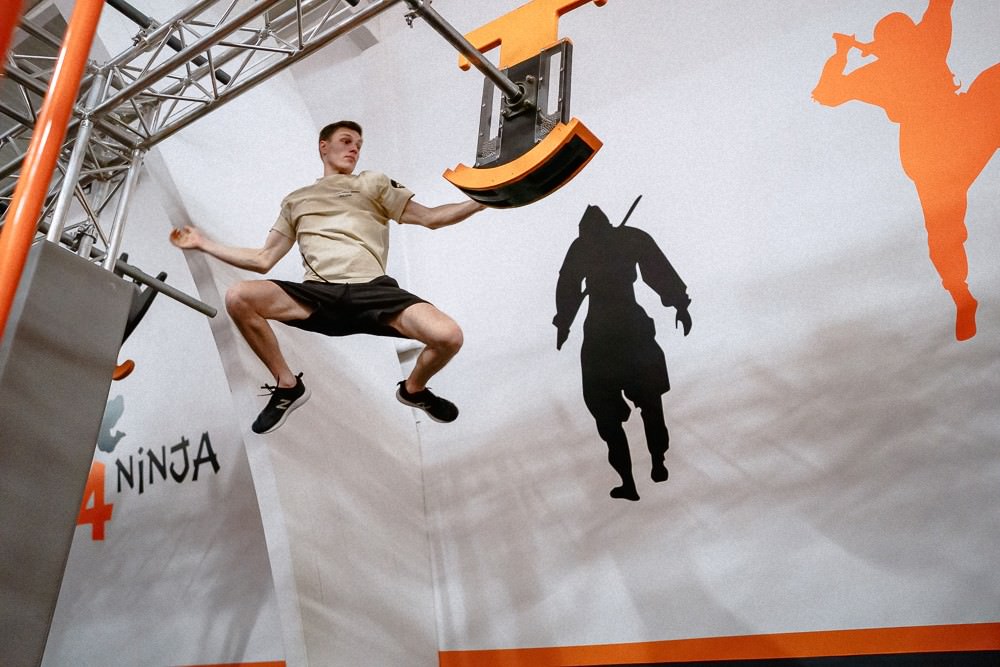
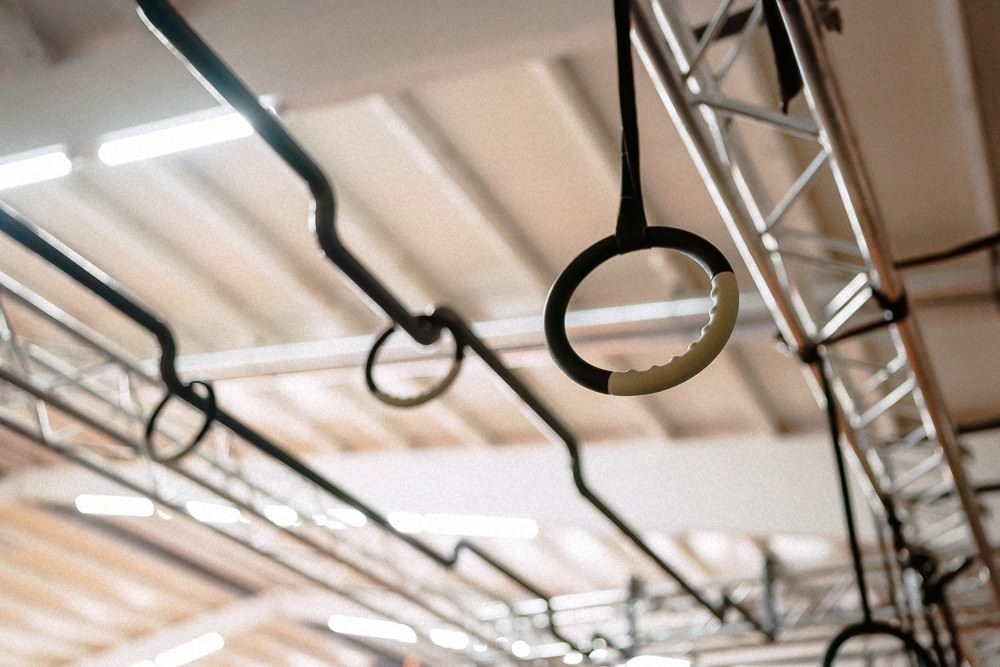
It was here that Julian balanced over rolling bars, swung on ropes and flew from ring to ring. And he realised that the movement sequences came naturally to him and that he improved quickly. “Without my dancing practice this would have taken much longer, for sure,” Julian says. Because he already had a fairly good body awareness. “I knew how to use my arms and legs and quickly had a feeling for the right rhythm for the swing turns.” As he glides through the course five years after his beginnings, he almost seems a tad big for the obstacles. With only one extra hold in between, he swings across the entire first part of the course, en passant balances over the horizontal rotating logs and effortlessly flies from one hanging rocker to another—in Tarzan-like style, flying all the way across the jungle.
This would also work with a liana—Julian swings onto a hanging rocker.
Uli Höflein from the trampoline centre team watches him with fascination. . “You can clearly see that he actually has outgrown this course,” he says laughing. The trampoline centre attracts mostly kids, youngsters and young adults and is a popular location for birthday parties. “The course on our site should not be too demanding—since nobody should get frustrated by it,” Uli explains. This is why Julian now trains in a special ninja sports centre in Weiterstadt near Darmstadt most of the time. However, to get a feel for the obstacles the course in Ladenburg is definitively sufficient, as Julian says. “What you can learn really well, here, is the basic techniques of how to overcome the diverse obstacles.” People interested in ninja sport can take their first steps—or flights—in a trampoline centre like the one in Ladenburg. Even some indoor swimming pools, for example, the Köpfel pool in Heidelberg, now sometimes build a ninja course in their pools—with soft but wet landing in case you should miss a hold. Just like in the TV show.
In an indoor pool, water replaces the mats. It’s just as much fun. Foto: Stadtwerke Heidelberg/Tobias Dittmer
“As a child, I always dreamt to participate there once,” Julian recounts. Yet, he was too young to take part in the show. In 2022, though, RTL lowered the age for participation to 16. Julian, 17 at that time, applied at once. A few weeks later he stood in front of the camera himself and demonstrated that in ninja sports, teenagers can indeed keep up with adults. With the growing success of the TV show, the number of people actively pursuing the sport in Germany also increased. Since 2025, there has been a national league for ninja where athletes compete on three levels of performance—there are 150 altogether. The ninja national league was established in 2025, with athletes competing on three performance levels – 150 in total. “There are, however, much more requests than places available,” co-founder Steffen Moritz explains. A good 1,000 to 2,000 ninjas train in Germany, amongst them are many newcomers having switched from climbing or gymnastics. To open the national league for more athletes, the sport would need even better conditions. “We need more referees, a high-quality training for coaches and targeted youth development,” Moritz enumerates.
A ninja should be able to hold on to even the smallest handles.
Because if you want to become really good at ninja sports, it does not suffice to complete a course a few times a week. “Endurance and targeted strength training are equally important,” Julian explains. While ninjas train on the course and share advice amongst each other, Julian, like many other top athletes, sought professional help for strength training. “My coach originally was a climber and knows exactly what muscles I have to train for which obstacles.” From biceps to fingertips. When Julian prepares for the show, he trains six times a week—this is a lot of time that the trained automotive mechatronic invests alongside his office job at his family’s car dealership. And this time is consequentially lacking for his dancing practice. “I miss dancing a lot. Yet I want to fully concentrate on ninja.”
‘Full Send’ is the name of Julian’s team competing in the national league for ninja sport in 2025.
Julian has also already taken part in European championships. He loves the atmosphere at international tournaments. “The courses are often noticeably more refined at championships and in the national league.” The prize money for wins in the league, though, is still quite modest. “The sport still needs some big sponsors—although it attracts quite a number of spectators.” There is hardly a ninja athlete who could make his or her living from the sport. “This would actually not be my goal at all,” Julian says. But he wishes for the sport to continue growing and to become even more professional and popular. “For this to come true it would be ideal if ninja became an Olympic discipline.” This wish is not entirely unrealistic at all. In modern pentathlon, an obstacle course has now replaced the much-criticised show jumping. And after all, this discipline is quite similar to ninja sport.
Tips for excursions and interesting stories about the Rhine-Neckar region can be found regularly in our newsletter.
And this is how it works: Enter your email address in the field and click subscribe. You will then receive an automatically generated message at the email address you entered, which you only need to confirm. Done!