In Schweigen-Rechtenbach on the Franco-German border, Gudrun Zoller turned a former school garden into a sculpture garden. This is where she invites artists from the Palatinate, Baden and the Alsace to show their works of art in the midst of old trees, in enchanted corners and multi-coloured flower beds.
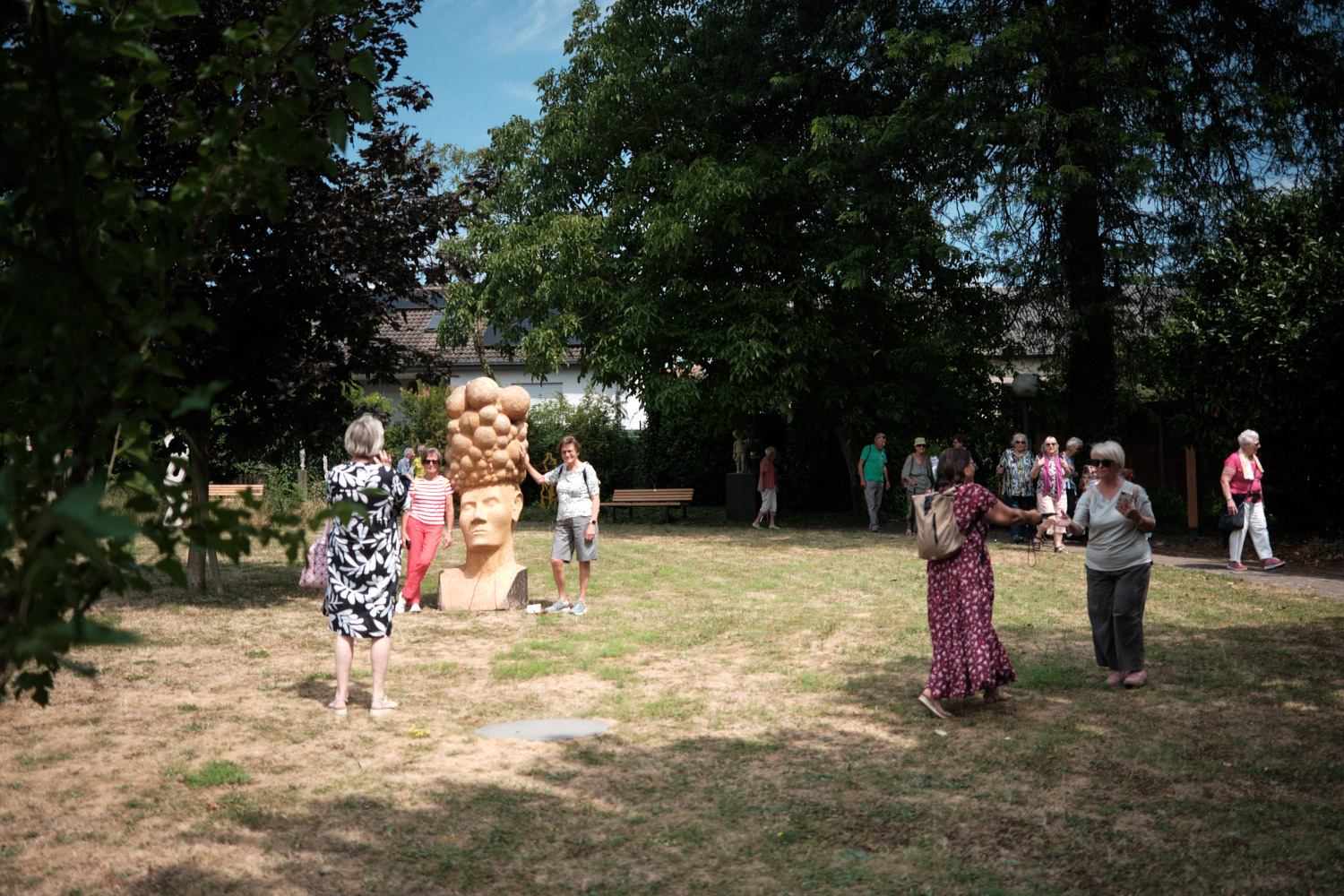
Gudrun Zoller is excited. She stands in the front garden of her old house, in the middle of wild roses and lavender and looks curiously at the neighbouring plot. “A really large group of women has just arrived,” she rejoices. And indeed, about 20 visitors, chatting cheerfully, many dressed in colourful summer dresses and wearing sunhats come flocking onto the premises next door. They all have come to contemplate the pieces of art that have been placed or hung up there in flower beds, between shrubs and old trees. “This is when I would normally go over and mingle with the visitors and tell them about the artworks and listen to how these come across to the individual visitor,” Gudrun explains.
Visitors in the midst of artworks, flowers, trees, bushes and shrubs.
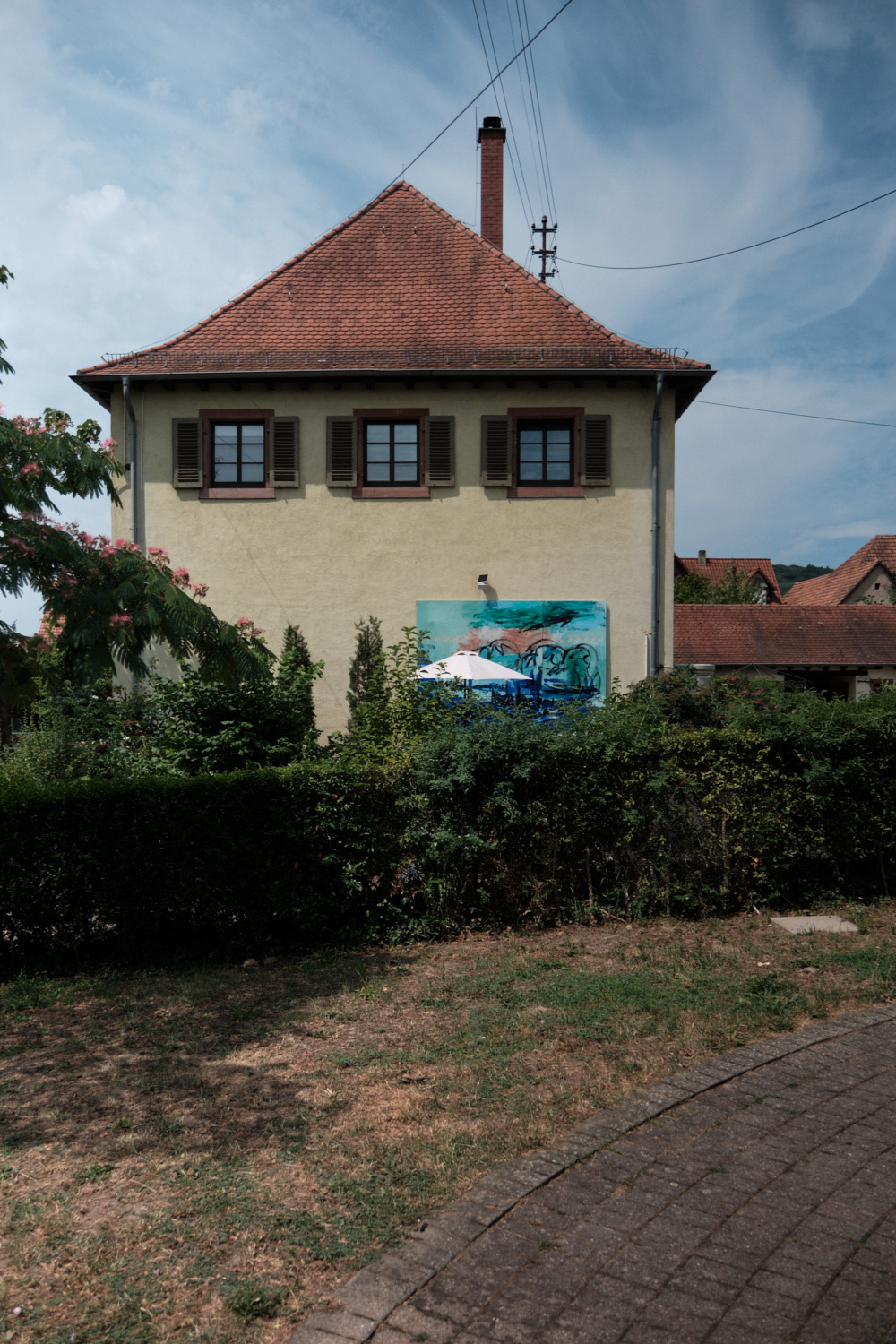
While she speaks, her blue eyes shine just as bright as the intensely blue gigantic artwork at the wall of her house. This is one of Gabi Streile’s pieces of art that are on display in the sculpture garden for a couple of weeks, while other artworks can be discovered here permanently. Her home’s name “Altes Schulhaus”—the Old Schoolhouse—is a dead giveaway: Gudrun’s house is no ordinary dwelling place but used to be the school of the town of Schweigen-Rechtenbach on the Franco-German border.
Nice view: artwork in the sculpture garden with the old schoolhouse in the background.
The building erected in 1894 is within a stone’s throw of the German Wine Gate on the main street of the town. When at the end of the 1970s the number of pupils continued to decline continuously in the town with 1500 inhabitants, it ceased operations as a school in Schweigen-Rechtenbach. After the schoolhouse had been used for different kinds of purposes several times—for instance, by the local choir—the imposing estate owned by the municipality became private property. In 2010, Gudrun came across a real estate advertisement on the internet that offered the house for sale. She immediately went to her car and drove there to get an impression of it. “It took less than a week until everything was signed and sealed,” she remembers. She moved from Stundwiller in the Alsace, where she had been living for 20 years, across the border to Schweigen-Rechtenbach and awakened the estate from its deep slumber.
The old schoolhouse in Schweigen-Rechtenbach.
Gudrun Zoller turned the garden of the house…
… into a sculpture garden.
Here, the works of art are placed in the midst of trees and flowers…
…and invite visitors to interact with them.
The exchange of ideas about art is especially important for Gudrun.
Part of this was a complete renovation in which Gudrun actively participated herself, for instance, by removing the old tiles. It became immediately apparent to the former art teacher and enthusiastic collector that the large and bright classrooms with their high ceilings offered not only the perfect arrangements for living but also for exhibitions, creative exchange and workshops. In short—for everything close to Gudrun’s heart.
Usually, I already have a concrete corner of the garden in mind. And up until today, I’ve been successful in getting them enthusiastic about it.
Gudrun Zoller
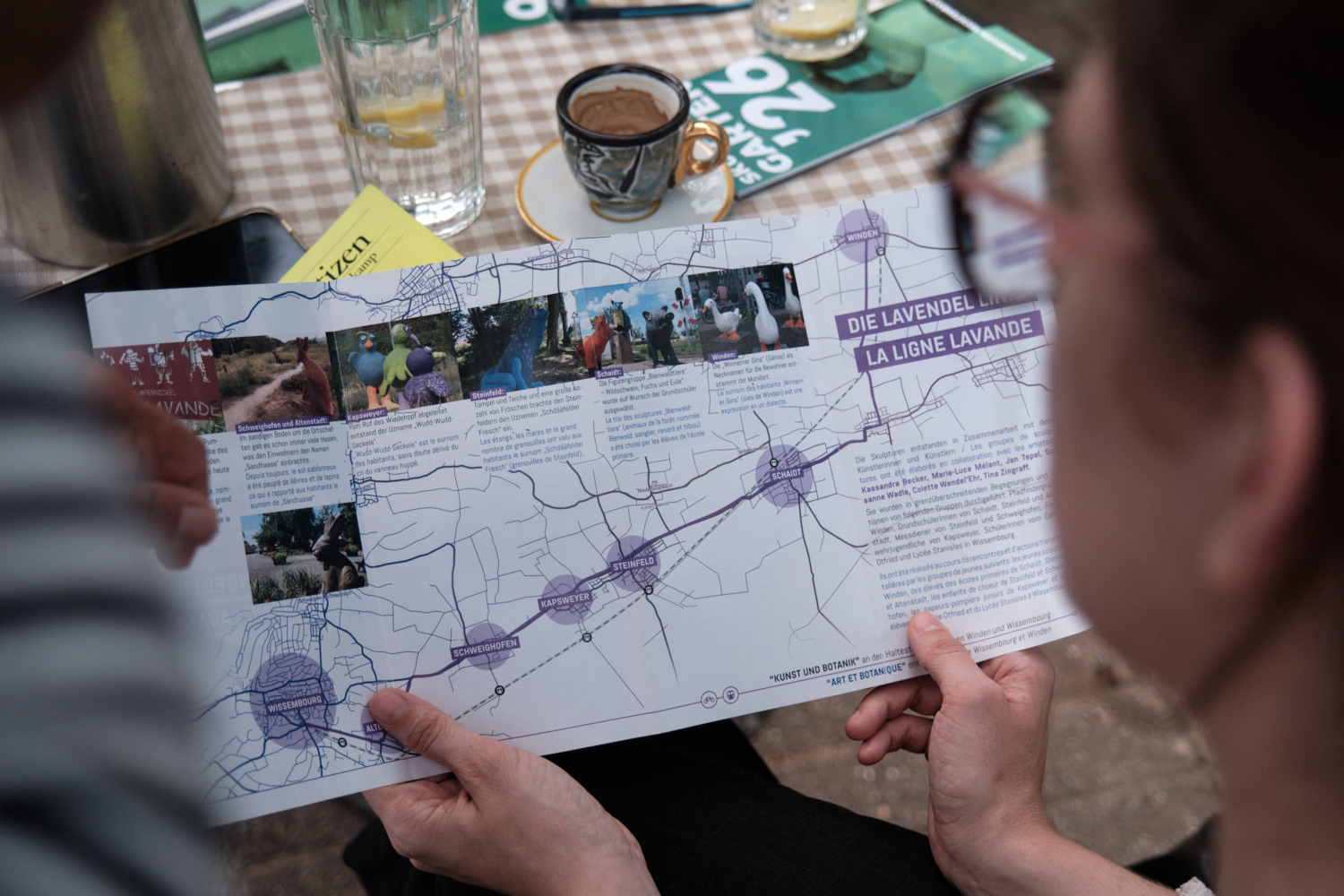
At what point her love for art began is something she cannot pinpoint. Somehow it had always been there. Born in Berlin in 1941 and raised in Stuttgart, she had been working as an English and art teacher before she changed to the Ministry of Education and the Arts in Stuttgart. There, as the representative of school arts she discovered her passion for giving others an understanding of art. Since then, projects with children and teenagers have continuously run through her life, whether by refurbishing the playground behind her house or the “Lavender Line”, where train stations along the historical Palatinate Maximiliansbahn train line have been artistically decorated and planted with lavender. She modelled animal sculptures with different youth groups in cross-border projects, while the outdoor areas of the train stations between Wissembourg and Winden were refurbished.
Lavender and art—the train stations along the historical Palatinate Maximiliansbahn train are well worth a visit.
Furthermore, artworks by the primary school pupils of the neighbouring town Dörrenbach are on display in the park each year, which is the town where the children of Schweigen-Rechtenbach now go to school. Jellyfish and bees made from cans as well as snakes made from crown caps are the results of a school upcycling project. “Important to me is that kids, too, already feel a connection to the park. This way, everyone takes care of it,” Gudrun states her conviction. The project is financed by sponsors, the association for the promotion of art and culture on the southern wine route (Verein zur Förderung von Kunst und Kultur an der Südlichen Weinstraße) and the Josef David Foundation.
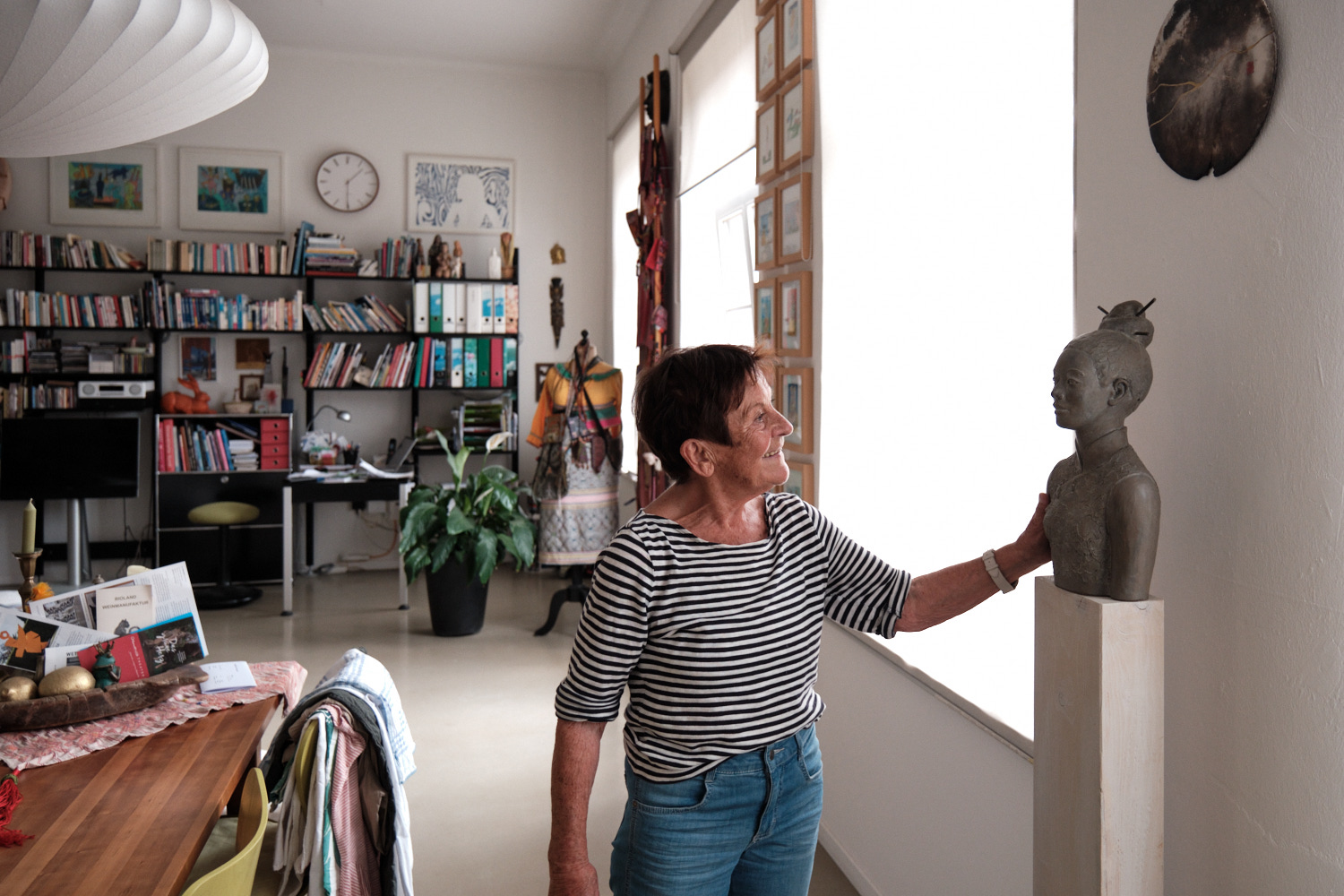
Gudrun Zoller in her house—she has always had a special connection with art.
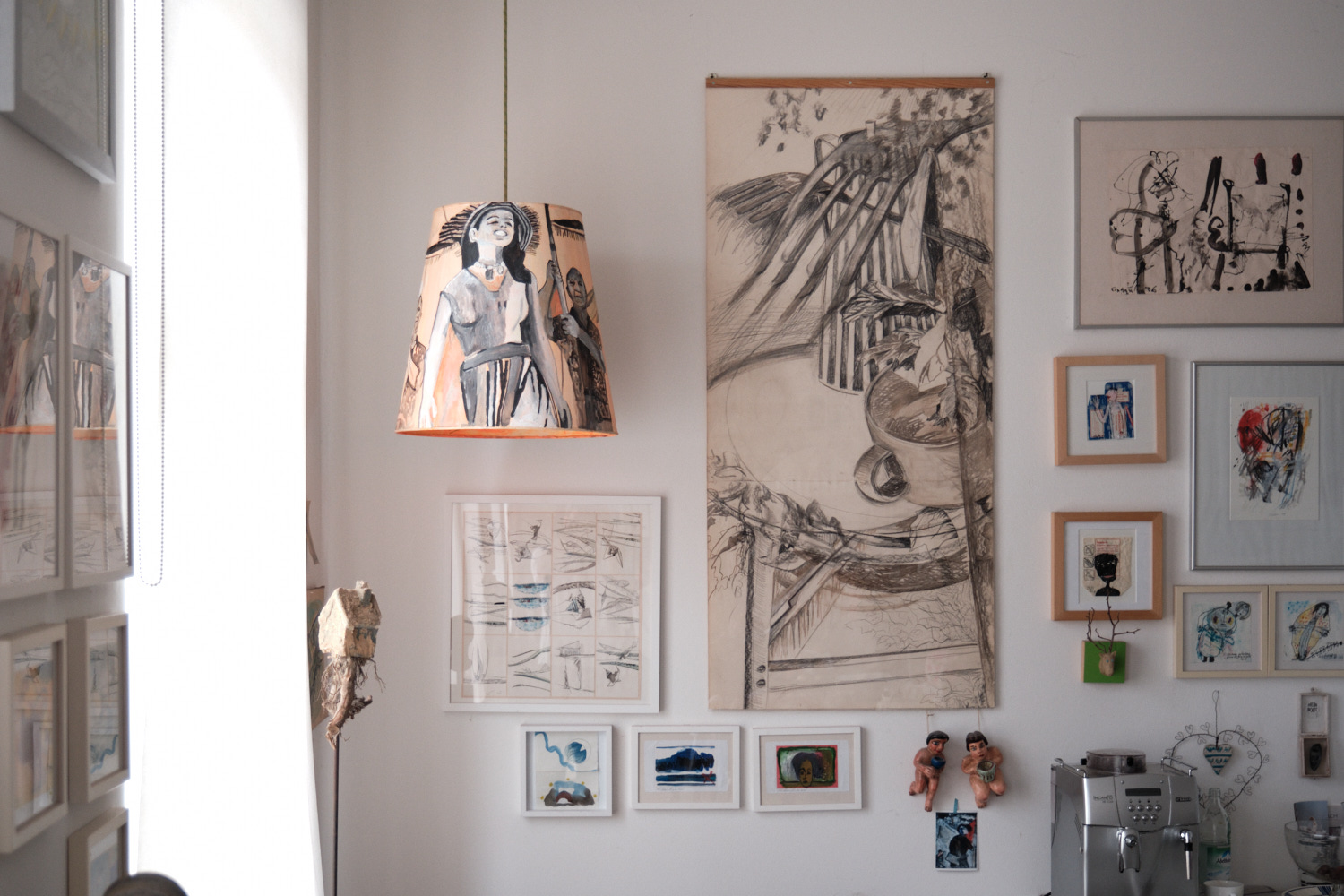
Both inside and out, you don’t have to search long for art at the old schoolhouse. In the converted classrooms where Gudrun has arranged a rental apartment, a holiday flat as well as her own apartment, it’s hard to know where to look first. Pieces of art of regional and trans-regional artists, design objects and special souvenirs from far-away countries have been brought together here. Many of them are personal mementoes of her own travels. Because Gudrun is drawn to far-away countries, that is. Right after her retirement in 2004 she travelled around the world. On her own. With small trolley bags. Through South America. Through Southeast Asia. Meanwhile, now in her 80s, she prefers to travel in groups. South Africa and Oman were her last destinations. Her next one is supposed to be Japan, soon.
The old schoolhouse is full of artworks and souvenirs from her travels.
Despite the abundance of all the things that can be discovered here, the park is not haphazard—everything appears to be equilibrated, clear and stylish. Gudrun has a sense of spaces; this is also for the benefit of her work with the sculpture garden. “It is important to me to visit the artists in their ateliers first,” Gudrun explains. She already travelled to the most remote corners of the so-called PAMINA region, the Franco-German European region for the cooperation between the Southern Palatinate, Baden and the Alsace. This is traditionally followed by a return visit: The artists come to Schweigen-Rechtenbach to inspect the location. “Usually, I already have a concrete corner of the garden in mind. And up until today, I’ve been successful in getting them enthusiastic about it.”
Grudrun chooses the places for the pieces of art in her sculpture garden carefully.
Besides the art room in the schoolhouse that she ran until 2020, Gudrun had yet another idea. And this involved the former school garden. During her time as deputy director of the State Academy of Teacher Training in Bad Rotenfels she had already initiated a sculpture garden there, including summer academies for regional artists. With regard to her new home, she wanted to realise a similar concept. Thus, without further ado, the art enthusiast made this a precondition for the municipality to repurchase the school garden.
Due to Gudrun’s concept, the school garden is a lively place today.
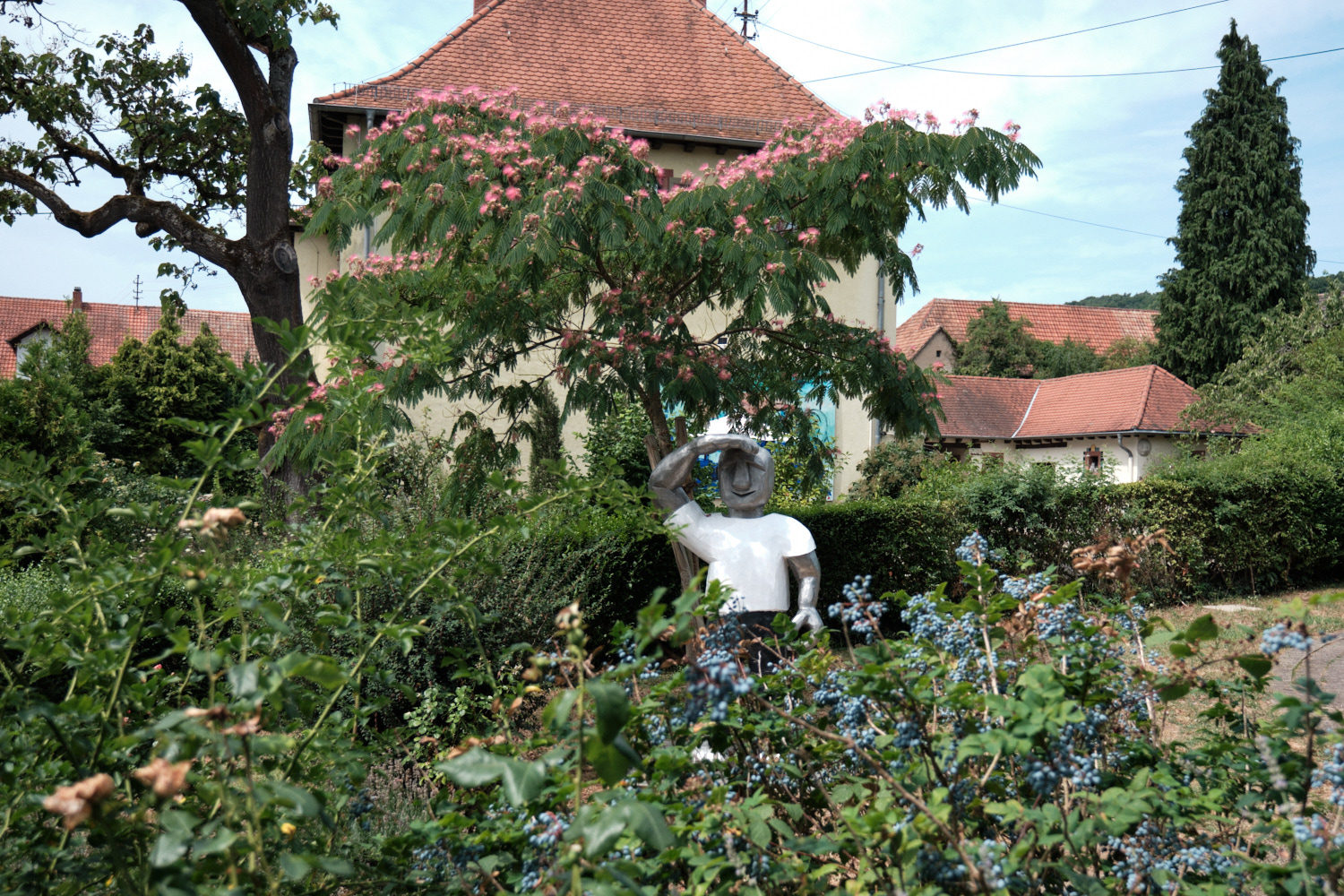
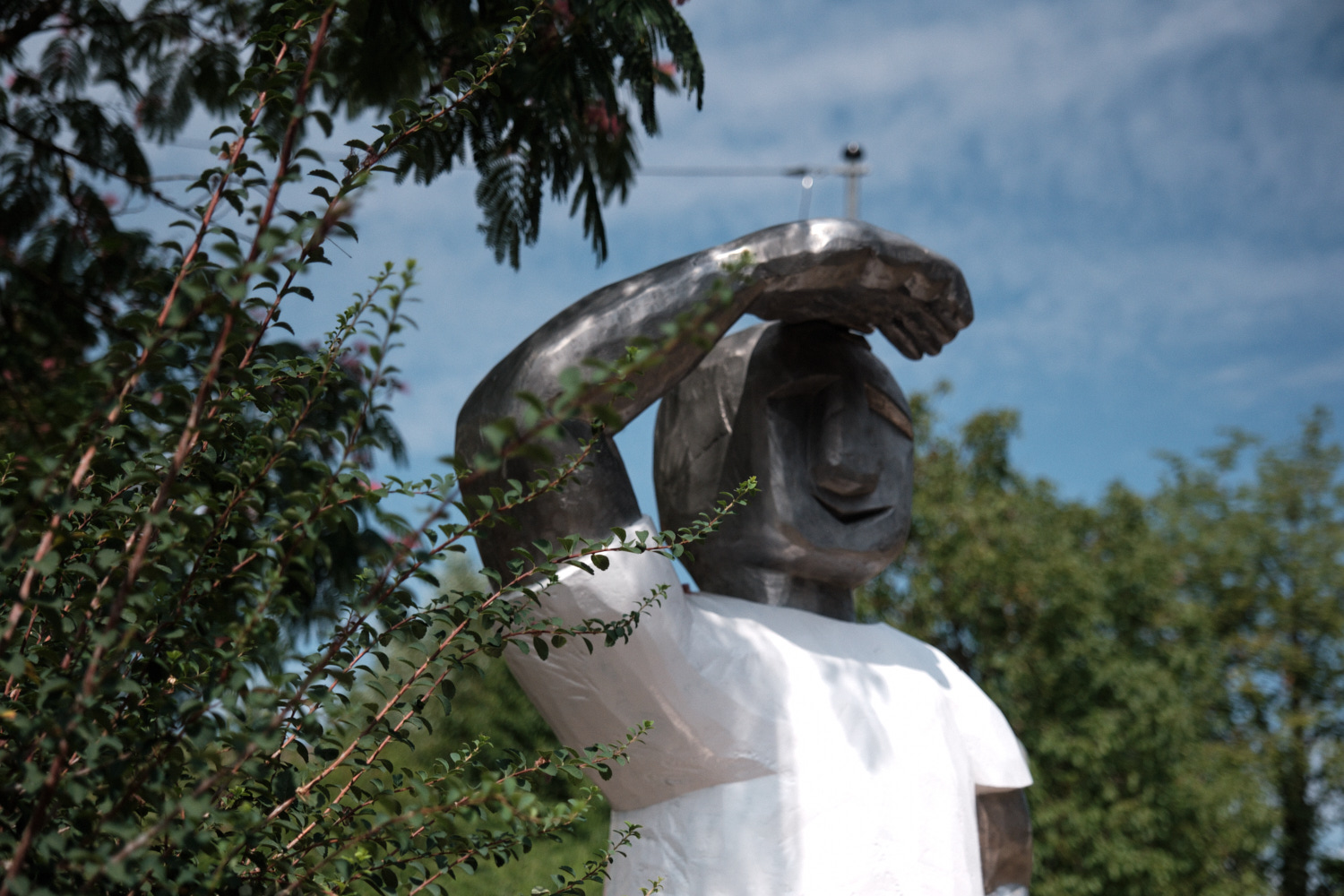
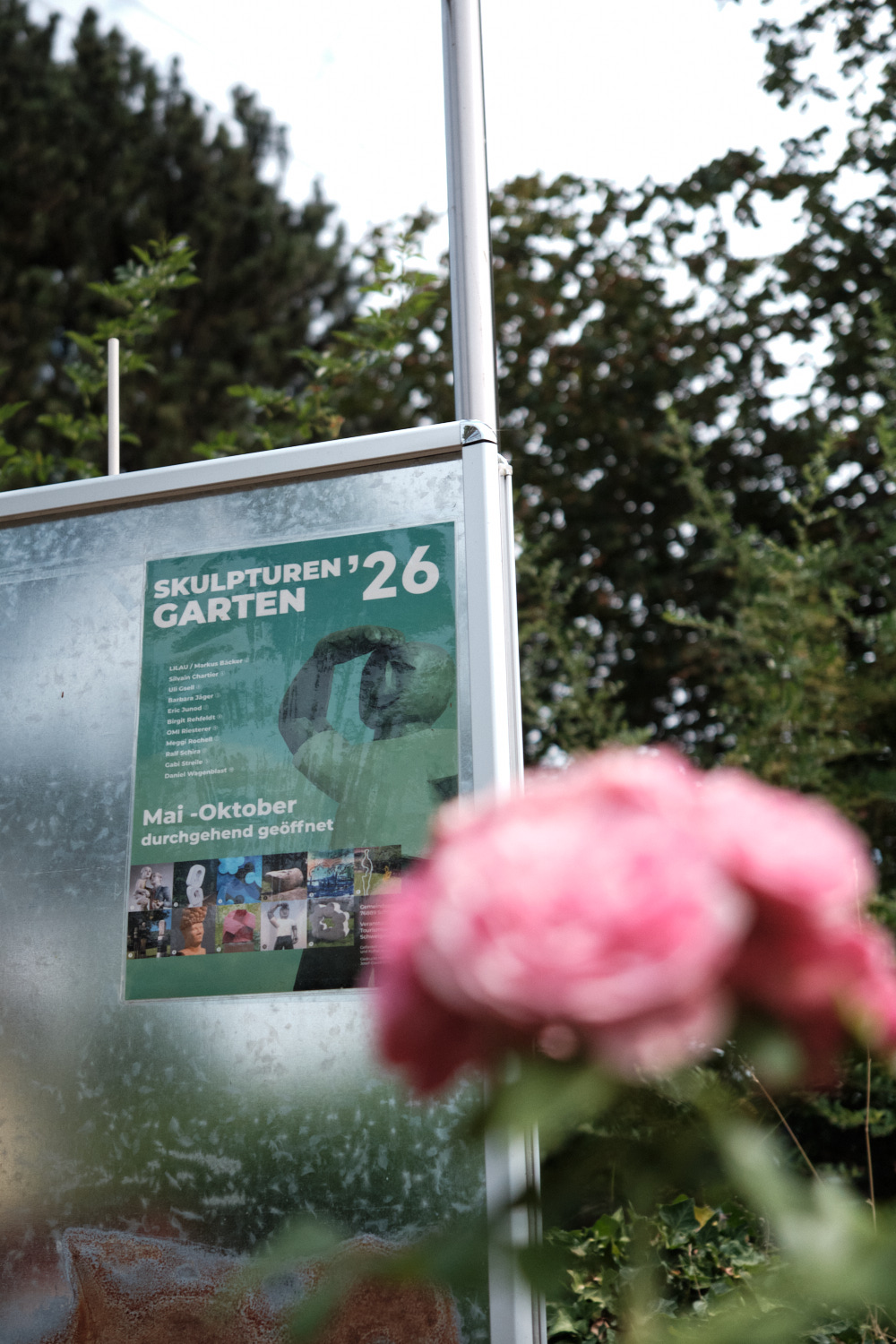
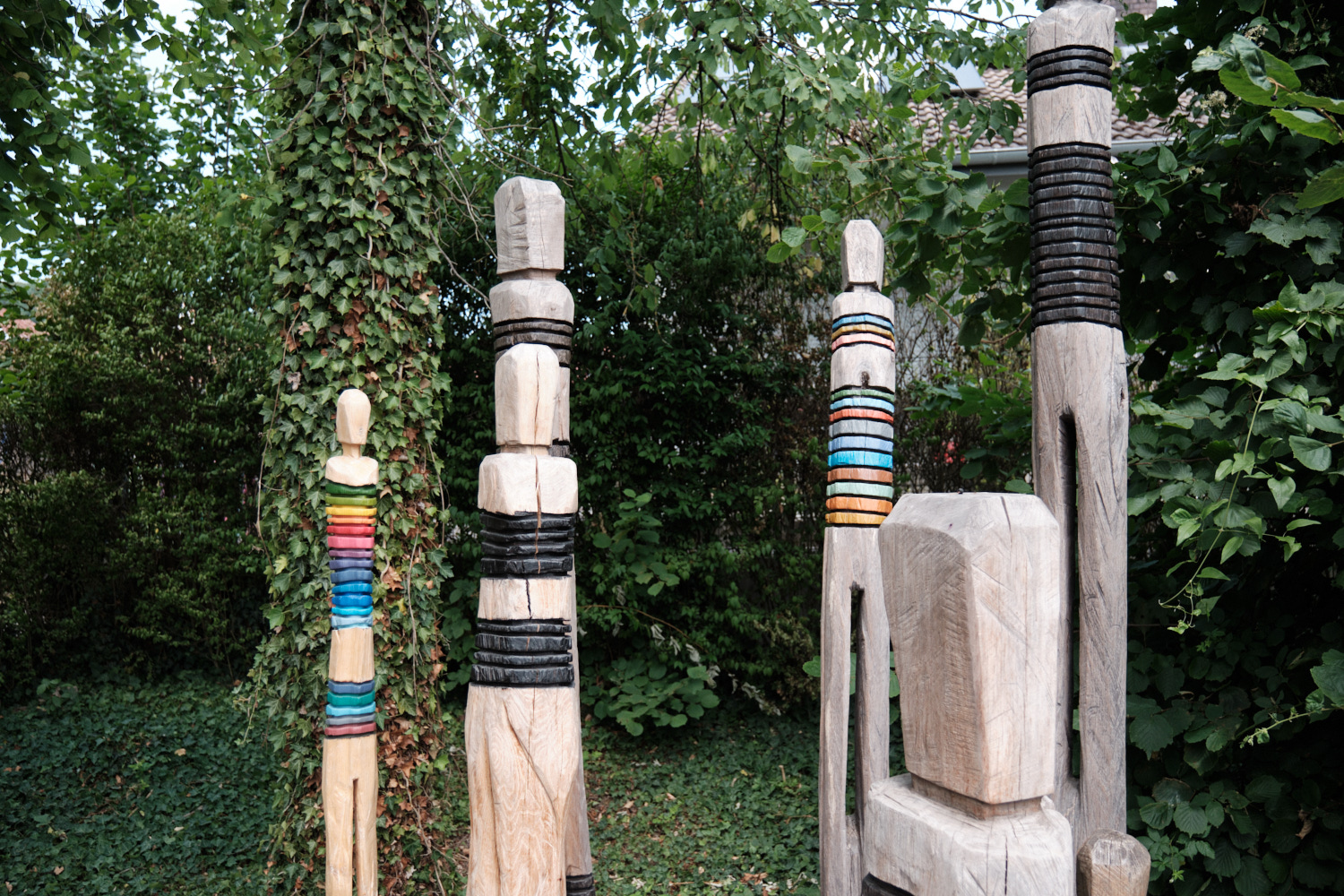
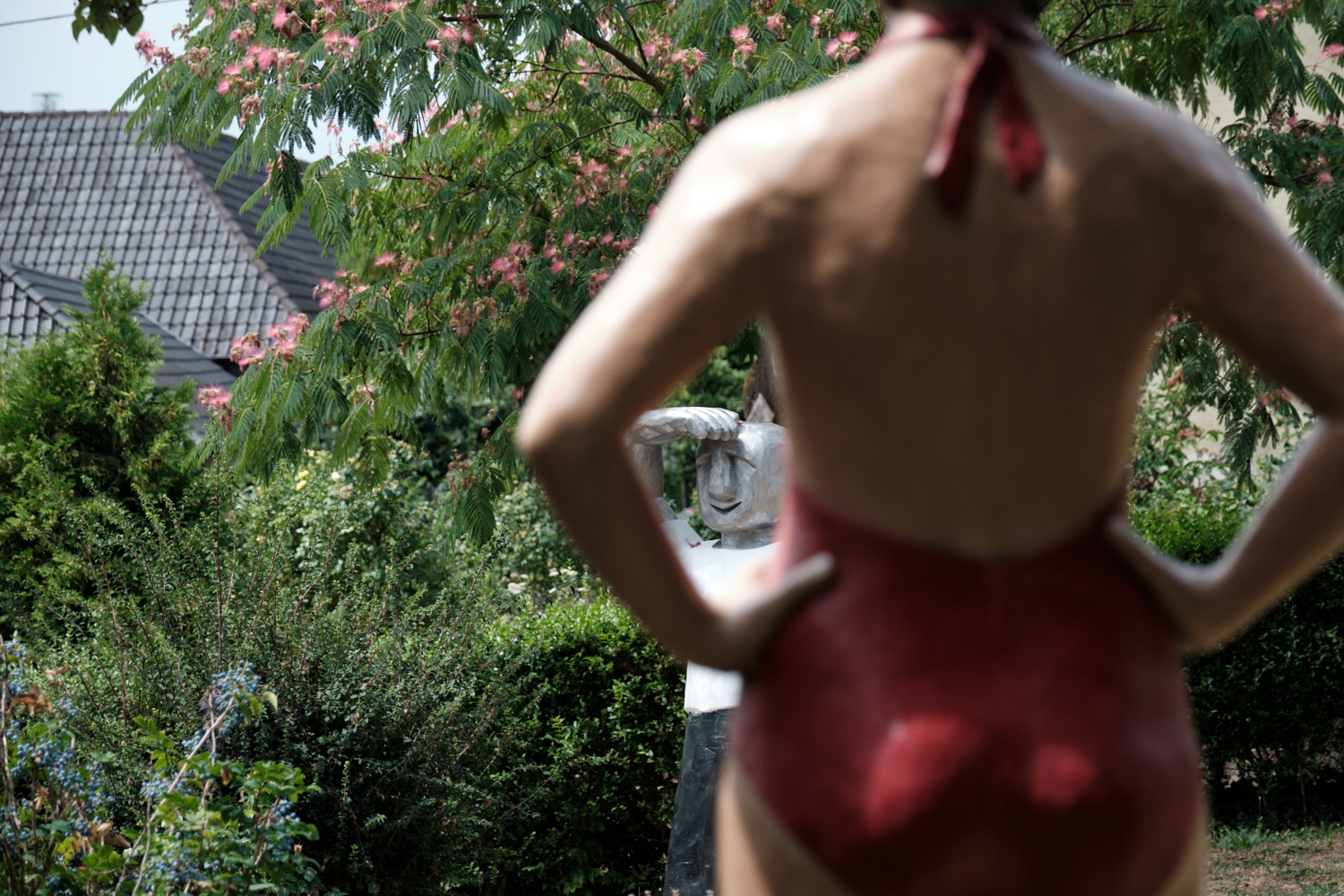
Since 2012, it has now been changed into an open-air gallery between May and October, displaying large-scale sculptures by artists from the Palatinate, Baden and the Alsace. Selecting the art works, Gudrun places importance on ensuring that, in addition to the regions, the pieces of art cover a variety of materials: wood, stone, ceramics and steel are among the materials used. Furthermore, a certain size and monumentality are also important to her, so that they don’t seem lost in the scenery—many of the exhibits actually tower over the exhibition organiser. However, she measures up to the task for sure. She is definitively on top of things and has some very clear criteria: the ratio of female and male artists should be more or less equal. “Figurative representations make it easier for most visitors to connect with art. This is important to me,” Gudrun explains. A current example in 2026 is the “man” that greets visitors at the entrance of the park with a Buddha-like smile, dressed casually in a T-shirt and black trousers. The friendly-looking sculpture made from aluminium with its oversized hands and feet was crafted by the artist Daniel Wagenblast.
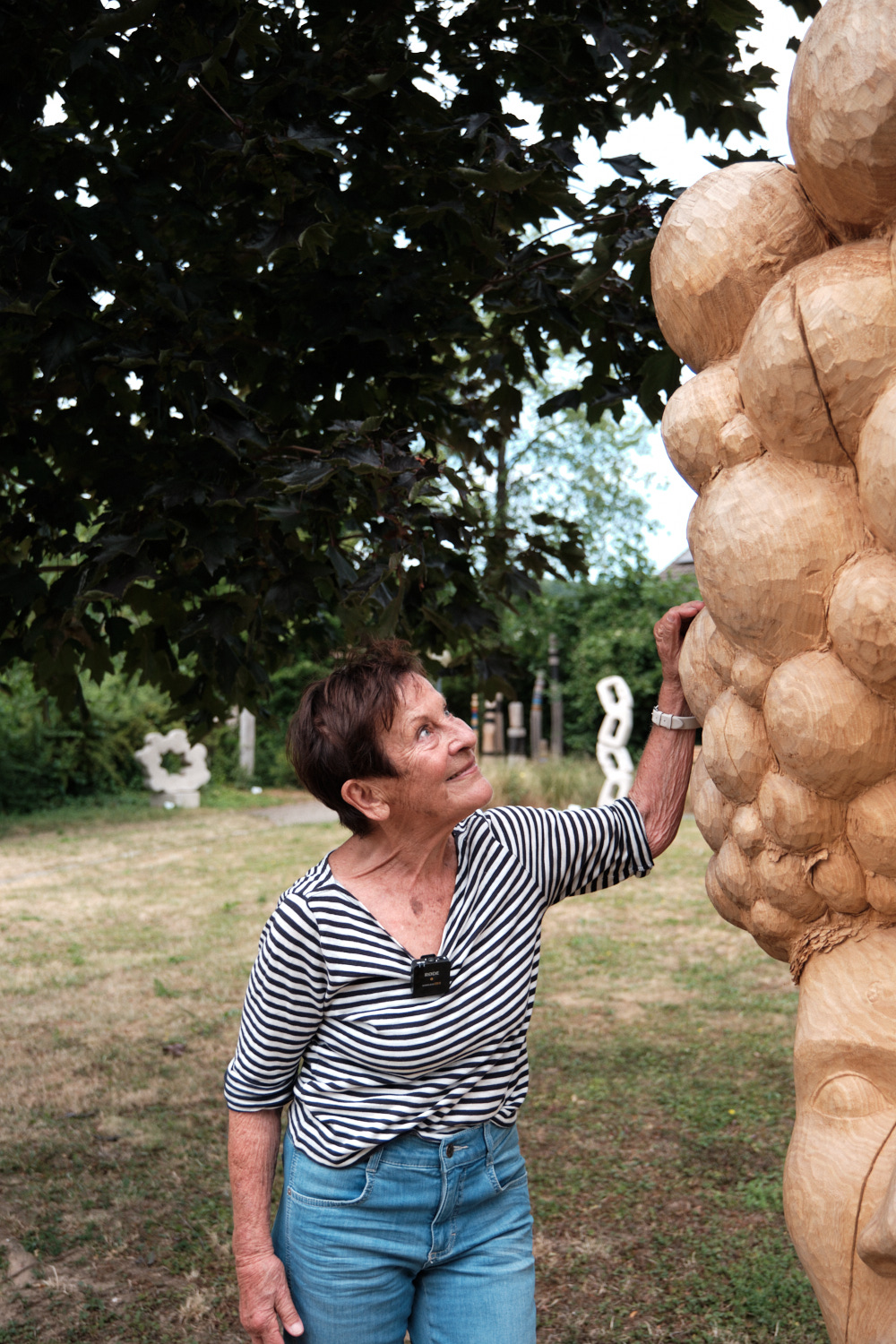
Right in the middle of the meadow, at the centre of the park you can find a special highlight: “Illusions” is the title of the larger-than-life wooden bust with striking headdress, created by the Ostfildern-based artist Birgit Rehfeldt. Wood from a princess tree that was cut down as part of the Stuttgart 21 project served as the material for this piece of art. And those who take a close look perceive—an old princess tree in the front garden of the schoolhouse within the range of vision of the statue. Because there are visual and thematic connections not only between the pieces of art, but the artworks also engage in dialogue with the garden.
Gudrun Zoller with “Illusions”—created by the Ostfildern-based artist Birgit Rehfeldt.
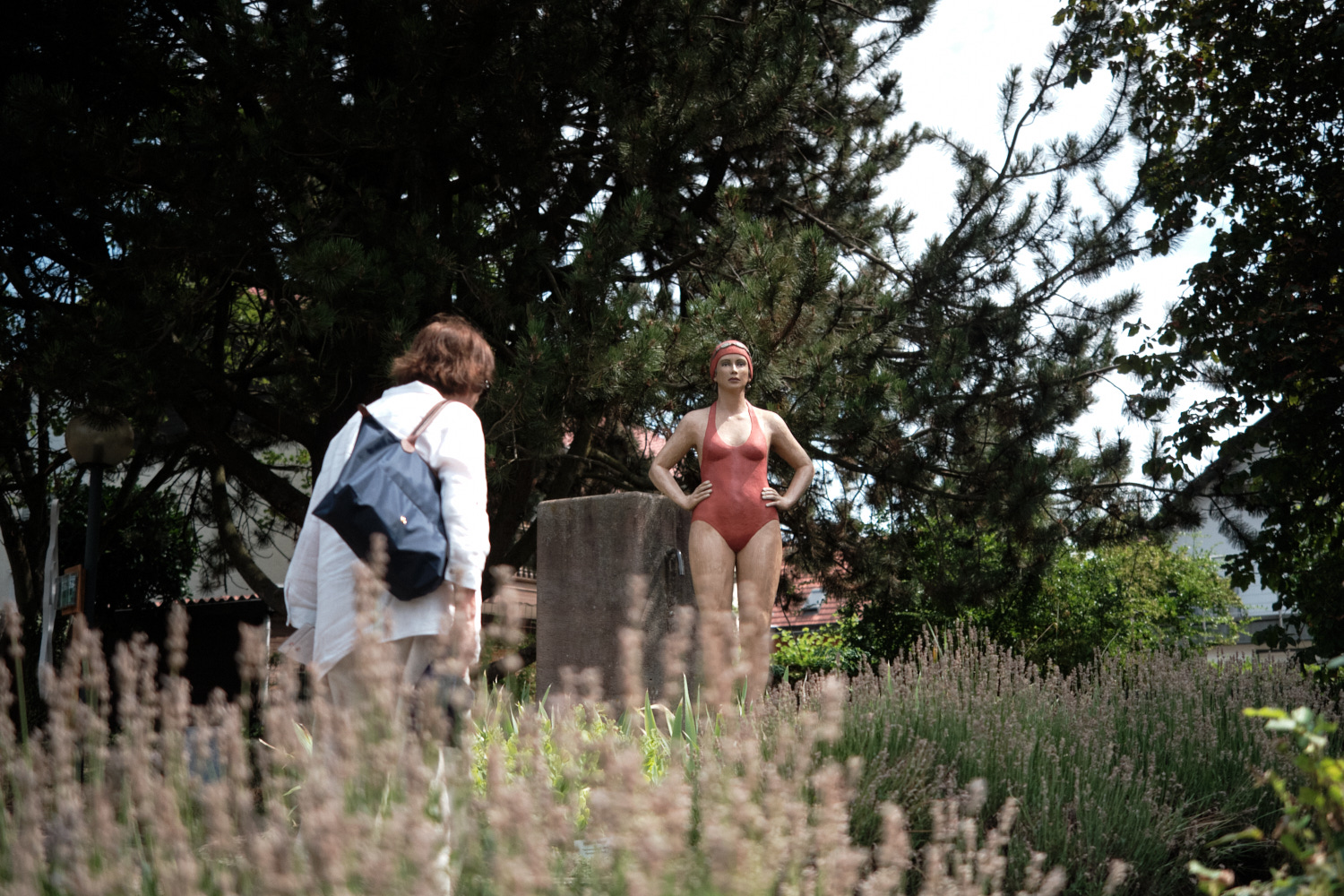
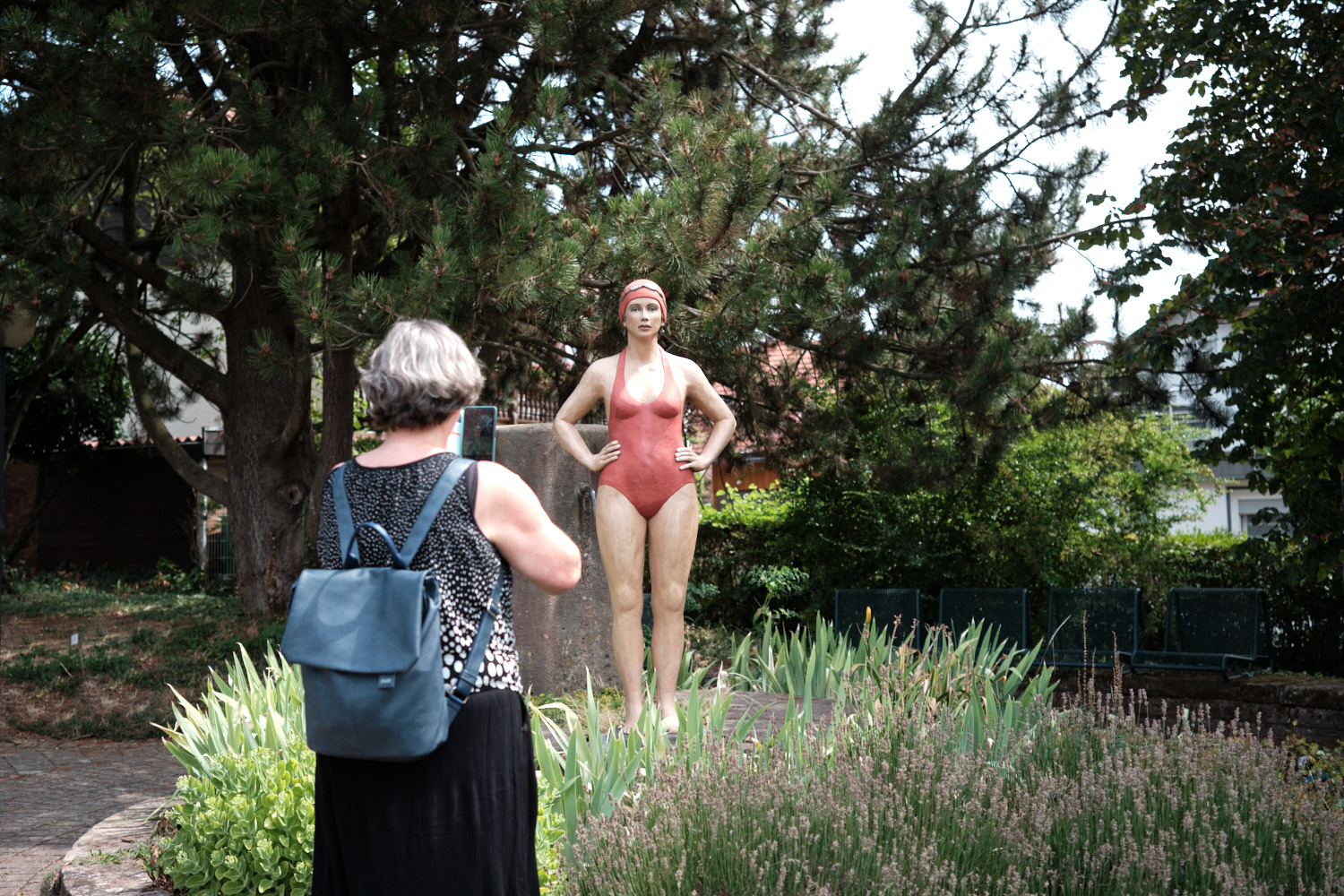
Outside of the tourist season, visitors can find several permanent sculptures, in addition to a memorial to those who fell in World War II. Amongst them is a woman in a red bathing suit made by the Palatinate artist Gabriele Köbler. Positioned close to the entrance of the park, she oversees the entire area. Not only the local mayor fell in love with the elegant lady, as Gudrun reports. “We had visitors coming here, wearing red bathing suits or red swim trunks who took pictures of themselves posing next to her,” she says and laughs, looking over to her lightly dressed neighbour. Gudrun, by the way, planted the flower bed she is positioned in together with a friend— with her own hands. How could it be any other way…
Tips for excursions and interesting stories about the Rhine-Neckar region can be found regularly in our newsletter.
And this is how it works: Enter your email address in the field and click subscribe. You will then receive an automatically generated message at the email address you entered, which you only need to confirm. Done!