Touching the shape of the castle, exploring the town with your ears or strolling through a park in a wheelchair—you can do all this in Annweiler am Trifels. This small, historic town in the Southern Palatinate is one of the pioneers of accessible tourism. Come along and explore it with all your senses.
The keep of Trifels Castle rises in pristine black against the blue autumnal sky. There is no sign yet of worn towers and shiny gold spots. But if the tactile model at the entrance to the old town in Annweiler am Trifels lives up to expectations, that will soon change.
Mit dem Laden des Videos akzeptieren Sie die Datenschutzerklärung von YouTube. Mehr erfahren
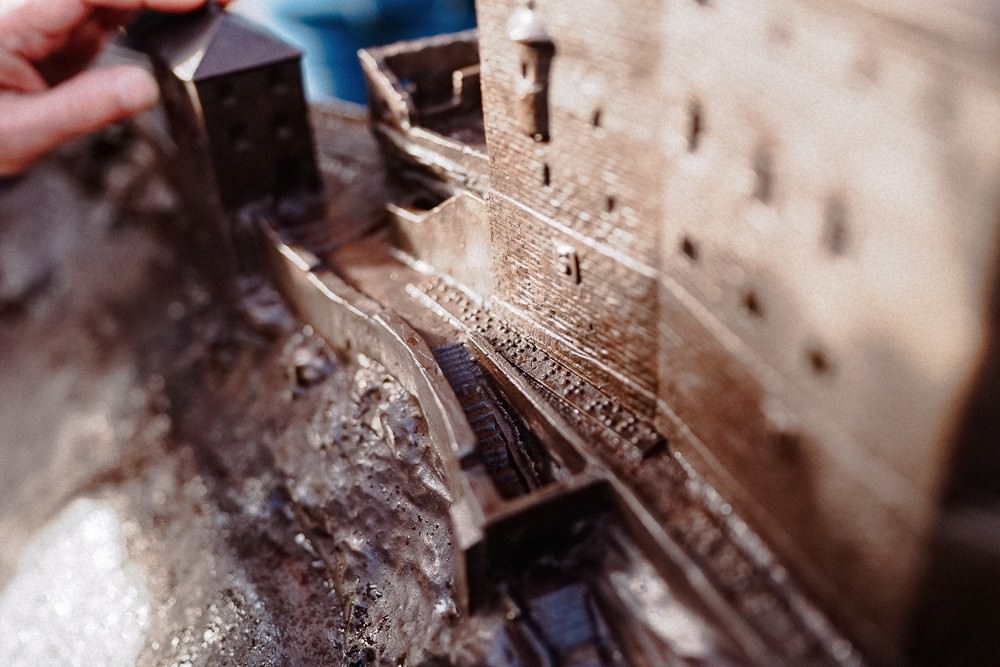
A castle you can touch—a model of Trifels Castle with inscriptions in Braille.
Ralf Augspurger lets his fingers glide cautiously but determinedly along the curtain wall. “Where do you enter the castle complex?” he asks his companion. The latter takes his hand and guides it first under the bridge to the fountain tower, then to the lower and finally to the upper castle gates. From there, Ralf continues on his way, pausing at the jagged rocks, then at the inscriptions in Braille embedded in the model, which identify the individual parts of the castle. “I didn’t realise it was this big,” he says. “I had been to the castle before, but I imagined it to be more of a ruin.”
Ralf Augspurger feels the dimensions of the castle with his hand for the first time.
On this sunny autumn day, Ralf has come to Annweiler to test some of the town’s accessible facilities. The state of Rhineland-Palatinate designated the Southern Wine Route as a model region for accessible tourism in 2015. Since then, a number of fully-accessible offerings have been added throughout the region. Christian Bohr, project manager for accessible tourism on the Southern Wine Route, believes that there are already quite a few good options for people with walking disabilities—ranging “from wine to hiking to huts”. For other types of impairment, offerings are gradually being added. Such as the tactile model of Trifels Castle.
The tactile model of Trifels Castle…
… gives both visually impaired and sighted people an impression of the castle.
An audio guide tells even more exciting stories about Annweiler.
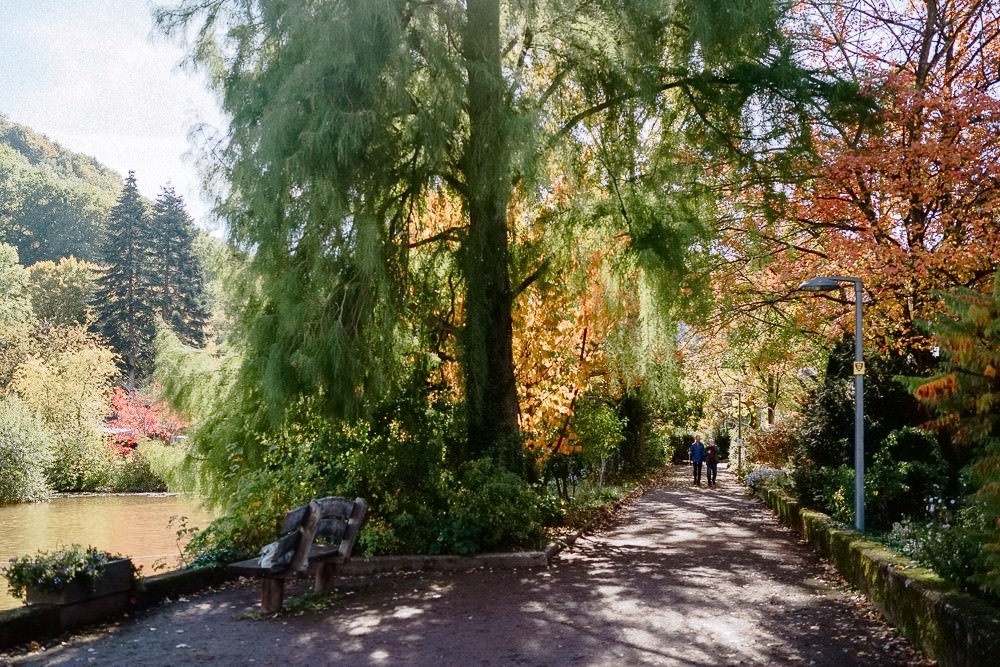
The Markward park glows in autumnal colours.
It is considered partially accessible…
… for people with visual impairments.
People with walking disabilities can stroll here without any problems.
This model was made possible as part of the Burgen am Oberrhein (castles on the Upper Rhine) project, which is part of the Interreg programme. And so were models of Landeck Castle and Madenburg Castle. Ralf is impressed. The wiry man wears his grey hair in a ponytail. His feet are clad in hiking boots. He holds a white cane in his hand. “I was born without an iris,” he says. He has been blind since the age of 40.
I hear that there is a wall here. I notice when I am approaching a tree. I feel the sun, notice where the wind is coming from.
Ralf Augspurger
. Until now, he could only imagine the triple-split rock that gave Trifels Castle its name, the majestic dimensions of the tower and great hall, and the layout of the gates and paths. And even though he prefers to explore his surroundings on foot, the tactile model is a welcome addition for him. “I like the fact that it really only depicts the castle, rather than the whole town or the topography of the region.” He finds other tactile models confusing. The one in Annweiler has actually given him a new perspective on the castle.
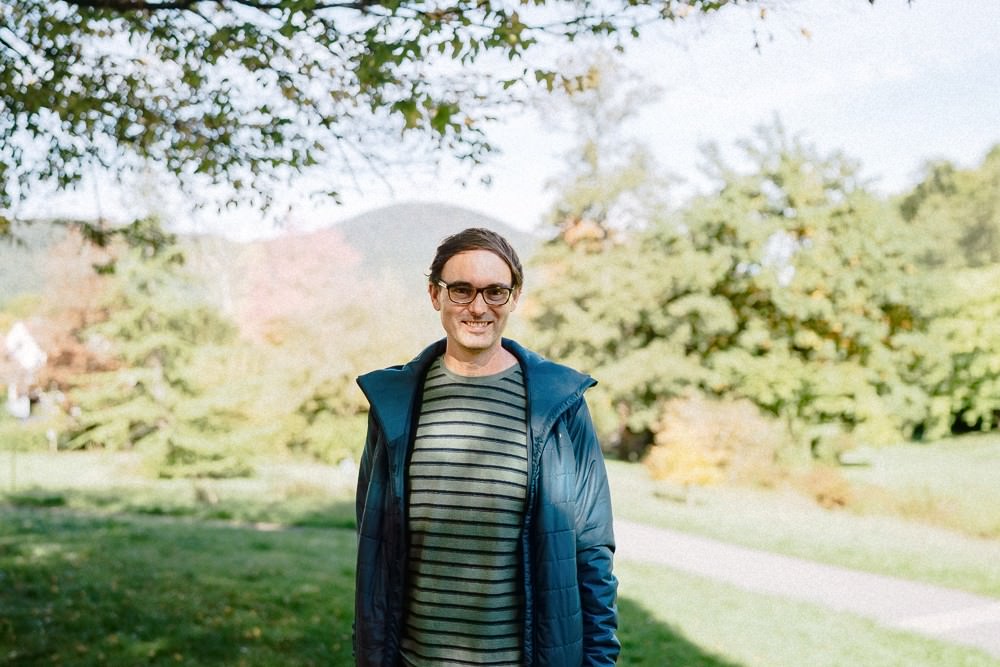
Christian Bohr, project manager for accessible tourism on the Southern Wine Route, wants to create many more accessible offers in the region.
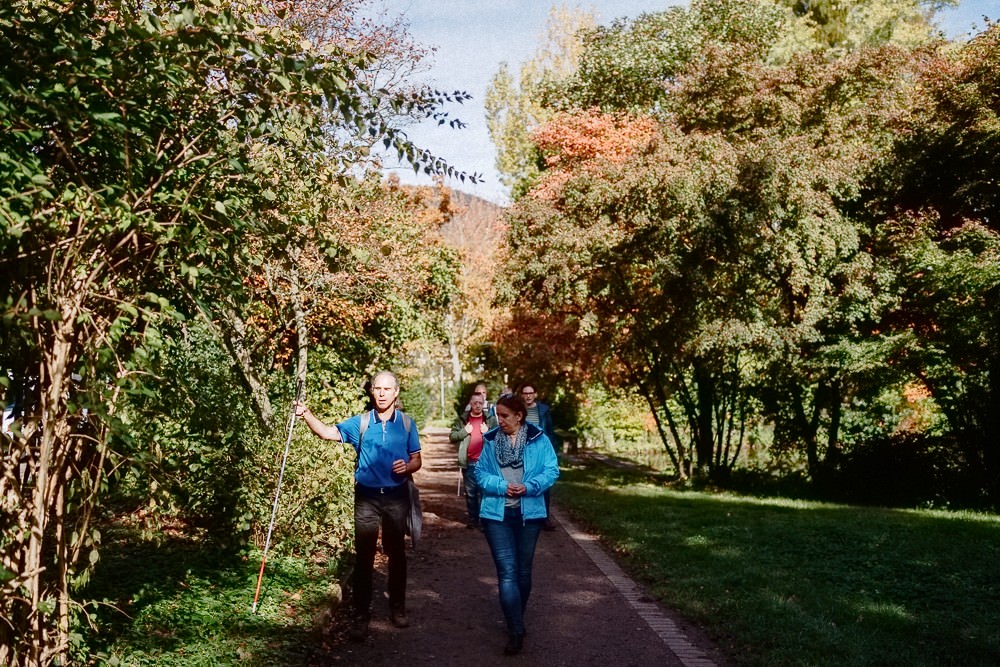
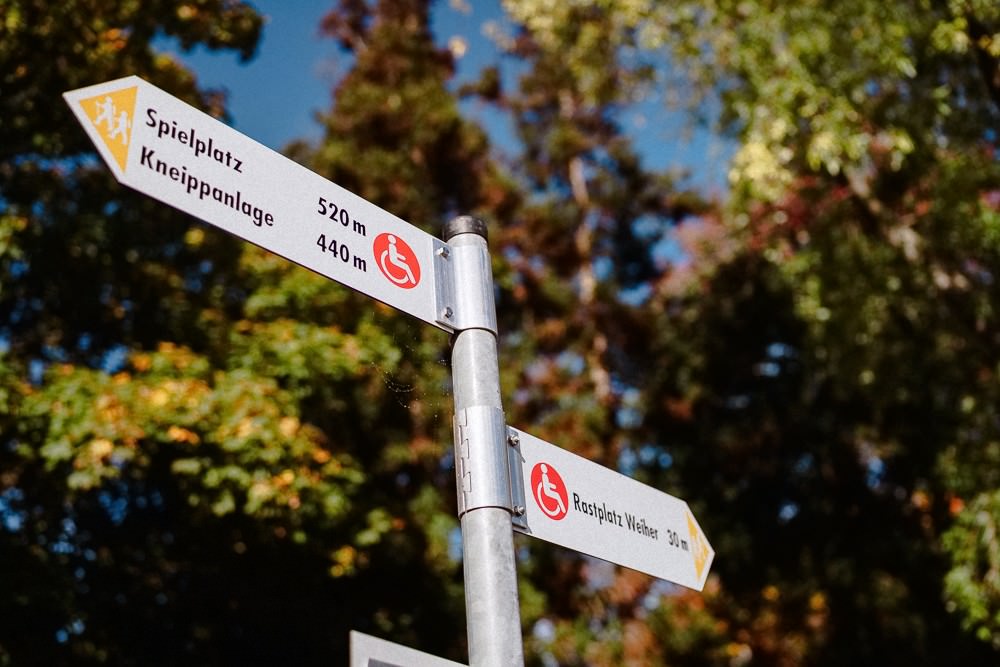
The small hiking group turns its back on the old town and sets off for the Markwardanlage town park. A barrier-free circular trail leads through the spacious park, past a swan pond, a Kneipp facility, rest areas, a playground, the concert shell and even to Palatinate llamas, with which you can hike through the surrounding area. Like the Trifelsbad swimming pool, the circular trail has been awarded the Reisen für alle (travelling for everybody) certificate, which recognises fully-accessible facilities. The town has relocated some paths to enable people with walking disabilities to stroll around without any problems, explains Christina Abele, who heads the local tourist office. Now, neither drainage channels nor steep slopes interfere with the one-and-a-half-kilometre-long path.
Autumn idyll in Annweiler.
According to the certificate, the Markwardanlage is also considered partially accessible for people with visual impairments. Ralf tests if he can find his way without help. The hiker, who lives in Mannheim, has just returned from a tour of the Zugspitze mountain. One and a half kilometres and a maximum gradient of six per cent on wide and partly asphalted paths seem like a walk in the park in comparison.
The Markward park can be explored without obstacles by people with wheelchairs, as well.
And indeed, it is usually not the condition of the paths or the terrain that causes him difficulties on his tours. “The biggest obstacle is getting started,” he says. Most tour descriptions simply assume that you can find your way there. But for blind people, this is often not so easy. Although both the tactile model of Trifels Castle and the entrance to the accessible circular trail through the Markwardanlage are only a few metres away from a bus stop, Ralf would not have been able to find them without assistance. What would help? “For example, description on the website,” he suggests.
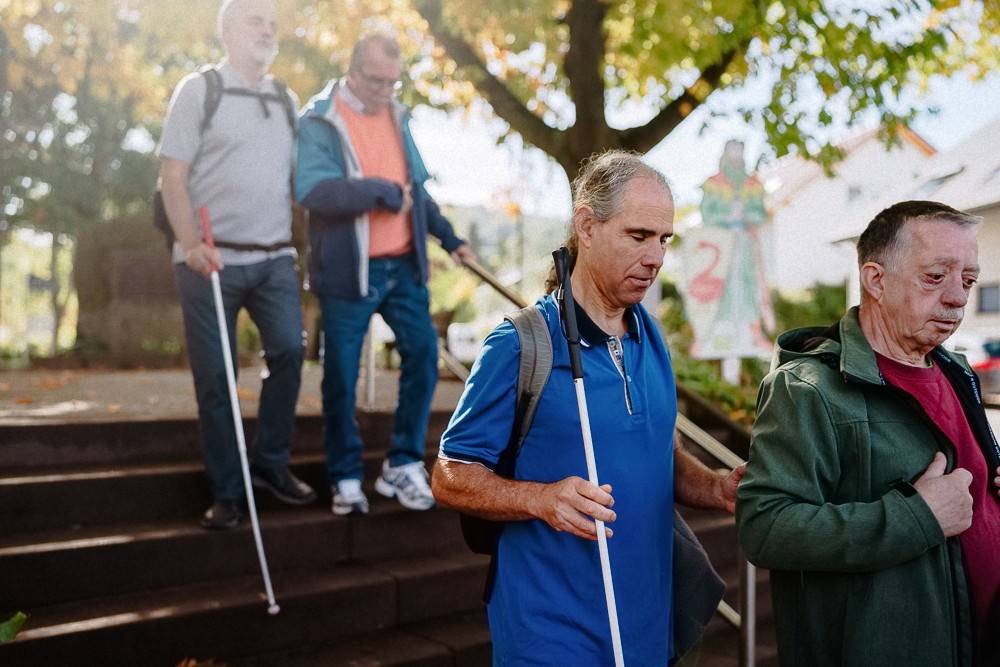
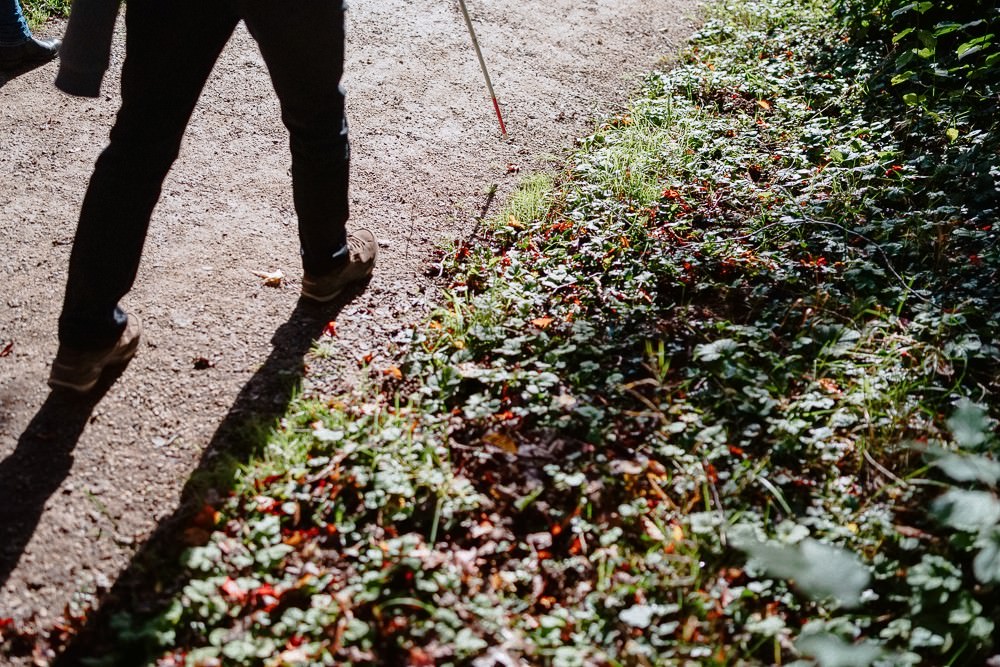
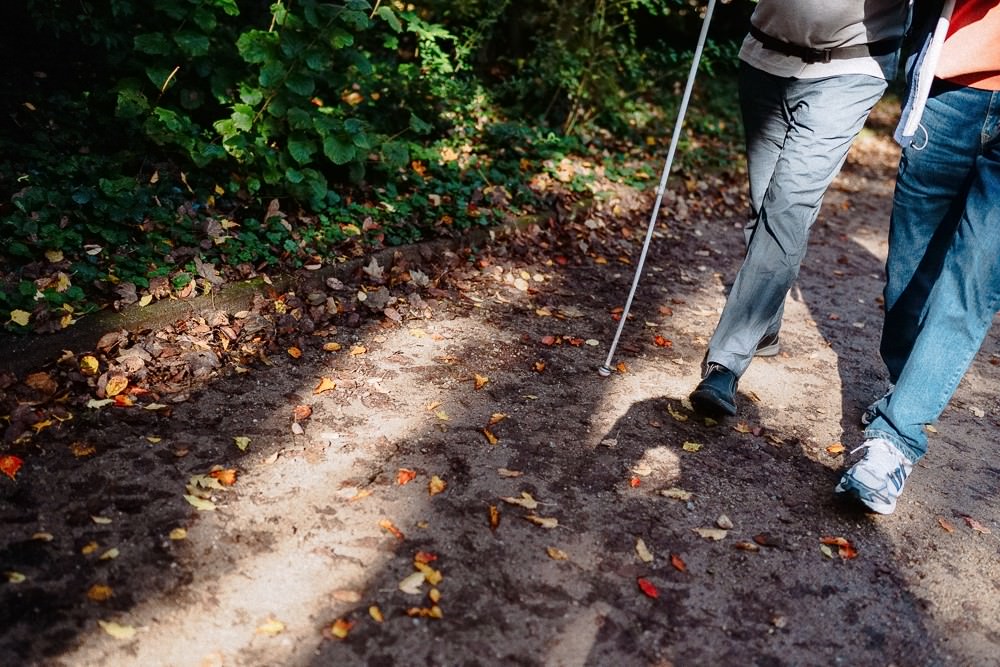
Ralf uses his white cane to detect kerbs and markings.
He sets off from the pond at the entrance. He swings his cane widely to the left and right until he finds his bearings at the kerbstones that line the path. As his eyesight started to deteriorate, he tried riding a tandem bicycle. “But that was too fast for me,” he recalls. “At that speed, I couldn’t take in my surroundings at all.” On foot, he experiences everything much more intensely. “I hear that there is a wall here. I notice when I am approaching a tree. I feel the sun, notice where the wind is coming from. I take each step twice—because I first place my foot down cautiously, feeling my way, and only then step properly.”
Navigating life.
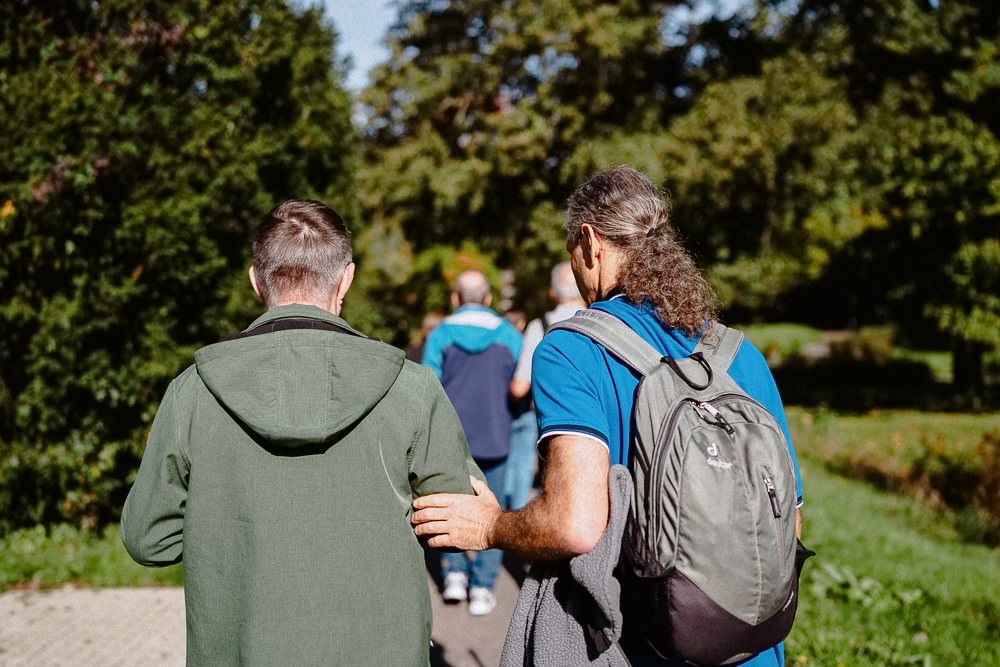
Ralf hikes almost every week and, as the inclusion officer of the Schwarzwaldverein Pfalz Weitsicht (Black Forest Association Palatinate Foresighted), he offers several hiking weeks a year for both sighted people and those with visual impairments in the region. He hopes this will help break down barriers. When he started looking for hiking groups that would take a blind hiker with them 25 years ago, almost all of them turned him down. “Some people think that you have to lead a blind person by both hands or that we are very slow and can’t walk on narrow paths at all,” he says. But Ralf can walk on almost any path and only touches his companion lightly on the arm. “On hikes, it’s usually the sighted people who fall, not the blind,” he adds.
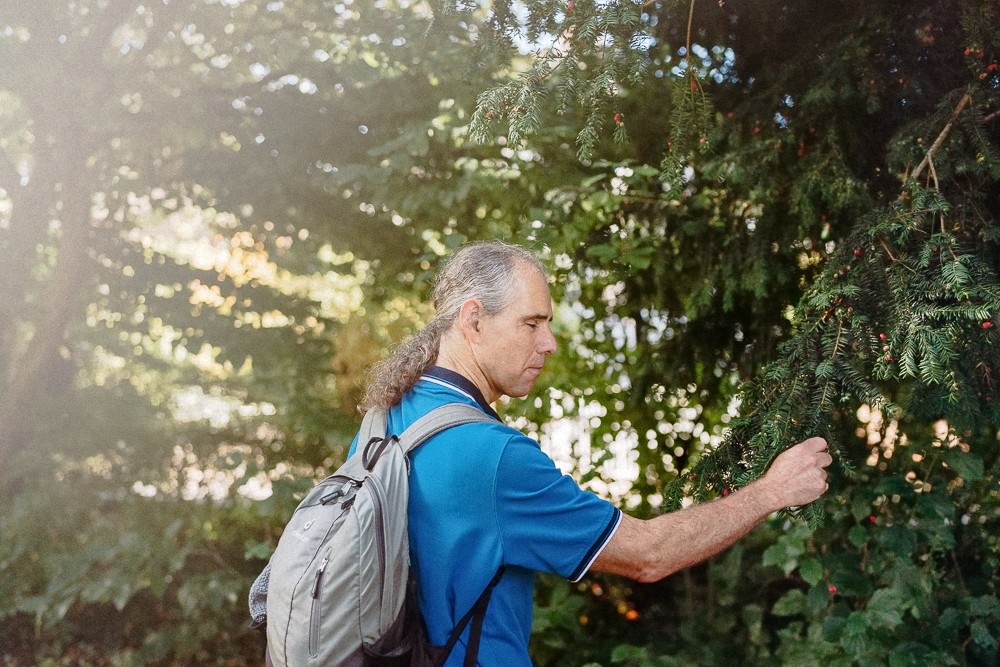
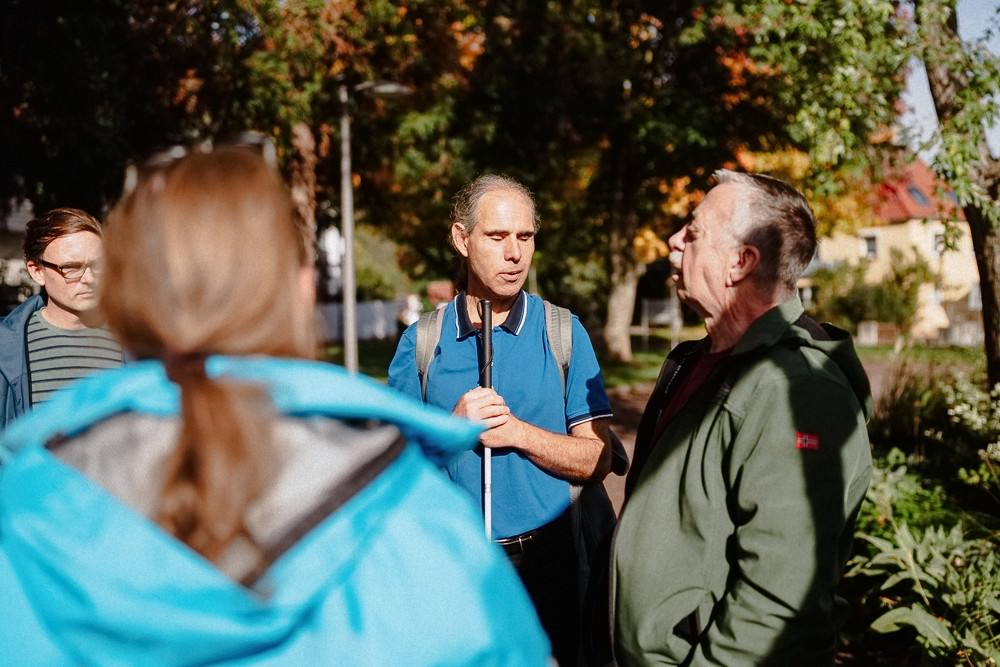
In the Markwardanlage park, he also makes good progress on his own—apart from the occasional detour into a driveway. “I don’t mind if I end up in a driveway. I can find my way out again.” However, not all visually impaired people feel the same way. “Many don’t dare to go out on their own. They’re afraid of losing their bearings.” In his opinion, better route descriptions that are also accessible to blind people, especially at intersections, would therefore be a good thing. And: “bushes that protrude into the path at eye level are very dangerous.” He grabs the branch of a yew tree that had hit him in the face. Christina and Christian listen attentively, asking questions again and again. After all, the aim is to continue promoting fully accessible tourism in the Southern Palatinate.
Tips for excursions and interesting stories about the Rhine-Neckar region can be found regularly in our newsletter.
And this is how it works: Enter your e-mail address in the field and click subscribe. You will then receive an automatically generated message to the e-mail address you entered, which you only need to confirm. Done!